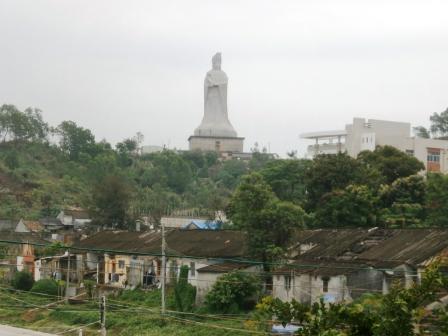
Shantou is a picturesque sea town with a late 19th and early 20th century historical quarter in s state of neglected abandon but almost still intact, unlike most of Chinese cities where modern buildings have replaced any sign of past urban beauty.
I spent two days walking about the town before heading to Xiamen, 250 kilometres to the north, the only port for maritime links with Capitalist China. Therefore, on April 21, 2012 I cycled on the highway G324 through the hilly area between the provinces of Guangdong and Fujian under a heavy downpour.
At nightfall the same day, I stopped a few kilometres before Yunling and, sheltered by the rain, I set the tent under the roof of an industrial building under construction.
The night watchman and his assistant came to check that I was not a danger. He first invited me to eat, which I politely declined because I was full, and then asked me if I wanted to take a shower.
I could not say no to this last offer, so I followed him through the maze of the construction where we first paid a visit to two clerks who were sitting in a bare office engaged playing an online video game and then in what will be the workers’ room showers.
There were many mosquitoes, but the water was warm and relaxing. The following evening, I arrived at the bridge on the provincial S201 leading on the island of Xiamen, which is subject to toll and prohibited to bicycles.
It was too late to seek an alternative route, so I spent the night again in my tent in Haicang, sleeping in a garden at the base of the luxury Future Coast quarter skyscrapers.
As the crow flies, I was just a couple of kilometres from Xiamen’s city centre, but on the morning of April 23 I had to ride for about 30 kilometres to cross the bridge of the provincial S206 to enter the island from north. The first ferry of COSCO Lines was leaving for Taiwan on April 26 and I spent three days strolling around the city observing the mix of traditional and modern that characterizes Chinese metropolis.
One of the arts, or science, according to the point of view, typically native of China is the famous traditional Chinese medicine. Its difference from the western one is first of all a diversity in the conception of nature and its relationship with man, and an even deeper difference between the ways to systematize the world and think of the problems.
The harmonic system of Chinese medicine is the result of hundreds of years of never interrupted critical philosophical discussion, analysis and experimentation leading in many cases to results of undeniable success, as in use of plants to heal, but sometimes coming to conclusions quite wrong, for example, the fallacy of rhino horn aphrodisiac qualities. I did not realize the vastness and importance of traditional medicine in the Chinese daily life until I run into a pharmacy.
They are real supermarkets with tens of thousands of products ranging from pills of concentrated plant to leaves, tubers, bark, berries, twigs and everything coming from the vegetable kingdom dried, pickled, fermented and crushed.
 There are also extracts and powders of organs, skin, muscles, hair, glands, secretions derived from the animals domains of insects, mammals, reptiles, fish and amphibians. All contained in jars, drawers, boxes, ampoules, bottles labelled with the corresponding ideogram and from which the chemist takes the prescribed amount, weighs it with precision scales and creates miraculous mixtures. There are also hospitals, often huge and in modern facilities, where only traditional medicine is used to cure ailments.
To conclude with the health care, something I find odd is that in hospitals advertising there are always pictures of smiling, welcoming, attractive nurses rather than professional looking, bespectacled, bearded doctors as I would find more reassuring.
On the morning of April 27, after a night on the ferry that shuttles between Xiamen and the port of Keelung, north of Taipei, I set wheel in the Republic of China, Taiwan. I have already been on this island in November 2010 (Diary http://travelforaid.wordpress.com/english/diary-vietnam-italy/chapters/taiwan-uk/ ) and arriving at Harmony Home shelter (www.hhat.org) I had the feeling of never having left.
The social workers welcomed me as if my presence there was normal and the older children come around calling me with the same name they used 18 months ago: “baba matte” … Until next time.