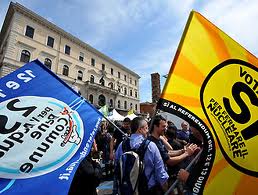
The outcome of the referendum held in Italy on 12 and 13 of June is clear. Italians with a high turnout exceeding the necessary 50% rejected the nuclear power as solution for energy supply.
This vote arrives just after Fukushima disaster and Italy is exposed to earthquakes as much as Japan.
Prime minister Berlusconi and the government said nuclear was needed to provide about 20% of electricity by 2020.
According provisional election returns from the interior ministry turnout is running at 57%.
Italians were also committed to take a decision about water’s privatisation and the exemption of the government minister from court cases.
The results are unanimous for all questions and Mr Bersani, leader of the centre-left Democratic Party exclaimed “ an extraordinary day”.
Mr Berlusconi during a conference at Villa Madama with the Israeli premier

Benjamin Netanyahu claimed «Probably Italy, after a decision of italians, must give up to the nuclear central and enlarge the commitment towards renewable energies ».
The consequencies of the plebiscite are several. The turnout and Berlusconi declaration are already registering their effect on the Stock Exchange market. Many companies in the renewable sector assisted a positive increasing of the market index:
Enel Green Power +3,1%
ErgyCapital +14,2%
K.r.Energy +13,1%
Pramac +11%
Falk Renewable + 2,33%.
Kerself +12,59%
Kinexia + 3,88%
TernieEnergia + 4,38%
Alerion +5,07%
Eems +6,55%
Maire Tecnimont + 7,01%
There is also who in the opposition party proposed Prime Minister dimission because unable to represent the will of people.
From Wikipedia:
A referendum (also known as a plebiscite or a ballot question) is a direct vote in which an entire electorate is asked to either accept or reject a particular proposal. This may result in the adoption of a new constitution , a constitutional amendment , a law, the recall of an elected official or simply a specific government policy. It is a form of direct democracy.
A legislative referendum can be called in order to abrogate a law totally or partially, if requested by 500,000 electors or five regional councils. This kind of referendum is valid only if at least a majority of electors goes to the polling station. It is forbidden to call a referendum regarding financial laws or laws relating to pardons or the ratification of international treaties.