Italy sets budget deficit goal at 2.4 pct of GDP

LONDON (Caterina Moser) – Italian government targeted the budget deficit at 2.4 pct of GDP, gross domestic product, from 2019-2021. For the next three years, these will be the provisions.

This targets would flout European Union rules calling for Italy to progressively lower its deficit and marking a victory for party chiefs over Economy Minister Giovanni Tria.

Tria had to surrender to the requests of Movimento 5 Stelle e Lega, although he had initially wanted a deficit set as low as 1.6 percent next year, in order to respect European Union demands.

Great satisfaction by the coalition government of the Movimento 5 Stelle e Lega, which took power in June. They had been pushing for a deficit around 2.4 percent of GDP to fund costly policy pledges.

“Today is a historical day! Italy has changed today!” Has wrote Luigi Di Maio on Facebook.

The agreement was approved after an informal summit at Palazzo Chigi which lasted about 4 hours with Prime Minister Giuseppe Conte, Vice-Presidents of the Council Matteo Salvini and Luigi Di Maio, Minister of Economy and Finance Giovanni Tria and Minister for European Affairs Paolo Savona.

Then, the Council of Ministers held the approval of the Def update note, the document with which the government indicates its three-year economic plans.

The Def, the document of Economics and Finance, contains all the economic and financial policies. It allows the government to establish how to spend public money.

It have been released 27 billion for the maneuver.

Prime Minister Giuseppe Conte said on Facebook that the budget goals were “considered, reasonable and courageous” and would “ensure more robust economic growth and significant social progress for our country”.

He added the budget plan included “the biggest programme of public investments ever carried out in Italy.”

Salvini said the budget would also allow people to retire earlier, freeing up about 400,000 jobs for the young, and cut tax rates for a million self-employed workers.

He called the expansionary fiscal plan “a revolution of common sense”. According to the government, the Budget Law will affect about 6.5 million people below the poverty line.

“With pension and income of citizenship that we introduce with this Budget Law, we will have abolished poverty” Di Maio had said in an Italian tv programme few days ago.

It will be up to M5S and Lega to demonstrate that such a potentially dangerous maneuver can find market and European Union approval.

The European Commission will evaluate the maneuver on October 16th. With these numbers it will be difficult to approve it.

Meanwhile, financial markets have been nervous since the government took office due to fears its spending plans will boost Italy’s debt.

Brexit seen by another point of view

London (Valeria Piccioni) – The phenomenon of the Brexit will have an impact on the future of the European Union: the difficult situation of the UK will affect the trade marketsboth internally and externally. However it is important not to fall in hasty conclusions. Infact, as soon as the UK leaves the EU, many changes will arguably be implemented in the trade with EU and with the Commonwealth countries.

The Commonwealth is an intergovernmental organisation made of 53 member states that are mostly former territories of the British Empire. Leaving the EU, the UK will exit the customs union and the bloc’s external commercial policy. This political phenomenon could put EU in a better position for possible trade market deals with Australia and New Zealand after Brexit. Indeed, New Zealand’s trade minister, David Parker, said that the UK’s withdrawal did not diminish the potential gains for his own country which would come from breaking down trade barriers with the remaining 27 member states.

Moreover also Australia has been currently under the spotlight. As a matter of fact UK is the big country’s eighth largest two-way trading partner. Australia’s Commonwealth Bank currently declared a doubling in costumers.

Australian government is now negotiating a deal with the EU. Nevertheless, according to experts, Brexit could be a new opportunity for the Australia and New Zealand to sell in a tariff-free market in the UK.

By establishing a Free Trade Agreement (FTA), Australia could achieve a new deal between its and UK’s enterprises. This recent treaty will also consider theregulations for the relocations of the enterprises allocated in both of the Countries.

In order to dislocate Australian and New Zealand companies to London, the businesses would require real estate services to stay in UK. For this reason, it is important  to focus on Stonelink International, London’s Real Estate Broker.

“International firms, especially from Australia and New Zeland who have a lot moving parts in terms of relocating staff and family, logistics & transportation of vital equipment want to ensure the commercial space and property they will move into, is ready for them, well ahead of time” said Nicholas Tsiougos, Managing Director of Stonelink International.

It has always been argued that several business and investments will experience  numerous difficulties after  2019. However this hypothesis could possibly not be accurate. As a matter of fact, a considerable amount of businesses has not been affected by Brexit. On the contrary, these enterprises have experience and unexpected growth. Therefore Brexit is likely to offer Britain different opportunities which are neither better nor worse than the previous ones.

Future starts here: the visionary exhibition

London (Valeria Piccioni) – The pioneer city of London inaugurates a visionary exhibition: “Future starts here”. This exhibition displays the future of design. Located at the Victoria and Albert Museum, it will be open until 4th of November. Over 100 prototypes that could possibly change the world will be exposed. As a matter of fact these inventions will probably influence our daily life shaping our routine .

The first department focuses on the ralationship between humans and technology. For instance the department displays “super-clothes” similars to wearable muscles thanks to bio-meccanic contribution. Moreover, there are exposed solars t-shirts which absorb sun’s Energy allowing to charge phones and cameras.

The Second part deals with the issues regarding public aereas. Some of protypes exposed will be: the first model of the zero-emission city, Abu Dhabi, or «The House of One» in Berlin that is at the same time a Church, a mosque and a synagogue.

Furthermore among the greatest inventions that exibition hosts it is possible to admire Volkswagen’s without-driver car, micro-satellites that throw artificial falling star in order to give an impression of atmosphere works. Moreover Samantha Cristoforetti’s pot is also being displayed. An area regarding the considerations revolving around the future of democracy along with progress can be visited within the exibition rooms. In addition the corrent department about life after death also focuses on the illusion of immortality.

Furthermore it is ipothetically possible to transfer cerebral connections in a USB key in order to create an avatar with artificial intelligence. It could be also doable to make disks conteining human knowledge’s heritage. Humanity is trying to fight mortality by surviving a possible extinction.

The final aerea displays several sprinkling questions over the exhibition’s walls. The main ones are: “What makes us human?” “Does democracy still work?” “Who wants to live forever?” “We are alla connected but do we feel lonely?”.

“Since the beginning our exposition sponsored pioneering art, sciences, design and technology” stated Tristram Hunt, the gallery’s director “we are in the middle of a digital revolution and with this exibition we want to research the most exciting experiments and the most incredibles teories about our future in order to take them out of the laboratori in order to share them with the audience.”

A draft bill for Italians abroad

London (Valeria Piccioni) – The new draft of the Italian Government deal takes into consideration the matter of Italians abroad’s.

“Regarding the Italian communities situated abroad, it is necessary to highlight knowledge and experience heritage in order to support Made in Italy, the Italian culture  and the Italian language all over the world. Furthermore, the election procedures in the foreign jurisdiction and the rappresentative institutions of the General Consulate (CGIE and COMITES) must be reformed. These measures will make these organisations more efficient, more transparent and less subjected to vote misrepresentations. Moreover,  concerning the COMITES and the CGIE, it is necessary to specifically reform the purposes of these institutions in order to blend them with the parliamentary representation. Finally, the diplomatic and consular net must be reformed in order to grant adequate services to the growing Italian communities that are settling permanently abroad” declares the final draft officially published on Friday.

Until now there has been a real negligence towards this matters: apparently, only the Italian citizens living in Italy seem to be considered whereas instead 4.2 millions of Italians abroad seem to be neglected.

Meanwhile, on Tuesday, the 18 Parliament members elected abroad from over 1 million and 100 thousand voters met for the first time during this legislation in the Chamber of Deputies. Are they conscious about the current lack of attention towards the Italians abroad? In the meantime, this meeting has highlighted some of the main issues of the Italian communities abroad which are:

  • Foundation of a “Bicameral Commission for the issues of Italians abroad”
  • Reform of voting procedures
  • The strengthening of Consular resources

It is important to remember the controversial relationship between the unborn Italian Government and Bruxelles. The faces of this new Government are still unknown, therefore Europe fears an Italian economical collapse. Recently, Salvini and Di Maio against Manfred Weber, exponent of the German CSU and president of the popular European party at the Europarliament who stated “Irrationals or populists actions could cause a new euro crisis” he said to them. “You are joking with fire because Italy is heavily indebted.”.

“Italians are tired of taking orders from Brussels and Berlin!” replies Mara Bizzotto, leader of the Lega in the European Parliament “Merkel and her proconsuls in Brussels always assembled and disassembled Italian governments according to German and their banks’ interests “.

Brexit Briefing: No EU superstate leap on horizon

by: Tony Barber.

There is at best thin public support among member states for any far-reaching unifying steps.

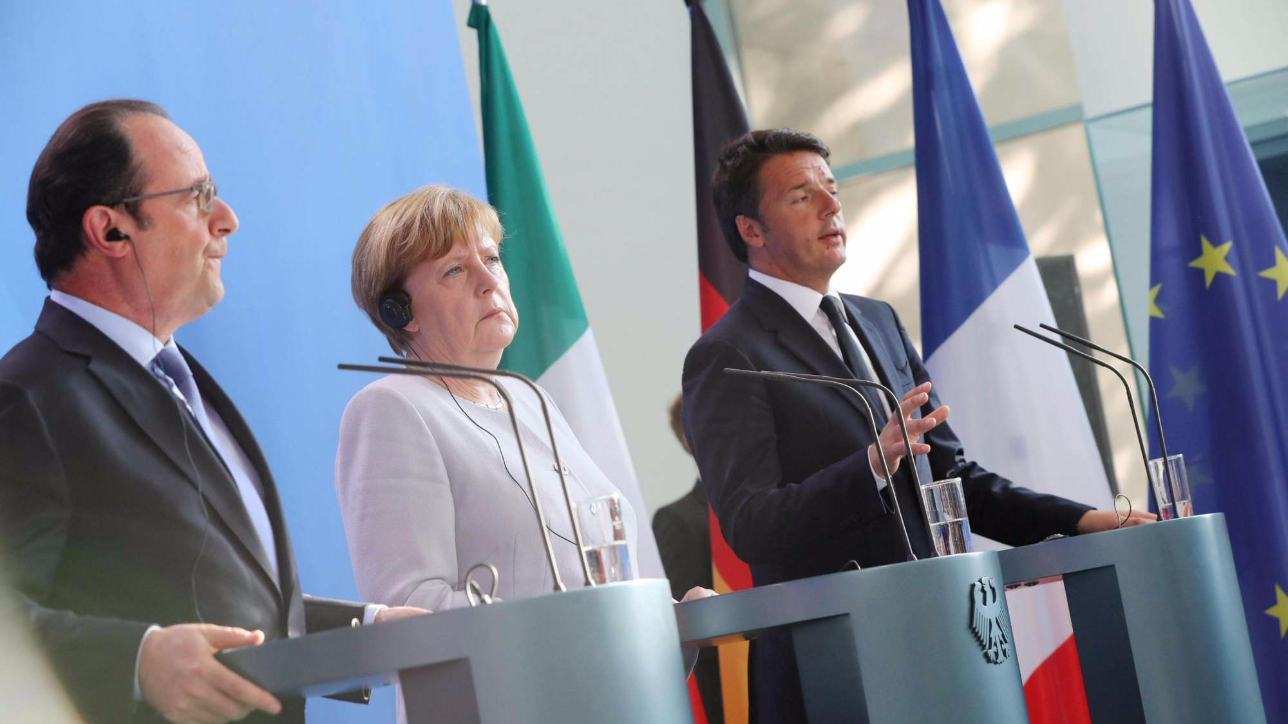
For the EU, life after Brexit goes on. Matteo Renzi, Italy’s prime minister, will play host on Monday to François Hollande and Angela Merkel, the French president and German chancellor, on Ventotene, an island near Naples.

There will be much for them to discuss: Europe’s uncertain economic outlook, terrorism, relations with Russia, Turkey and the tide of refugees and migrants flowing across the Mediterranean into Italy. But the overriding issue is how to protect and strengthen the EU after Britain’s vote on June 23 to leave the 28-nation bloc.

corriere.it
corriere.it

It is no accident that the Italian government selected Ventotene for the meeting. For in 1941 Ernesto Rossi and Altiero Spinelli, two Italian intellectuals imprisoned on the island under Benito Mussolini’s fascist regime, wrote the so-called “Ventotene Manifesto”, a document known to historians as an early clarion call for the political unification of Europe.

The key sentence of the Ventotene Manifesto reads as follows: “The question which must be resolved first, failing which progress is no more than mere appearance, is the definitive abolition of the division of Europe into national, sovereign states.”

Such grand sentiments played into the hands of anti-EU forces in the UK referendum campaign. They contended that Europe was turning into a superstate that would throttle British identity and self-rule.

Yet the reality is very different. Neither the Ventotene meeting nor a summit of 27 EU states — minus Britain — which will take place on September 16 in Bratislava, Slovakia’s capital, is likely to agree on any measures resembling a leap towards a superstate.

Broadly speaking, there are three explanations for this. The first is that in most EU states there is at best thin public support for such far-reaching steps. As Donald Tusk, the Polish president of the European Council, which groups EU heads of government, said before the UK referendum: “We failed to notice that ordinary people, the citizens of Europe, do not share our Euro-enthusiasm.”

The second explanation is that many governments do not want such a leap, either. For example, the Netherlands adamantly opposes changes to the EU’s basic treaties of the kind necessary to make big strides towards closer integration. As for Poland, the fifth-largest EU state now that the UK is on the way out, it is pushing for the opposite: the repatriation of certain EU powers to memberstates.

theguardian.com
theguardian.com

The final reason is that Germany, Europe’s pivotal power, takes the view that the EU — and especially the 19-nation eurozone — has enough to contend with at the moment without setting itself unrealistically ambitious goals on European unification. In particular, the Germans think France and Italy have much to do to put their own economic houses in order.

None of this means that the EU, as a 27-nation group, is paralysed or drifting towards a break-up, as some British commentators predict. Some modest steps forwards, notably on defence and security co-operation, are conceivable over coming months.

But the political unification of Europe, as set out in the Ventotene Manifesto, is a very remote prospect indeed.


New anti-terror plan to be announced tomorrow for Germany

GERMANY – Germany’s Interior Minister, Thomas de Maiziere, will be announcing new anti-terror measures tomorrow, following the two attacks – claimed by the so-called Islamic group – that happened in the country recently: one, an ax attack on a crowded train in Wuerzburg, and the other a suicide bombing in Ansbach.

According to local media reports and as reported by the BBC as well, there are plans to ban and deport migrants for being a “threat to public security”, to increase the use of video surveillance, to speed up the process of deporting migrants who are convicted of crimes, forbid the public usage of burka (full veil), to forbid radical Islamist funding of mosques and to allow doctors to break their confidentiality agreement if they think one of their patients could be planning a terrorist attack. A possible ban on dual citizenship is also in the talks.

In addition to these bans, it is planned that 15,000 more police units will be added nationwide to surveille urban areas and crowded places like train stations and airports – their weapons and equipment will also be improved -, a special police cyber defence unit will be created as well as powers to investigate suspects as young as 14.


May – Renzi meeting: “Rights of Italians living in the UK won’t change after the Brexit”

ROME – The Prime Ministers of Italy and UK met yesterday at Villa Pamphili in Rome, to discuss some crucial aspects of the relations between the two countries after the Brexit results in a press conference, and to get to know each other a little bit better while enjoying some Italian goodies. Theresa May explained once again that, even if the UK will soon be out of the EU, it will “still very much be a part of it” and added that her main goal is to develop a plan that can benefit both parts; a plan that could be totally different from everything we have already seen happening in the EU with Norway, Switzerland and Iceland.

As far as the Anglo-Italian relations are concerned, both premiers stressed how this result marks the beginning of a new chapter for everyone: Matteo Renzi confessed his bitterness towards the referendum results but stated he is confident “some good would come of it“. In addition to that, with the Brexit being a turning point in history, economics, politics and society, he underlined the importance of arranging and following a precise timeline in the upcoming months. His English counterpart didn’t agree: Mrs May explained how every decision made from now on has to be cautious and mindful and said she hopes that EU leaders will be able to understand the UK’s need to have more time to set up a plan for the future.


Mrs May assured that nothing will change in the way rights are applied to Italians living in the UK but, she added, that she will guarantee a different and better treatement UK’s citizens in their own country, since that is what they asked for with the referendum. Regarding the current economic relations between Italy and the UK, both premiers wish to create a future “win win” plan for their countries: Italy occupies the 8th place in the list of trading countries with the UK, with a current £24bn annual two-way trade which, they hope, will be boosted in the future.

After a month from the Brexit results the situation still appears quite uncertain for both the UK and Europe, but the shared plan all leaders have in mind is reassuring: this referendum marks the beginning of a new era for the European Union, which Renzi defined as a “miracle” that “allowed a 60 years period of peace and prosperity“, in which all countries have the opportunity to grow and better themselves in order to create a brighter future for the EU and its citizens.

Cameron has announced: freedom of vote for the ministers of the government around the Brexit.

Another hit against the unity of European Union.After the European summit of one month ago in Bruxelles, during which the prime minister Cameron seemed convinced that the United Kingdom would have remained member of the European Union, he received a lot of critics by the members of his own government.

The United Kingdom has always received a different treatment compared the other country members, and in this complicated moment for the unstable international situation in Middle East, several exponents of Conservative party did not want to accept the directives from the Union.

This will for keeping a certain level of independence has been spreading across the members of Conservative party that, how I highlighted earlier, they don’t want to accept the complex of rules that arrive from Bruxelles.

Therefore Cameron was almost obligated to allow freedom of vote for the critical referendum Brexit. It means that the exponents of his party will not vote following a directive of party but following their own opinion about this delicate referendum.

After the last European summit held in the capital of Belgium, Cameron looked convinced to carry on the permanence of United Kingdom between the members of European Union and in an interview also announced that the date of the Brexit vote would have been anticipated.


Nevertheless now it seems all changed, in fact there will not be directives from the headquarter of the Conservative party because each minister will vote according to their own viewpoint.


Eurozoneconomics: less inflation and mor…

Eurozoneconomics: less inflation and more unemployment (Phillips Curve for dummies)

Eurozone-Having previously made reference to Frenkel’s Cycle to illustrate the Greek crisis (The eco… READ MORE

Eurozoneconomics: less inflation and more unemployment (Phillips Curve for dummies)

Eurozone-Having previously made reference to Frenkel’s Cycle to illustrate the Greek crisis (The economic rise and fall of Greece), hereafter I re-elaborate the findings of an analysis I originally included in my book ABC Economipedia which investigates the inverse relationship between inflation and unemployment rates within the Eurozone since the introduction of the single currency in 2002. In heterodox economics this inverse relationship is often referred to as “the Phillips curve”.

The curve was originally formulated by A.W.H. Phillips following his breakthrough study of wage inflation and unemployment in the United Kingdom from 1861 to 1957 which found a consistent inverse relationship: when unemployment was high, wages increased slowly; when unemployment was low, wages rose rapidly.


 Phillips Italoeuropeo IMG1


The close fit between the estimated curve and the data encouraged many economists to substitute wage variation with inflation rate and to use the Phillips curve as a sort of menu of policy options e.g. with an unemployment rate of 6 percent, the government might stimulate the economy to lower unemployment to 5 percent.


At the height of the Phillips curve’s popularity, Edmund Phelps and Milton Friedman independently challenged its theoretical underpinnings by asserting that the Phillips Curve was only applicable in the short-run and that in the long term inflationary policies will not decrease unemployment. Notwithstanding Phelps and Friedman’s critique to Phillips, when assessing the state of the Eurozone economy I found evidence that the original formulation of the Phillips curve is actually still relevant in the long-run.


My analysis concludes that:

1. Within the Eurozone there is an inverse relationship between rates of unemployment and corresponding rates of inflation for the 2002-2014 period. 2. Germany is the sole the “core” Member-States where inflation outpaced unemployment whilst everywhere else within the Eurozone unemployment grew faster rather than inflation 3.


In the countries at the periphery of the Eurozone, i.e. those which have been most affected by the so- called sovereign debt crisis, there is a greater spread between the rise in unemployment and a fall in inflation rates.


 Phillips Italoeuropeo IMG2


reade more 

THE ECONOMIC RISE AND FALL OF GREECE (THE FRENKEL CYCLE FOR DUMMIES)

London- As some readers many know, in recent weeks I tried to avoid sharing my views on the Greek crisis. For a number of reasons. ...[here]


MAPFRE CLOSES ACQUISITION OF DIRECT LINE IN ITALY AND GERMANY

AFTER OBTAINING AUTHORIZATION FROM REGULATORY BODIES The company reinforces its efforts to grow in Europe and expand its online automobile insurance business With this deal, MAPFRE gains 1.6 million new clients and 709 million euros in premiums in two major .

European markets MAPFRE has closed the acquisition of Direct Line in Italy and Germany after receiving due authorization from the domestic regulatory bodies and the European Union authorities.

This authorization allows MAPFRE to launch the integration process for both companies. The deal is part of the company’s strong focus on strengthening its presence in Europe as well as multichannel and online direct insurance.

Based on the latest P&L (2014), in total the businesses in Italy and Germany will provide MAPFRE with 709 million euros in premiums, 1.6 million new clients and 26 million in pre-tax earnings. The price for the transaction is 550 million euros.

Direct Line Italy is a leading provider of automobile direct insurance in the Italian market with a market share of approximately 24 percent in this channel, 458 million euros in annual premiums and one million clients.

Direct Line Germany is the third largest provider of automobile direct insurance in the German market with a market share of approximately 13 percent in this channel, 251 million euros in premiums and about 600,000 clients.


About MAPFRE MAPFRE is a global insurance company present in 49 countries across five continents. It is the leading insurer in the Spanish insurance market, the leading multinational insurance group in Latin America and one of the top 10 insurance companies in Europe in terms of premium volume. In 2014 it reported a net profit of over 845 million euros and revenue of 26,367 million euros. MAPFRE has more than 38,000 employees and over 27 million clients.