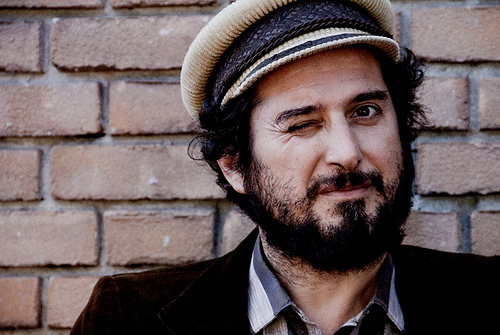
The British weather can weaken even the sturdiest man, especially of the ones born close to the Mediterranean Sea. However, there are some ways to temporally calm the strong nostalgia. A gig of the storyteller Vinicio Capossela is the placebo effect which I was looking for. Capossela is not an unknown artist in Britain. His work has been many times exalted by the British media as an example of what Italians can do better: culture.
A mix of poetry, theatre, magic and clown could be a possible definition of his music, evolved in an impressive way under the quality aspect since he started his career in 1990. Stepping inside the red and gold painted Koko club, in Camden, it’s instantly possible to feel a southern breeze blowing in the air. Back to London for the European tour “Rebetiko Gymnastas – Esercizi allo scoperto”, Capossela presents a selection of songs from his new album, in a gig organised by the company TIJ events.
Wearing a red hat, big moustache and a black jacket with a hand sewn on his left shoulder, Capossela came on stage while the world famous song Misirlou was playing in the air. Opening the concert, he said: “Gymnoo in ancient Greek means to bare, and this what we’d like to do with our music tonight: to uncover you both in a physical and emotional way.”
Among the other six musicians present on stage, Alessandro Asso Stefana at guitar, Ntinos Chatziiordanou accordion and Farfisa organ, Dimitri Emmanouil drums, Glauco Zuppiroli contrabass and Vassilis Massalas guitar and baglamas, Manolis Pappos stood out for his superb bouzouki technique leaving the audience astonished. As the concert went on, it was clear that his Rebetiko Gymnastas, launched last June, is the final proof of the high musical level reached by this itinerant artist.
In time of economic and social crisis, the choice to rework his songs in this foreign urban style has been neither a random and easy one. As blues for the Americans, fado for Portuguese and tango for Argentineans, rebetiko for Greeks is the music that allows people to share happiness and sadness, lifts and falls, in a unique folk melody. The audience probably struggled a little bit to absorb the message of this liberating sound, but the gymnast Capossela was always there with his epic charisma to lead them through the most intimate notes of his repertory.
At the end of the night, wearing a wooden bull mask and holding a bunch of cowbells, Capossela reminded to the audience his real passion, his origin, a world made of demons and heroes, of shadows and blinding lights, where only brave people can be able to survive.
The Koko was actually trembling while the energetic “Il ballo di San Vito” liberated its ancestral rhythm through the audience. Everybody looked oblivious of what was happening in the world outside, singing loudly shoulder to shoulder to enjoy the ballad. And suddenly, it’s like to be home again, surrounded by your friends, confirm that it’s possible to find your own identity, wherever you are, even if far away from your native place.
Capossela demonstrated one more time to be a complete and complex performer. He certainly does not need any more to perform in London in search of success, but vice versa it’s London calling for him to warm up with a Mediterranean breeze its melancholy foggy nights.
REBETIKO GYMNASTAS: ALBUM REVIEW by Alberto Muggeo
 Capossela bumped into the Rebetiko almost accidentally in 1998, when he was in Thessaloniki after having failed in the attempt to reach the Saint George celebration.
Looking for a place to play with his band, the Italian songwriter was told to reach the inn where he would have found the so-called “Greek blues”.
As he explained in the interview with the “La Repubblica” journalist Gianni Mura, “blues” powerfully identifies the Rebetiko, born from the exertion and the lament of the Asia Minor’s refugees who settled in Greece at the beginning of the XX century.
Capossela said that when he came across this urban folk music, he felt like in front of a “conspiracy” and he was totally impressed by the fact that there was no distinction between performers and audience. Everyone was singing and dancing together, sharing the harmony, enliven by the sense of hope which the Rebetiko brings along.
Capossela’s Rebetiko Gymnastas efficaciously conveys the original meaning of the genre, reinforced by the use of the traditional Rebetiko’ instruments, like the bouzouki and the baglamas. The album includes four new works and eight songs already published back in the years, but proposed again in Rebetiko style.
Pulp Fiction lovers will recognize Misirlou, an old Greek popular song, whose Dick Dale surf rock version has been used by Tarantino in his acclaimed movie. Capossela’s Misirlou keeps the passion and the tenderness of the original, mixing them with the lively rhythm of the Rebetiko.
The result is a perfect melting pot between a traditional love lyrics and the nostalgia of the “Greek blues”, highlighting the ability of the Italian songwriter to gather inspiration from everything involving the Hellenic culture.Worldwide literature and the classic philosophy are the engine of his lyrics, and London doubtless played a key role in his career.
“London remains the city of the gothic and the romance. Coleridge and Dickens embodied in the modernity through the rock of MacGowan, o Joe Stummer… Here I watched the grotesque show of the Tiger Lillies, Shockheaded Peter: wonderful. So, this is what attracted me regarding the city,” Capossela told to Italiansoflondon.
Among the unreleased songs of Rebetiko Gymnastas there are also Abbandonato, based on the piece of Atahualpa Yupanqui, and Cancion de las simples coses, taken from the work of Mercedes Sosa e Chavela Vargas.
The rest of the album shows tunes already known in the repertory of the songwriter, who has been defined as the “Italian Tom Waits”. Contrada Chiavicone (from Il Ballo di San Vito), Con Una Rosa (from Canzoni a Manovella) and Morna (from Il ballo di San Vito) seem perfectly suitable to be played in Rebetiko, with their structures and lyrics easy-fitting in the Greek style.
Capossela wrote on his website the album has been recorded at the Sierra studios of Athens on analog tape, with the help of “Greek masters of Rebetiko”: Ntinos Chatziiordanou on the accordion, Vassilis Massalas on the baglamas, Socratis Ganiaris on the percussions and the superb Manolis Pappos on the bouzouki.
Rebetiko Gymanstas was published last June by La Cupa/Warner label and it comes after the 2011 Marinai, profeti e balene (Sailors, prophet and whales).
“After the sea comes the port,” Capossela told. “The ports are for the music what the pollen is for the flowers. This is a album of port’s music which perform exercises, individual disciplines. It’s an album played in Greek, as a dept for the Greece, which gave the World one of the best urban music ever: the Rebetiko”.