London: From model to designer: the birth of DW

Determined and creative, this is Danish Wakeel, Pakistan born fashion student at the prestigious London College of Fashion, part time model at London Fashion Week’s shows and other fashion events and fashion designer with the label DW under his tailored belt.

With clear ideas in mind, Danish organized a glamorous launch for his collection at the uber cool Amika Club in High Street Kensington.

Being a model Danish knows how to direct a great show for his guests and what everyone has seen on that evening was more than a mere catwalk, it  has been a very visual runway, with models acting and posing and at the same time showing the beautiful dresses with a upbeat musical background. http://www.facebook.com/l.php?u=http%3A%2F%2Fwww.youtube.com%2Fwatch%3Fv%3DqKDnodUuDhM%26feature%3Dplayer_embedded&h=16fe3


A team of gorgeous male and female models some of them just wearing body paint and with a bright make up strutted on the carpet laid on the sophisticated lounge and Danish could not resist stepping in modelling his clothes.

ItaloEuropeo caught up with him for a few questions in order to know better this new designer:


Who’s the woman that wears DW ‘s creations ?

My creations are for those people who are ultra fashion concious and enjoys a new take on classic and contemporary designs.


How come this change from a model to a fashion designer?

Modelling has been more of a hobby then a career path really. I had been studying fashion for a couple of years now at London College of Fashion. I studied aviation and did a degree in aviation prior to my studies in fashion and now I m doing my MA in fashion specialising in menswear.


Where did you take your inspiration for this collection?

The inspiration came from by looking at the conventional silhouettes and going back in the history to find ideas of what people did in the past. That I think is the only way one can be original.


It was great to see you on the catwalk modelling your clothes, are you going to do this as a signature of your future collections ?

Whenever I will feel I can contribute to my designs by modelling for them I will. Its a bit too early to say if that is going to be my signature since I just launched myself as a designer.


You are going to be a menswear designer do you think that it is possible to be creative but still design a collection that a man wants to wear?

Of course !!! Men lately have become really fashion concious, sometimes I feel men are more into fashion then women. The response I got from my first collection was tremendous which is apparent in the fact that guys wanted to buy my pieces immediately after they have been showcased on the runway. In my upcoming collections I will be pushing boundaries slightly more by creating more creative pieces !


Are you going to focus only on menswear or you will carry on with create a line for women as well?
From time to time i will be designing womenswear but my main focus is going to be mesnwear for sure !


(Photo by Marco Fazio)


Carnaby Street ends in style its 50th Anniversary

A shopping party event with all the shops in Carnaby Street area offering 20% discount to their customers ended a year long strings of events to celebrate the gold anniversary of this part of London that launched this City in the fashion world.

Christmas decorations by the award winning design team “James Glancy”, with a space age theme including Santas in space suit, planets, stars and sputniks, greeted the visitors loaded with shopping bags while entertainments like live music, bands, DJs were playing in several shops. Stewards were handing out cards to invite passer-bys to enjoy a glass of wine or a bag of pop corn while rifling through the rails in several boutiques.

Lucky shoppers received an exclusive goodie bag with lots of lovely treats from several shops and makeovers, competitions and gifts for purchases dotted this afternoon,  kick-starting the Christmas Shopping with a choice of shops that in the Carnaby area are a 60% of unique and independent boutiques.

Even the restaurants and eateries were offering a 20% discount and in some cases free desserts or other offers.

The weather has been mild allowing everyone to have a great time in this festive climate while saving money and have the chance to buy something different ticking off name from their gift lists.

 (photo courtesy beautymole.blogspot.com)


A new couturier in town

 Keeping Londoners fashionistas busy is not easy after London Fashion Week but Lewis-Duncan Weedon, a couturier, managed this difficult task when he unveiled his S/S11 collection at the sophisticated boutique Hotel Montcalm.

During a glamorous evening started with fruity cocktails and then followed by a runway led by celebrity model Zoe Hobbs and with a musical background provided by the singer Sofia Hayat  performing old jazz classics, the chic dresses of  LDW Atelier  have been shown to the selected guests in all their beauty.

Here again a pastel colours palette, flowing fabrics and richly embroidered and hand beaded gowns for that red carpet moment have been modelled together with classic day wear accessorized with a collection of jewellery supplied by Labante  a company that selects international jewellery designers to launch on the British market. A selection of sterling silver jewellery with semi precious stones or crystal encrusted necklaces perfect to enhance a simple black dress.

To know better Lewis- Duncan, ItaloEuropeo organized this small interview:

Hi Lewis, where have you studied fashion?

Hi darling I learnt pretty much everything from my grandmother Annie-Izzabelle Weedon who was a couturier and artist. I did study at school and college too for art fashion design etc but she taught me better than any school could.

Where did you take your inspiration for this collection?

I take inspiration from French way of life I like women to be elegant and dressed up. Old school Hollywood is the image I think of  my collections and also from private clients telling me what colours they like to wear as I live in black.


Is this the first time that you’ve shown a collection?

I’ve shown before but I mostly do private or charity events. I’ve had some at the Embassy Club and the Langham Hotel; we had dresses at the New York Angel Ball and the Oscars.

Which celebrity has been seen with one of your creations?

My closest friends are celebs so I’m very lucky to dress them, also many socialites. My close friends are models Jasmine Lennard, Tabitha Phillips. We are soon to be loaning to Zoë Salmon and I know Zoë Hobbs loved the clothes and she wants some pieces I have done styling too so  I have a good list of celeb clients who remain private.

Are we going to see you on the LFW runway soon?

I will be doing a larger showing at LFW in February which I’m very excited about, the website  that it will be done soon too www.ldwatelier.com  as I currently only do private order but will be doing a bag line for a certain company which is currently under wraps.

Well thanks to Lewis-Duncan Weedon and we are sure we will hear of him more and more.

London:An exclusive gig: NINA ZILLI


The new Italian soul queen @ Dingwalls


15th November 2010


PROMOZIONE ITALOEUROPEO

2 biglietti omaggio ai primi cinque che risponderanno alla domanda


QUALE PREMIO HA VINTO NINA ZILLI a San Remo 2010?


spedire la risposta a redazione@italoeuropeo.it


For the last gig of her sell-out tour Nina Zilli will play in London, bringing a cocktail of past and recent music; soul, rocksteady/reggae, beat music and “canzone italiana” (Italian vocal pop songs)- the great loves of Nina’s life!


Nina has been nominated for the Best Italian Act award in the latest MTV Europe Music Awards (2010) and is undoubtably the Italian revelation of the year. If you love music you simply can’t miss the performance of one of the most exiting Italian female voices of the moment; think Amy Winehouse meets Italian diva Mina (in the late fifties and sixties) and you’ve got the idea!


The gig includes tracks from the recent album “Sempre Lontano” (already a Gold Album), mixed with great covers that have influenced Nina’s music, from Alton Ellis to Solomon Burke, Adriano Celentano and Etta James, to name just a few.


Nina will be accompanied on stage by excellent musicians such as Gianluca Pelosi (bass guitar), Nico Roccamo (drums), Antonio Vezzano (guitar), Marco Zaghi (sax), Riccardo Gibertini (trumpet) and Angelo Cattoni (keyboards).


http://www.youtube.com/watch?v=EkjoCMvc-lI


http://www.youtube.com/watch?v=aJg3tMqEMUw&feature=related


Press ticket requests and name of competitions winners must arrive by Thursday November the 11th.


NINA ZILLI 15th November 2010 @ Dingwalls – Londonwww.dingwalls.com (Middle Yard – Camden Lock Place, Primrose Hill, London, NW1 8AF, UK – tel +44 20 7267 1577)

doors: 7:30 PM   show time: 9:00 PM                       

tickes:     £12.00 adv + service charge     £15.00 on the door
      Info: www.tijevents.com


Seetickets:http://www.seetickets.com/s.asp?a=nina+zilli&p=7018

Gigantic:http://www.gigantic.com/gigantic/event_gce_22177a.html

WeGotTickets: http://www.wegottickets.com/event/95429


Clarinet anf Piano Concert


Luca Luciano (Clarinet) & Phil Best (Piano)


Date – Friday November 12th 20107:30 – 9:00 p.m.


Venue – Lauderdale House, Waterlow Park, Highgate Hill, London N6 5HG“This performance marks the beginning of a wonderful collaboration between the clarinettist and academic Luca Luciano (“Masterful Clarinet!”, Musician Magazine) and virtuoso pianist Phil Best. The exciting programme includes original compositions by Luca Luciano that form part of his academic research and beautiful new music for piano by Phil Best along with pieces by Debussy, Berio and Leighton”.

LUCA LUCIANO  is a noted Italian clarinettist and composer who now makes his home in London, having developed an enviable reputation as an instrumental virtuoso around the UK and overseas via recordings and concert hall appearances (“Masterful Clarinet!”, Musician Magazine)”.

Clarinet professor (Leeds College of Music, UK), he is very much appreciated for his unique style and the quality of his compositions also quoted in books about the clarinet repertoire. He starts his career at a very young age performing at one of the most prestigious and ancient concert-halls of his home town Naples, appears on television nationwide live aged twenty-one before graduating at the Conservatoire of Salerno (Italy).

He is mainly active as soloist/composer, touring extensively the UK and overseas and his experience includes concerts/recitals,studio sessions, TV performances, masterclasses.


Piano & singing teacher LondonPhil Best is a pianist, teacher, singer and composer/arranger/producer of over twenty years’ experience.

He trained at the Royal Northern College of Music as a first study pianist with Ryszard Bakst and graduated in 1989 with 1st class honours. He has also studied with Ella Pounder, Denis Matthews, Renna Kellaway and is currently working with Bryce Morrison. At the RNCM, he won the Elizabeth Hannah Lees Scholarship and the Frederick Dawson Piano Prize. From the age of just eleven, he appeared as soloist in numerous concerto and recital performances.


Tickets – £8 (£6 concs) on http://www.philbestmusic.com/tickets or 07500893063


LONDON- A tribute to portraitist Thomas Lawrence.

LONDON: “Thomas Lawrence: Regency Power and Brilliance” exhibition opens its doors from 21st October 2010 to 23rd January 2011.

The exhibition is at the National Portrait Gallery the first for 30 years and displays 54 portraits coming from all over the world.

Lawrence was one of the most famous portraitists of UK, very innovative.

The exhibition is in chronological order of portraits.

Lawrence was a prodigy. He started to portrait as a child. Once moved to London he became more and more famous. He was appointed President of the Royal Academy in 1820 and remained until he died in 1830.

The National Portrait Gallery hosts the show, organised in collaboration with Yale Centre for British Art, New Haven in USA, where it will be next year.

The first exhibition in the UK dedicated to Lawrence, for 30 years, displays 54 dazzling portraits some seen in public for the first time.

Works on display are coming from around the world, remarkably The Royal Collection, The Metropolitan Museum of Art, New York, the Palace of Versailles and Art Institute of Chicago, and including also many portraits from private collections.

The greatest paintings and drawings of Thomas Lawrence are present. Some of them are rarely to be seen in public.

This exhibition makes people understand why Lawrence work is so important, firstly placing him within the bigger framework of the art debates, networks of patronage and politics of his day. An unmarked point of view of this exhibition is about Lawrence production, about technical innovations, both as a draughtsman and painter, and also about his international reputation.

Lawrence can be called today a master of the Regency period though in the past his name was linked to advertisement environment.

Beginning as a child prodigy working in pastels, Thomas Lawrence succeeded Sir Joshua Reynolds as Britain’s greatest portrait painter. He has represented Regency high- society with dazzling brushwork and an innovative use of colour.

At the exhibition entrance a recently rediscovered self- portrait of Lawrence one of his earliest experiments in oil painting.

The first room “Arrival on the scene: the 1790s” contains important portraits, like “Arthur Atherley” and “Elizabeth Farren” displayed at the 1790 Royal Academy exhibition, and allowed Lawrence to break in the London art world, when he was mostly unknown and 21 years old only.

The second room “Delineating a life: Lawrence as draughtsman” contains drawn portraits. It is possible to see examples of the most innovative technique Lawrence created: drawing predominantly using chalks directly on primed canvas as preliminary stage of painting. To be highlighted here the “Thomas Holcroft and William Godwin” and “Mrs Angerstein Nursing”.

Next gallery is “New ambition: experimentation in portraiture” and it covers the period from 1805 to 1815 in which Lawrence started to innovate, pushing his art into new territories. From this room “Sir Francis Baring, John Baring and Charles Wall”, “John Philip Kemble as Cato” and “Isabella Wolff” the latter represents a figure of inspiration for Lawrence and maybe a lover.

The fourth room “Lawrence in Europe: international career and reputation” starts from the year 1815. After the Napoleon final defeat, Lawrence could achieve the reputation of greatest British artist by travelling Europe and painting a series of monumental portraits of the sovereigns and military leaders allied in the wars, such as “Charles Archduke of Austria”, “Charles Lambton” and “Pope Pius VII”.

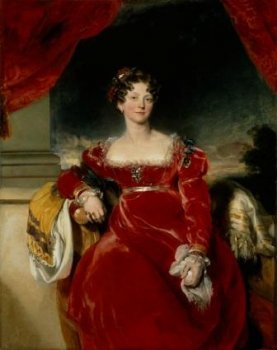
Last room is “Court, Academy and Society: the 1820s”. Lawrence success was huge at that time. Here to be highlighted are “Princess Sophia”, “”Arthur Wellesley” and the famous “Earl of Aberdeen”.

Sir Thomas Lawrence (13 April 1769 – 7 January 1830) was a leading English portrait painter and president of the Royal Academy. He was born in Bristol in a troubled family. Moving in Devizes in 1773 his father started to use Thomas talent for drawing and reciting poetry to make money. Thomas formal schooling was limited but aged ten he was enough famous to be mentioned in local newspapers.

They moved to Bath, in 1779, his father was declared bankrupted and from then on it was Thomas to support his family with his portraitist work.

In 1787 Lawrence arrived in London. In 1788 he participated at the Royal Academy annual exhibition and started to be famous. In 1789 Lawrence received his first royal commission from Windsor.

He was an innovative artist in using subject. For many of his portraits there were critics or great acclaims, creating a real artist figure that was important not only for art but also for the entire society.

01_Self_Portrait__Denver.jpg

In 1791 Lawrence was elected an associate of the Royal Academy and the following year King George III appointed him “painter-in-ordinary to His Majesty”.

Though receiving many commissions, Lawrence was in financial difficulties. He was a hard worker and didn’t live extravagantly, but debts would stay with him for the rest of life. Biographers couldn’t discover the source of his debts, maybe related to his generosity, his inability to keep accounts and his costly collection of Old Master.

Lawrence never gets married and his romantic life was tantalized by complicated relationship beginning with the Siddons sisters. In later years Elizabeth Croft would provide him with companionship. Lately was Isabella Wolff who biographer suggests that Lawrence may have been the father of her son.

His international reputation was ensured when the Prince Regent commissioned portraits of all the foreign leaders involved in the downfall of Napoleon.

After travelling Europe Lawrence arrived back in London in 1820 and was voted the new President of the Royal Academy, a position he will hold until his death in 1830. In 1822 he was elected as a Fellow of the Royal Society “for his eminence in art”.

He died suddenly on 7th January 1830 few months later his friend Isabella Wolff.

This exhibition is the first in Britain since 1979. Some of the works are absolutely superb. It is strongly suggested to pay a visit.


image001arte.jpg

CONFERENCE AND EVENTS
A full programme of events including lectures, tours and lunchtime talks will accompany this
landmark exhibition. A major conference Thomas Lawrence: Regency Power and Brilliance will be
held at the National Portrait Gallery and The Paul Mellon Centre for Studies in British Art, 18-19
November. This will include talks, panel discussions and a keynote speech by Richard Holmes.
Tickets (including lunch, refreshments and entry to the exhibition) £40/£20 concessions and Gallery
Supporters. Please call 020 7580 0311 or email events@paul-mellon-centre.ac.uk


For further press information, please contact:
 
National Portrait Gallery, St Martin’s Place WC2H 0HE, opening hours Monday, Tuesday,
Wednesday, Saturday, Sunday: 10am – 6pm (Gallery closure commences at 5.50pm) Late
Opening: Thursday, Friday: 10am – 9pm (Gallery closure commences at 8.50pm) Nearest
 
Underground: Leicester Square/Charing Cross General information: 0207 306 0055 Recorded
information: 020 7312 2463 Website/Tickets: www.npg.org.uk


The launching of the PAD 2010.

LONDON :The PAD Pavilion of Art & Design in London opens with a stunning 4th edition, from 13th to 17th October, in Berkley Square, Mayfair.

Patrick Perrin and Stéphane Custot organise one of the most important fair of the world with 49 galleries and over 2,500 pieces covering Modern Art, Design, Decorative Arts, Photography and Tribal Art.

Some of the most famous galleries of all over the world are participating, coming from London, Milan, Geneva, Barcelona, Brussels, Zurich, Paris, Cologne and New York.

Only few years ago nothing similar was in London, Stéphane Custot explains: “I moved to London from Paris 5 years ago. We had the Pavillon des Art et Design in Paris for 15 years. When I arrived in London I discovered that there were no fairs of Modern Art and Design. Of course Frieze was there. At that time there was also Grosvenor and was a very good antique fair. And there were no fairs in between. So it was very easy for me to think about doing something in London for modern art and design. That’s why Patrick and I created PAD fair 5 years ago. The first 2 years was a design fair only with 20 exhibitors. Last year we enlarged, we have moved to Berkley Square and we included also Modern Art. And I think the combination between modern art and design it fits very well”.

Walking between the stands one can appreciate the atmosphere in a pavilion literally built on the gardens of Berkeley Square: “It’s a great location. It’s between Selby and Christies and it is near Bond Street and all the galleries and between places. So for me it cannot be a better spot. Because we have a lot of people, a lot of exhibitors who wants to join us, even though we could, we won’t enlarge the fair. Because we want to stay at Berkley Square. It’s so fantastic for us”.

The Moët Hennessy- PAD London Prize is a noteworthy moment of the fair every year, sponsoring the donation to the V&A Museum of a young artist piece of Design or Decorative Art. The winner is selected by a prestigious judging panel, chaired by architect and designer Nigel Coates, and comprising of prominent figures of art, fashion, culture, communication and business.

Richard Prince, Untitled (Fashion).jpgFor the year 2010 the winner is the absolutely unmissable ”Drift – Fragile Future Concrete Chandelier” by the Dutch duo Lonneke Gordijn & Ralph Nauta, made with real dandelion seeds, bronze, LED lights and concrete, of which any dandelion seed was attached in itself creating an amazing effect of softness and light.

The Prize for Best Stand goes to “Chahan Gallery” of Chahan Minassian from Paris presenting with his own style an international interior design project, finishing with a selection of vintage pieces of 20th Century.

And the Prize for Best Object is for “Map of China” by Ai Weiwei, on display at the Friedman Benda gallery, from New York, an ironwood piece from dismantled temples of the Qing Dynasty (1644-1911).

At PAD is present also visual art with rarest prints of photography materials, in between notably works of Newton, Cartier- Bresson, Leibovitz, Avedon and Mapplethorpe.

Worth of mention the Galerie Gmurzynska (Zurich) that turned the entire exhibition stand in a piece of art of Zaha Hadid the multi award winner who – the last 11th October – just received the Barclays award “Woman of the year 2010”.

Modern British Art Modern and classic contemporary paintings stars and painting masterpieces are presented.

Many of the galleries have some of the most exceptional works of Modern Art, rarely displayed in the UK and can find them throughout the fair. It is possible to see pieces of arts of famous artists, including Mirò, Klimt, Botero, Matisse, Basquiat, Giò Ponti, Degas, Rodin, Giacometti, Schiele, Balthus, Warhol, Ernst, and Grosz.

And you can be happily surprised to find out that Mitoraj, Braque, Dalì, Picasso, Anish Kapoor, Niki de St. Phalle, Fontana, and even Man Ray the photographer, were also jewellery makers not only painters or sculptors. Those are to be found at the exquisite post-war and contemporary artist- made jewellery galleries.

Design and decorative arts exhibitors comprise prominent contemporary pieces, together with French Art Deco and iconic 20th Century American, in a wide array of international artists, with a solo show of Czech glass master František Vizner, and elegant interiors objects by American designer Tony Duquette.

PAD unveils also brand new furniture by Guy de Rougemont, introducing the latest in interactive and cutting-edge design with fashionable from Zaha Hadid.

Furthermore are staging woodwork furniture by American artists Michael Coffey and Jack Rogers Hopkins.

The prestigious Entwistle Gallery (UK & France) launches the new genre of Tribal Art and Sladmore Gallery (UK) introduces 19th and 20th Century life-size bronzes and animalia.

Alongside Adrian Sassoon, the UK’s most respected dealer in contemporary ceramic, glass and metalwork, Jean- David Botella (France) showcases a selection of sumptuous Art Deco objects.

At the entrance on display works of the Postgraduate Art and Design course of the Royal College of Art. PAD London also affords this interesting project aimed at supporting young design talents. Created by curators Janice Blackburn and Nigel Coates, who have selected twenty pieces to be exhibited and presented for the first time, this project provides the 15% of the profits generated from the sale of these works will go towards to the RCA Student Fine Art Award Fund.

And there is a future for the PAD: “We have a selection committee and we try to invite the best galleries in design and modern art. That’s why this year we have some fantastic people around. It’s even better than the last year actually. Because last year we had a big success we were able to invite other very important colleagues so we are very happy. I can tell you now, next year we have 2 or 3 of the most important galleries, and they want to join us. So there is a future for this fair, no doubt. And there is a future also because it is a small fair. It’s small and beautiful. We keep the size, we don’t want to make it bigger. It is not that, the question is to please the art dealers, to please the colleagues: I am an art dealer myself, organiser but also art dealer that is my main activity. So I want to please my friend”.

LONDON’S ARTS: (Banksy), mysterious artist GLORIFIED GRAFFITI OR UNDERRATED GENIUS?

 LONDON: Politically thought provoking street artist, known as “Banksy” uses his spray painting as a form of pro-active expression. Whether you consider his work improper vandalism or a refreshingly fascinating medium of response to issues within society, it’s hard not to feel a sense of individual empowerment through the defiant resistance which emulates from his work. Some of the greatest works of genius through time have been published and created under cleverly crafted pseudonyms.

Whether that be for literary purposes like Emily Bronte concealed under the identity of Ellis Bell when she wrote Wuthering Heights or for deeper underlying political and cultural motives like early Indian scholars who deemed it egotistical using one’s name to acquire acclaim and Japanese artists who changed their pseudonyms as their creative style developed. The most recent of these anonymous maestros is the Bristol born street artist Banksy, whose work has been in the public eye for over a decade appearing unheralded on public property all over the world- London, New Orleans, Los Angeles, Melbourne and Israel to name but a few.

Banksy’s art has become an international phenomenon, sparking artistic debates and raising a certain awareness of his non conformist views amongst his audience. His adopted stencil style “guerrilla,” has become a trademark in itself and certainly secured him a critically savvy reputation amid his contemporaries, such as Jeff Aerosol and CES53, who was the first street artist to paint on the side of the Northern European trains.

In 2006, Max Foster coined the term- “The Banksy Effect” saluting Banksy as the first street artist to ameliorate the bad reputation of this hooligan-esque medium of artistry which others have attempted to forge, given that his work now is auctioned at several thousand pounds a piece, becoming a collectible must-have. However it’s usually obvious whether the attempt is a true expression of the street prankster or a feeble pursuit of impersonation. Even Hollywood’s elite; Angelina Jolie and Christina Aguilera are eager to get their hands on an original Banksy.

Aguilera purchased a controversial painting of Queen Victoria portrayed as a lesbian for the rather respectable sum of £25,000 and a quirky synthesis of the classic, iconic portrait of Kate Moss as Marilyn Monroe was auctioned at an impressive £96,000 at Bohams in London. Despite the whopping success of his paintings, Banksy sees no revenue from his efforts. His style encapsulates his hostility towards government surveillance, crime, violence and commercialism which he juxtaposes with symbols of innocence to create visually stimulating and somewhat disturbingly humorous art, challenging the perceptions of the world in which we live. Rather ironically, his art characteristically threatens the high brow, socially acceptable notion of what art really is and what we expect it to be. Mutilating public property and defacing buildings is a criminal offence so perhaps his identity is best left masked behind a veil of creative representation. Banksy’s raw talent is discovered in the most obscure of places, usually regarding the most contaravertial of topics.

This mystery man is not going to let his identity be exposed anytime soon as many of his spectators are a little less amused by his images which echo undercurrents of a poverty of political and social inequality and a little more eager for him to pay his share of detrimental charges.

The need for a new niche of innovative expression is essential for the development and broadening of human consciousness. Banksy addresses this requisite and his urban art is a delightfully fresh reclamation of the peevishly scrawled graffiti we pass everyday without the slightest impulse of stimulation.

For an artist that makes his work look deceptively easy, his identity is one which has proven to be eminently deceptive to decipher.

bansky.jpg work of the mysterious artist after having been ruined  and now protected from glass  

attacking a girl, Rosebery Avenue, London, January 2008

Diaghilev’s Ballet Russes on show at the V&A Museum.

“Diaghilev and the Golden Age of the Ballet Russes 1909-1929” is an impressive exhibition that reveals the importance of Diaghilev as impresario and artistic director of his “total theatre” an amazing combination of dance, music and art. It is an exhibition with more than 300 objects and popular material showed in a chronological order.

At the V&A Museum there is a vast collection of Ballet Russes and Diaghilev. Ballet Russes collaborated with famous choreographer, artists and designers. New music scores were commissioned for nearly half of the Ballets Russes: music was crucial, so it was put around the visitors at the show. The exhibition begins with Diaghilev’s life in St. Petersburg, proceeds to a deconstruction of the ballet through inspiration, choreography, music and creation of the sets, next is the difficult moment during the War and a final gallery about the 1920s a period when he had achieved great status.

This superb exhibition gives to anyone the chance to deepen the knowledge about Sergei Pavlovich “Serge” Dyagilev and the Ballet Russes in an intense manner with more than 300 objects and popular material that gives a global glimpse.

Designs and colours used in Ballet Russes created a new aesthetic in the twentieth century. The exhibition is a chronologically ordered digression on the Ballet Russes, from the origins to Diaghilev’s death in 1929 in Venice, where he’s still nearby buried. Ballet was a declined art across Europe and America at that time but Diaghilev transformed it.

This major retrospective will celebrate Diaghilev enduring influence on 20th–century art and design including objects from the V&A’s own unrivalled collection and from a variety of lenders. Jane Pritchard curator – together with Geoffrey Marsh –explains the reason why this exhibition was opened: “At the V&A Museum we have Britain’s major collection of theatre and performance materials and we have a vast collection of Ballet Russes. We have the largest collection of costumes in the world from Diaghilev’s company. And we also have very expensive collection of designs, drawings and archives. So two thirds of the exhibition comes from our own collection and the rests are loans.

So it seems very appropriate that we should do an exhibition on the Ballet Russes”. The ballet uses the human body to express story and emotions. Then an interesting part of the show analyse the elements of the production of a ballet: inspiration, choreography, music and sets. “In the third gallery which is our central gallery we do much more deconstructing what goes into a ballet. So we’re looking at the ideas, the choreography, the music and the sets. People who come to the V&A tends to have a general interest in the arts, they maybe have not great ideas about dance in particular” Jane Pritchard said. Ballet Russes had five main choreographers Mikhail Fokine, Vaslav Nijinsky, Leonide Massine, Branislava Nijinska and the young George Balanchine. Particularly Nijinsky, on one side his dances reflect the Expressionism art, but also he was Diaghilev lover for many years, followed by Massine. On show the original works of the many artists and designers that collaborated with Diaghilev to create sets, costumes, props and cloths including Leon Bakst, Alexandre Benois, Coco Chanel, Jean Cocteau, Giorgio De Chirico, Natalia Goncharova, Tamara Karsavina, Mikhail Larionov, Serge Lifar, Henri Matisse, Nicholas Roerich, Misia Sert, and Auguste Rodin. Amazing the huge front cloth for Le Train Bleu, an example of the collaborationswith Pablo Picasso, who also married a company dancer Olga Kokholva.

The superb music had a vital role in the Ballet Russes.

New scores were commissioned by Diaghilev mainly from leading Russian and French composer for nearly half of these ballet including Stravinsky, Prokofiev, Debussy, Ravel, De Falla, Respighi, Satie and Poulenc. Specifically created for the show footages of composer and broadcaster Howard Goodall explaining the development of music accompanying the Ballets Russes. It is also possible to see videos about creating a mini- choreography so could understand what choreography is. “Because we also feel that music is crucial has brought to the Ballet Russes how’s the ballets has new music written for that. If you just put music in the background now, people don’t pay attention to it. So we used to put music around us. We acknowledged the British composer, he is also a podcaster, Howard Goodall to make four AVs explain what’s happening and music in that shows is Mussorgsky and Stravinsky and Debussy. How is about to composing of the dance and the importance of the Firebird composed in the 1920” Jane Pritchard said. The exhibition begins with Diaghilev’s life in St.

Petersburg. With an overview of the dance scene the first gallery tells the story of the Ballets Russes up to the outbreak of War in 1914, including a rich array of costumes designed by Bakst. The second gallery will take visitors behind the scenes of the Ballets Russes’ productions their inspiration, choreography, music and creation of the sets.

The exhibition will look at how the Ballets Russes survived during the War having been cut off from their roots in Russia with little access to the cities they performed in before 1914.

The final gallery will present Diaghilev and his company in the 1920s a period when he had achieved great status in European culture. The works of artists, authors and musicians he knew or was associated with will be shown – including manuscripts by Joyce, Proust and Eliot. Diaghilev’s dedication to pushing boundaries and collaborating with the best designers, choreographers and artists of his time left an inspiring legacy.

An interesting bit of trivia is that even a perfume was created by Chyphré dedicated to Diaghilev.

Today the V&A Museum proposes again, in limited edition, “Diaghilev” a fragrance by Roja Dove. The exhibition isn’t an end in itself, there are also other related events like talk and tours, courses and workshops, study day and young people and families.

Internet details: www.vam.ac.uk/exhibitions/future_exhibs/diaghilev/index.html

Hungarian treasures at the Royal Academy of Arts.

It is a really amazing exhibition “Treasures from Budapest” featuring over 200 works, many of which have never been exposed in the UK.

It is an exhibition of many important artists from Renaissance to contemporary time.

The works show, likewise in the original presentation, the artistic interchange between Hungary and the rest of Europe.

Besides the history of Museum of Fine Arts is bound up with the one of Hungary.

The organisation of exhibition is chronologically ordered starting from Renaissance to Modern and Contemporary Art.

On display it is possible to see some of the most important Hungarian – or related to Hungary – artists from Renaissance to the twentieth century. The exhibition brings together works from both Museum of Fine Arts of Budapest, with additional key loans from the Hungarian National Gallery. Many masterpieces are on display and the list of artists is so long from Maso di Bianco and Jacopo del Sellaio, to Vaszary, Rippl-Ronai and Ferenczy, to Doré and Delacroix, but also Perugino and Leonardo da Vinci and Luca Signorelli, or Van Dyck and Canaletto and, yes, John Constable and many others. Really a must to be seen.

The presentation of works is intended, as the original one, to show the interchange of artistic ideas it has existed between Hungary and other parts of Europe across the centuries.

Furthermore the Museum history itself is strongly bound up with that complicated of Hungary: a site of many religious and political conflicts between different nations.

So Hungary was subject to a wide range of external artistic influences and this gave the opportunity to blend styles and swap artistic practices between Hungary and different parts of Europe.

Subsequently the organisation of exhibition is chronologically ordered. The show starts with a first section about the Renaissance period displaying Historical Art in Hungary. Here there is a significant St. Andrew Altarpiece surrounded by paintings of Italian artists.

The second section is about Sacred Art of Fifteenth and Sixteenth Century with still a strong presence of Italian artists, above all fine Tintoretto.

The theme of the third section, where the works to be highlighted are the ones of El Greco, is Sacred Art After Reformation. In the sixteenth century this kind of art should be seen also, respectively of the great changes due to the religious movement and the later Catholic Counter- Reformation. Sacred art was much influenced by the commissions coming from religious institutions but Protestant deliberately avoided the use of imagery in the church.

This part of the collection – the first three sections – reflects the prevailing taste for Italian art above all else.

Then we move to a section about Renaissance revival of interest in the classical world. Greek and Roman Mythology and Ancient History Paintings were considered, at that time, the highest form of art. Again a remarkable Tintoretto is to be noticed here.

Next section, Sacred Art in the Baroque. This form of art tried to reach people through their senses and emotions as well as their intellect.

But it is in the section of Collecting Old Master Drawings that there are really notably drawings of Leonardo da Vinci and Raffaello in between famous others.

Portraiture section, the seventh one, gives us the idea that portraits were commissioned from their sitters, or their families and friends, and were displayed in royal and noble houses to celebrate the dynasty of the family.

These last three sections are the results of the purchasing of Nikolaus II Esterhàzy, the greatest collector of the family, whose devotion for art could bring to these results.

In the eighth section there are on display works of Still- life and Genres scenes, considered at that time more bourgeois form of arts but much appreciated because of the dissimilarity between it and the great themes of religious and mythological art. Works of Benedetti, Claesz and Koets are to be highlighted here.

Then a second section is dedicated to Collecting of Old Master Drawings. By the seventeenth century Old Master drawing were fully established as marketable properties, here outstandingly shown are some Tiepolo and Rubens.

The following Landscape section deal with a seventeenth century topic, related to idealizing Italian landscape through the works of celebrated artists like Villa, Canaletto and Bellotto.

In 1873 through the unification of the cities of Buda and Obuda on the west bank of Danube and Pest on the east bank, Budapest was created. Budapest was one of the fastest- growing cities in the nineteenth century. So, the next to last section displays work about Collecting Modern Art in the New City of Budapest. The Museum of Fine Arts was opened in 1906 with the aim of preserving and displaying the national collection of historical art.

The museum was also created with the intention to encourage the creation of contemporary Hungarian art and represents the major recent movement in Europe such like Realism, Symbolism and Impressionism. Strongly were the connections with Paris.

In the last section it is possible to find works of the Modern and Contemporary Art in the twentieth century, such as Picasso, but also a superb piece of Egon Schiele (Two women embracing) which gives to the all exhibition a special hint.

Here in this section it is also explained that the collection of the Museum of Fine Arts was totally revolutionised by its second director Elek Petrovics who transformed the entire collection and putted together up the patrimony of contemporary Hungarian arts.

It is not an end in itself this exhibition: it is also possible to take part of other related events, like workshops and lectures.

The exhibition is so clear and so well organized that it is very easy to understand and follow the superb works displayed. Not to be missed for an artistic digression from Renaissance to contemporary Hungary.


Internet details:


www.royalacademy.org.uk/exhibitions/budapest