-The veil in the Oriental tradition. – The veil in the European countries. – The veil like a woman’s chose.
In the Qur’an women are admonished to cover their heads and to pull their coverings over their bosoms . In chapter 33, verse 60 of the Holy Qur’an and in chapter 24 verse 32 Allah says that the women should pull down upon them of their outer cloaks and they display not their beauty or their embellishment and their private parts.
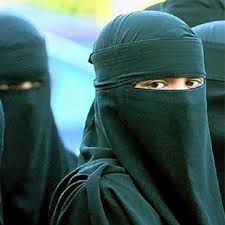
In light of these sentences some women choose to cover the faces or to cover the heads only. So there are different interpretations, both of which are valid. The Niqaab covers the face and the head with the eyes showing.
The Burqa covers the face, the head and the body, the woman can see from a gauze over the eye area. The Hijab covers the head and the neck only. So, the style of veil varies according to the situation and to the culture.
But why do the women wear the veil? Is there just a religious reason? The Qur’an orders to use the veil, but in the Islamic community the Qur’an isn’t just a religious text. It is the main and the first source of Islamic law, the Qur’an has laid down rules which cover the whole way of life. So for the Islamic women wear the Hijab is a religious, cultural, civil duty. And the reason is the necessity to shield the woman.
But protect from who? Someone thinks the veil is necessary to safeguard the women by men’s gazes. But do the women want to be shielded? Is the veil an obligation? How does the veil became an imposition by the Islamic men? A lot of questions about this duty. But the countries cultures and the valid interpretations of Qur’an are a lot and this means a lot of different answers. For example in the Yemen, the women always use the Burqa and the men cannot image a woman without its.
 He cannot know the woman’s body and her shapes, so it will result absurd to see a woman without Burqa. We have met an Italian who Antonella, has worn the Burqa: Even in the Yemen, the woman cannot sit close to a man in the bus. Antonella used the Burqa during your travel in the Yemen because it was necessary like a protection against men’s nuisances. In the Iran the women wear the chador in public space, it is a full body length that is open down the front, it hasn’t hand opening or any buttons. Today black chador are reserved for funerals and the women prefer to use a colored chador.
And in Europe? How do the European countries consider the veil? In London the women can wear the type of veil their prefer. So the women with close-face can attend public areas in England.
Whereas in Italy some Tribunals banned the integral veil in the public places because it can be a community safety problem and because in Italy exists a law, (22 may 1975 n.152 )in which is just banned the use of integral helmet that covers the face during public events.
 But the State Council believes it’s necessary to edit the law with specific indication about the integral veil in the public areas. So actually there is an important discussion about this issue but yet there isn’t a law with specific prohibition to wear a veil in the public places. On the contrary in France, like in Belgium, a law ban the total veil in the public areas with a fine for the transgressor.