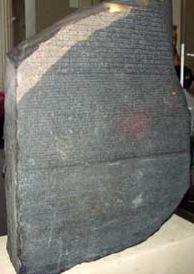
London – ROSETTA Stone is a black granodiorite stele with a special peculiarity: there are written some inscriptions in glyph, demotic and ancient Greek. These various sentences had been written for the King Ptolemy V.
Its name took origin from the city Radish, near to Nile, and it was found by Pierre-Francois Boucher. Right now, since 1802, it is possible to admire it in the most important museum of London: the British Museum.
The text deals with all benefits by king to people, about taxes, the division of the clergy etc..
However, the state of the Egypt wanted the relic back because it is represented a clear symbol of the Egyptian culture.
Some scientists, inspired by the study of their predecessors, have made one of the most important experiment of the story: Rosetta spacecraft.
Its name derives from “Rosetta Stone”; scientists gave this name because they used the same way to study: as Pierre-François Bouchard used his knowledge of just one language to understand the others, they use their knowledge about meteor to learn more about solar system.
The spacecraft was sent into the space in March 2004, after three fails. It had to study the birth of the comet and their life, to understand the origin of the solar system.
 It was arrived on the 67P/ Churyuma Gerasimenko, and it has done three flyby with the Earth and one with Mars. After that the spacecraft went in state of hibernation because of the distance from the sun, and this lasted until a few month ago, when it finally started again its work. [photo Rosetta spacecraft.]
The name of the lender is Philae, from the name of a little island on the Nile, where Giovanni Battista Belzoni found obelisck with some greek’s inscription, in 1817. The place where the spacecraft arrived is known by the name of Agilka, which is another Nile’s island where now there is The Iside’s temple.
A simple way to get to the afterlife wor…

London -Have you ever heard of an afterlife world, in which all the souls keep living? In the old Eg… READ MORE