A religion made of symbols: “Ascending with Christ giving keys to St. Peter

In this world there are many kinds of opposite feelings and opinions; in fact some people think that the relationship between humanity and the world could exist only thanks to science, but on the other hand some believe that truth would be a continuous investigation, maybe helped by faith in some divinity.
Also the great artist Donatello, from Florence, believes in this second opinion.
Together with other artists of his time, they shared beliefs which weren’t very shared by Catholic church, although quite common in public opinion;

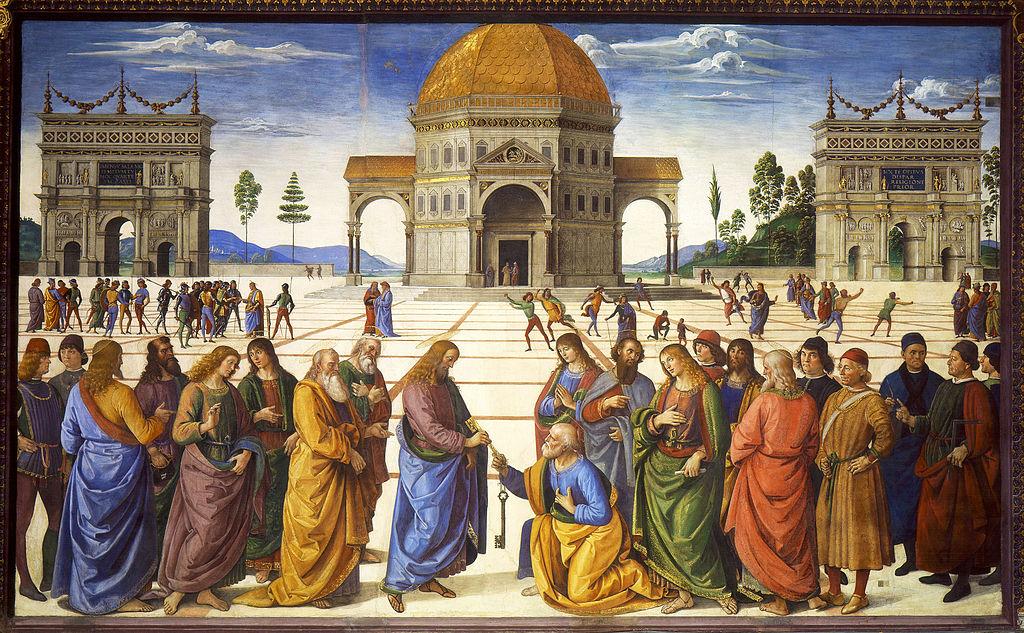
However Donatello had these beliefs, which were changed in symbols within masterpieces, to express the concept of salvation derived from Christian faith, and maybe the totality of Christian would hold out their hands to his salvation. Like St. Peter in one of the above mentioned artist’s masterpieces: “The ascension with Christ giving the keys to St. Peter whose copy is situated in the “Victoria and Albert museum of London”.
Here the image of Christ stays in the middle of the relief and it is surrounded by a circle of people whose various pious persons form part of. So, there is the presence of a circle of people: a lot of experts of esoteric theories could affirm that the circle has got a determinate meaning about artistic symbology.
In fact the circle, that is the absolute element of perfection and unity, indicates something that hasn’t neither a begin or a end. This fact is certainly a reference to Greek’s philosophy about the so called “circular theory” of time. This theor has been eliminated with Messiah’s advent; but now this theory is expressed by Donatello referring to eternal life, here symbolised by ascension of Jesus.


However the circle has got also other meanings about field of this masterpiece; in fact it represents the spiritual dimension and intellectual one of mankind. The circle, compared to the square, indicates the contrast between spiritual field and material one, and this is a concept surely embodied by the figure of Jesus ascending.
Christ isn’t surrounded only by his apostles, who are arranged in circle, but also by some ‘Cherubim’ angels. Cherubim would be supernatural beings which are present in Hebraic religion first and then also mentioned in Christian religion.. They had the duty to defend the way for “Life’s tree, but in this artwork they don’t exercise again this task because here Jesus represents the metaphor of “Life’s tree” whose entrance now is free for everyone, contrary to Adam and Eva’s time.
In fact, within this masterpiece, apostles stay between Jesus and Cherubins Angels Because they have the duty to defend, and apostles couldn’t stay so close to Jesus Christ.
In many Christian masterpieces, the concept of rebirth is connect to Trinity’s one; Obviously this concept is also present in above-mentioned Donatello’s artwork, not because there are images regarding God or Holy Spirit. In fact there is a triangle made up of heads of Jesus, Mary and St. Peter; but in despite of the Christian meaning, the triangle presents determinate symbolic values. Some Greek or Roman philosophies considered it as the foundation of world’s creation, because all geometric elements except for circular ones, could be divided in various triangles. However also in Christian religion the triangle can be connected to the creation’s beginning, because our would was created by Trinity itself, according to Bible’s doctrine.

chiaviok
So, there are a lot of esoteric symbols within the artworks of these great artists; maybe they, through these symbols, wanted to reproduce in miniature the great “drawing of God”.

Minds beyond psychological borders

Humans consider esoteric symbols and subliminal messages as modern ideas to induce people to buy a determinate product or to vote for a political party.
Most of the time no one would think that there are those kind of messages in some of the most important artistic masterpieces in the history. So, “messages from other times”. In fact, humans often believe that those messages, now used principally in marketing’s strategies, were born in the 18th century during the famous Revolution’s time.

It is difficult to forget the many school lessons about the quarrels between Montagnards and Girondins during French Revolution, the disputes from English colonies in America against King George III of England and about the consequences of Industrial Revolution in social and economic field.
Some people could believe that the result of these events have been established in advance by secret companies. If this manipulation of historic events has been real, it has led to a positive result because, the consequences of above-mentioned events have improved our today’s life both in economic and social field. On the other hand it is very important to underline that “evil puppeteer of this world” made use of the most important geniuses and artists of history, to manipulate human mind and prepare it for future projects, utilising esoteric elements from the oldest civilities, Greek philosophy and even present in the first centuries of Christian age.

One of most important representatives of this symbolism, in the artistic field, has certainly been Leonardo da Vinci. In Leonardo’s masterpieces nothing has been placed accidentally, everything has a determinate meaning, according to its message.
In fact everyone can analyse one of his paintings, which is situated at Sainsbury, an area of the famous n

ational gallery of London; this masterpiece is named: “The Virgin of the rocks”; but first of all we need to answers to some questions:
If Leonardo was Italian why this painting is now kept in London?
The answer is simple. The masterpiece belonged before to a confraternity, when it shut, the painting was given by Cicognara’s count to an English painter, Gavin Hamilton. He carried it in England, where the canvas continued its way between the different owners. Like many others masterpieces of that ages, this one present a hidden drawing.

This fact was been discovered after an analysis during 2005;
Apart from the scientific analysis there were also interpretative opinions about it.


To understand better this canvas it is necessary to divide it in various parts, it is easy to note Maria sitting in the middle of the painting, as she has the function to connect the left side to righ one of the painting. These two sides would represent the human’s point of view and divines one respectively, In fact John the Baptiste and the left part of Mary are certainly human figure, even Mary who is human but burn without original sin, so containing “a divine spark within herself”.
Finally on the right side, it is possible to note Jesus as a child, a God who became human. A figure surely belonging to a mankind. The distance of physical connection which is carried out by Mary’s position, is balanced by important exchange of glances and gestures that connect the various figures, thus the various dimensions.

No one could commit the mistake of thinking that there are only these mentioned elements about Leonardo’s canvas; it isn’t in fact possible to enter into the mind of these geniuses, for sure very different from other common mortals.

Friezes of Parthenon: England or Greece?

London- The British Museum has some areas dedicated to civilization that influenced the progress of humankind. For example, there is an area dedicated to the Ancient Greece which actually is one of the most visited areas of the Museum. 

Located in the Ancient Greece section there is the frieze of the Parthenon, which is now object of discussion between Greece and England. The Greek government wants to have back the sculptures since they historically belong to Greece. Otherwise, the British Museum doesn’t want to give them away.

If you are wondering why the Parthenon frieze is in the British Museum, here there is what happened. Lord Elgin went to Greece and brought it with him back in England. But during the travel, the ship wrecked and the frieze went lost. Someone found the piece near Marseille (France) and delivered to the British authorities.

According to the opinion of British Museum visitors being interviewed, British people would prefer the Parthenon frieze to remain in London, since they are an integral part of the Museum. Also British feel like a part of their the myth already discussed about the transportation of the frieze from Greece to London.

However, there are someone who would give back the frieze to Greece: those people think friezes are a symbol of Greece and a reason of pride. Taking also into consideration the current difficult situation in Greece, returning back the frieze could be seeing as a positive initiative in a period of dark.
A little percentage of visitors interviewed did not answer to the survey, because they considered the situation difficult to judge: the frieze contribute to attract tourist at the British Museum, but, at the it is an important part of the Greek history, able to restore the ancient beauty of the Parthenon.


British women in the Second World War …

British women  in the Second World War  :WVS

London – During the Second World War british women tried to value their condition. Before this perio… READ MORE

Beyond the frontiers of Science

Whoever would learn the secret of altering things must know that everyone can influence everything magically if he falls into a great excess of love or hate or the like.  Albertus Magnus (1193 – 1280) – De mirabilibus mundi.

Since the dawn of every civilization there has been a grey area between proven fact and that which falls within the field of the inexplicable, labeled Magic.
The Roman Code of the Twelve Tables (ca. 450 B.C.) stated, “ When grain or crops are prevented from growing by means of magic, the perpetrator shall be sacrificed to Ceres ” and “ Poisoning another person or rendering him ill or inactive through the exercise of magic or diabolical arts is a capital crime punishable by death.”
The Latin writer Apuleius (c. 125 – 180 C.E.) was accused by his wealthy wife’s relatives of having seduced her by magical means. To counter her family’s charges in court, Apuleius wrote his
‘Apologia’, or ‘Defense’, in which he draws a careful distinction between black magic, or necromancy, where the intentions are evil, and white magic, or theurgy, practised by him so as to purify his soul and attain divine wisdom.
The duplicity of magic has itself been tackled in a duplicitous way by the Christian Church. Pope Sylvester II (999 – 1003) was alleged to have practised alchemy, a branch of magic, and had to swear before a special council that he himself was no sorcerer. Albertus Magnus, Bishop of Regensburg, on the other hand, despite being a declared alchemist, was officially recognised as a Doctor of the Church and eventually even canonised as a saint (though not until 1931). The reason for the Church’s ambivalent approach is that alchemy can be seen, not only as an early forerunner of chemistry, but also as the spiritual path leading to inner discipline where matter and soul achieve equilibrium. Ultimately, however, Pope John XXII did in fact outlaw the practice of alchemy in his papal bull of 1317: “ Poor themselves, wise in their own conceit, they fall into the ditch they themselves have digged.” Nowhere has alchemy, as the overarching form of magic, had an easy passage. As early as 144 BC and again in 60 BC the Chinese Emperors banned it, as did the Roman Emperor Diocletian in 296 AD, while King Henry IV declared it illegal in England in 1406.
Physics and chemistry have long marched ahead, leaving the traces of their arcane origins to fade into oblivion and abandoning all reference to the psyche, originally inextricably bound up in the practice of any magical art. Everything that cannot be explained through the canons of proven experiment has been confuted and excommunicated from the field of scientific research and denied as untrue. Thus phenomena such as psycho-kinesis, geomancy, telepathy, foresight and so on have been kept alive only in myths, sagas and legends and are seen only as old-fashioned superstitions.
Carl Gustav Jung attributed the origin of paranormal phenomena, known also as extra-sensorial perception (ESP), to an erratic and peculiar activity on the part of the human psyche not explicable through the laws of science, whose laws are suitable only for macrophysical quantities.
‘There are things,’ he said, ‘that people do not talk about for fear of exposing themselves to thoughtless ridicule… I was amazed to see how carefully their secret was guarded.”

One well-reported case of psycho-kinesis is that one of the Capuchin friar, Joseph of Cupertino (1603–1663), who in the grip of extreme ecstasy was said to levitate and fly. The friar was interviewed by the Inquisition on a charge of witchcraft and sent into isolation in one monastery after another, where he kept on levitating until his death. Centuries later Joseph was canonized as the patron saint of travellers, aviators and astronauts.
The movie ‘The Water Diviner’ has drawn public attention to a facet of geomancy, once widely practised in the countryside all over Europe. When looking for underground water for irrigation purposes, farmers would call on the assistance of experts, known as water diviners.
Telepathy is implicitly a concept of everyday life, witness the old expression ‘you have just read my mind’. The experiments conducted by J.B. Rhine, the Father of Modern Parapsychology .


(1895–1980), at Duke University, North Carolina, have shown that ‘telepaths’ can read a series of cards before they are turned face up but boredom or lack of interest in the course of such experiments are negative factors. As Albertus Magnus said, the genuine alchemist should choose his days and hours for labour with discretion. Furthermore, in keeping with Jung’s theory of the psychic relativity of time-space, distances in time or space do not appear in any way as inhibiting factors in the outcome of experiments.
And now we come to the most inexplicable facet of the whole paranormal conundrum. How is it that our minds are capable on occasion of slipping backwards and forwards in time so as to read past and future events?

The English engineer J.W. Dunne (1866–1949), when serving in the Boer War, foresaw the catastrophic volcanic eruption that was so soon to destroy Martinique thousands of miles away in the Caribbean. He explained this paranormal experience in his book, “ An Experiment with Time. ”
Dunne and others tried to give precognition some sort of scientific basis but the most intelligible hypothesis would seem to remain the one provided by Carl Gustav Jung, namely that ESP phenomena are connected to the absolute knowledge of our collective unconscious, where space and time are contracted to almost zero. These paranormal phenomena display an erratic and unforeseeable pattern, being singularities similar to those occurring in physics.
In the unrelenting search for the laws that govern matter, the old magic has been bypassed, dismantled, explained away. Alongside mankind’s growing dominion over matter, a sort of modern black magic has been building up: nuclear radioactivity, biochemical arms, pollution, deforestation and so on, and we have neglected to focus on the human psyche, which, through its where’s and when’s, makes relative any intended scientific objectivity. It is high time we looked for a fresh white magic and that we investigated our common ancestral pattern of unconscious fears, wishes, dreams and nightmares. In doing so let us go back to the ancient magic riddles and start again from the dictum of the Delphic oracle: “ Know thyself. ”

Banana doesn’t suck:Andrea Jublin at Genesis

CinemaItaliaUK One of the pure gems screened during CinemaItaliaUK festival at Genesis Cinema is, undoubtedly, Banana (2014), a very clever comedy directed by the Andrea Jublin, the story of a naïve young boy – actually Banana – who fights with all his forces to gain his own idea of happiness: he is the only one to strive hard, the only one to hold on despite the disappointments, and his determination becomes a limpid example for someone.

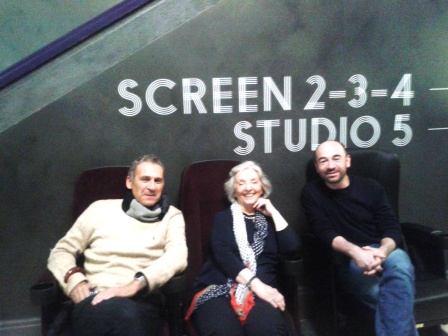
[in foto from left: Andrea Jublin,clara Caleo Green and lecturer Paolo Nelli].

Andrea Jublin has something that fervently shines inside and his pathetic, tragic hero tells more than a story. Banana is not merely a comedy: it has something deeper. With his movie, the director has opened an effulgent glare. The audience, at the end, was excited, as if it has gained a new, vigorous strenght.

The lecturer Paolo Nelli did Andrea some questions about the movie.

Q.Tell us something about the setting. We know that it is from the suburb of Italy, but you show a panoramic view of the town just once. Why this choice?

The city is Rome, but it’s very hard to understand if it’s a big city, or a suburb of a big city. We wanted to show the suburb of Italy. The movie is also about Italy. Italy at this time, so not a very smiling and rich country, not a very beautiful country. The flag, which is like broken, in the very first part of the movie, means: “Now we are in Italy!”.


Q.You’ve been a Oscar nominee for your short film The substitute. The actors has the same age, the movie is set in a school.

The theme are very similar, yes. It’s about purity. Banana is a sort of pure boy against all over the world. Actually, the first title was Against all over the world, but Banana is shorter, it’s better. The substitute was about purity, too: in that case, the main character was a teacher, who, actually, was a lawyer, and couldn’t stand to be a grown up man. He wanted to be with pupils, so he went in a school just for having fun with children. The problem of Banana is how to continue to be pure in this world, in Italy now. Does grewing up mean lose purity? Probably yes, but you should try not to lose it.


Q.The main chacter is great, but not only him. Also kids and teenagers. How did you cast them? And how you managed to have them so real?

They hate me now. The rehearses were so hard for them. They had a panel, a terrible panel for them, and they were so upset for that. There were so long rehearses, and also the casting was so long. The truth is that when you put them in front of the camera, you just have to say Action! Also the professional actors were impressed.

 banana2

Q.The character of Gianni is played by you. He’s a director and he works with children. In a wonderful scene, a child suggests him to try to lower his expectations. Is it a metaphor about Italian cinema?

It’s not only about cinema. It’s about people living in Italy. A lot of time I went to producers and they said me: “No, it’s so clever! You can’t do it!” It’s very hard to find money for movies. There’s a sort of ideology: you should try to do less. It’s a big problem.

 [in foto from left: Andrea Jublin,clara Caleo Green ]

Q.Football has a wide space in the movie. How important is for you?

It’s a metaphor about how you should be. You should try to be courageous, romantic, you have to believe in what you are doing. Brazilians are good in attack, they want to win. That’s why it’s so powerful like metaphor.


Q.Why comedy? Is this your natural way to tell stories?

This genre is the closest to reality. In reality you can cry and you can smile.


Andrea Jublin kindly allowed some minutes to us. 

Q.You are one of the founder of the Company of Indipendent Cinema. What’s your opinion about Italian indipendent cinema?
I think that now some Italian movies are very good. I’m very proud. They are trying very strongly to do something good.

[italian version]

Discovery of new Polio-like virus in America highlights magnitude

The discovery of a new Polio-like virus in America, which has led to 100 children developing paralysis, underlines how much work is still to be done to eradicate Polio says national charity, The British Polio Fellowship.

Scientists in the USA believe that this new virus is linked to Polio after a six year old girl with paralysis tested positive for enterovirus C105. Although this is a newly discovered virus, it is in the same family as Polio. Worryingly, the virus has spread across 34 different states in America, meaning the chances of controlling the virus have been lowered drastically.

“This is very saddening news,” said Ted Hill MBE, CEO of The British Polio Fellowship. “Setbacks like this only make us stronger though and even more determined to eradicate Polio in all its forms once and for all.” Since 1988, a global initiative to eradicate Polio was established, leading to the number of cases being lowered by more than 99% in 30 years. Through routine vaccination, an estimated 350,000 cases in 1988 were reduced to a reported 650 in 2011. However, the fight against Polio still goes on, as this recent news shows.

“There’s still a lot more work to be done to be rid of Polio for good,” said Ted. “At The British Polio Fellowship, we strive to empower those in the UK living with the late effects of Polio and Post Polio Syndrome through support groups across the country. We also spread awareness of the disease as many people forget it exists in today’s world.”

To find out more about The British Polio Fellowship and to learn about the late effects of Polio and Post Polio Syndrome visit the charity’s website at www.britishpolio.org.uk.

About Post Polio Syndrome (PPS)
Post Polio Syndrome (PPS) is a neurological condition which can occur in up to 80% of those who have had Polio. It is estimated that around 120,000 people in the UK are living with PPS today. After an interval of several years of stability, individuals can develop increasing weakness, fatigue and pain in previously affected or unaffected muscles, a general reduction in stamina, breathing, sleeping and/or swallowing problems and cold intolerance. PPS usually begins very slowly, although it can appear suddenly and often following triggers such as falls, surgery or immobility. There is no specific cure for PPS, but properly managed it may stabilise or only progress slowly and lessen the cost on the NHS whilst increasing the quality of life of those affected. Much can be done to retain independence, including self-management strategies such as pacing and energy management, appropriate use of adaptive equipment, looking after your general health, and social and emotional support.


Thousand of stories through the streets.

London – Maybe one of the most folkloristic and mysterious London districts, Aldgate, is the best in showing what
the real life in London is like. Set in the eastern part of the city, it has a long history that started almost one
thousand years ago. From the Famous “Jack the ripper “ to the wonderful Street art the quartier has
a lot to tell: just by walking around, you can feel the absolutely clear difference between the atmosphere in
Aldgate and in the rest of London. That is its beauty, to have the capacity to in representing the authenticity, a scene of London that you would never see anywhere else but in Aldgate.


brik 2

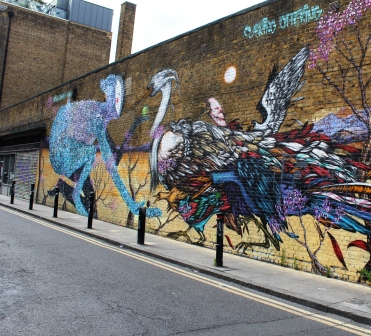
 [photo – Martin Ron  Brick Lane street art  photo by Bruno Ciarciaglini]

There you can admire several paintings, but the most amazing are those of Bansky.
His style is particular because he uses black and white and he makes some colourful shades.


brik5 2

 [photo –  Brick Lane street art  photo by Bruno Ciarciaglini]

 His subjects are ironic and aggravating and he attacks in particular war, civilisation, various institutions, capitalism, and otherwise he supports peace against the injustices.

brik5 1


  [photo – Brick Lane street art  photo by Bruno Ciarciaglini]


Street Art: a scream of freedom

In the world there are so many ways  to express art. Nowadays the most famous kind of art is the “street art”. As the name says, this art is shown in public places but most of the times it is illegal.
Inspired by their feelings, the street artists, with their paintings, want to deal with illegal problems to criticize a broken and corrupted society.

brick 6
The street art has appeared for the first time in France and then it developed in other countries like Spain and Great Britain.
In England, it is possible to find the street art in West London, also famous because of Jack The Ripper’s story too.  
It is easy for artists to express their worst inner feelings because the place where they draw is degraded and for this reason no one forbid them to work for.
brick7The most considerable thing is that these artists are appreciated by most people!  

There you can admire several paintings, but the most amazing are those of Bansky.
His style is particular because he uses black and white and he makes some colourful shades. His subjects are ironic and aggravating and he attacks in particular war, civilisation, various institutions, capitalism, and otherwise he supports peace against the injustices.

Discovering DNA: what you don’t know

London -Let’s start with something that everyone already knows; in the late nineteenth century, it was believed that the nucleic acid, long-chain polymers of nucleotides, were made up of sugar, phosphoric acid, and several nitrogen-containing bases. Later it was found that the sugar in nucleic acid can be ribose or deoxyribose, giving two forms: RNA and DNA

Many science students tried to find out the chemical structure of DNA. Just two of them achieved their purpose: Watson and Crick, two Cambridge University scientists. Their discovery was one of the most important in the history of men. In fact, the birth of molecular biology is owed to this incredible innovation.
DNA, short for deoxyribonucleic acid, is the molecule that contains the genetic code of organism and each one of us has his own DNA code.

It has a double helix shape, which is like a ladder twisted into a spiral.

Each step of the ladder is a pair of nucleotides. There are four types of nucleotide: adenine, thymine, cytosine and guanine.
Nowadays, the discovery of DNA is a common knowledge as well as who played the main role in this.

In fact, it’s guaranteed that hearing the names of Watson and Crick it rings a bell in your mind. However, what happens if we say ‘’Roselind Franklin’’?
Rosalind Franklin was born in Notting Hill in 1920. She was an English chemistry and x-ray crystallographer. She was an incredibly strong and independent woman.
She dedicated all her life to her passion for science and research.
Franklin studied at King’s College in Cambridge. She was working to her project but, because of her relationship with some wrong people just like Wilkins, her discoveries were shown without her permission.

In 1951 Crick and Watson “invented” the first DNA type using the Rosalind’s stolen information. Anyway she found a mistake: there wasn’t water! Right in that moment she decided to increase her studies and with the “Photo 51” she improved the DNA’s structure.

In 1962, after their studies, both Watson and Crick won the Noble Prize but they forgot to remember and thank her for all the support.
Even though Rosalind Frankline was the first promoter of one of the most important historical discovery, this woman has never been mentioned neither in school books, nor in scientific articles. [photo Rosalind Franklin]

Dinosaurs: they are still here

London- 230 million years ago the Earth was inhabited by fascinating creatures that still appear us frightful because of their body size.

Dinosaurs are still here but they aren’t as dangerous as they were in the past because now we have only their fossils.

Some studies reveal that these giant animals were also herbivorous, so not all of them were really dangerous.

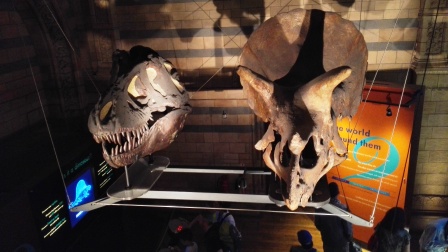
In London we have the chance to enter  their world thanks to the Natural History Museum situated in Cromwell Road.  In this Museum there are many remains of them and you can admire the first T-REX fossil ever found.

Moreover there is a robot which simulates T-REX moves and roars. It’s an exciting experience that catches your curiosity because it looks  real.

dino3At the entrance of the museum you can see a massive reconstruction of the Diplodocus, the longest dinosaur ever existed. If you wish to see  other  pre-historic animals, the museum has an area dedicated to them.
In this area there area lot of  copies of skeletons of herbivorous ,carnivorous, from the biggest to the smallest.

During the tour we could also see ancient stones and plants,. Some are original and some are reconstructed. What is amusing here is that you can also enjoy some interactive activities.dino2

In another section of the museum you can come across the bone structure found by Mary Anning in 1810 at the age of 11. This has given her the name of “The fossil girl”.

So the Natural History Museum is a good place if you are a fan of the creatures from the past.

[internship students european proiect (Naples)]


Richard Branson’s secrets to success.

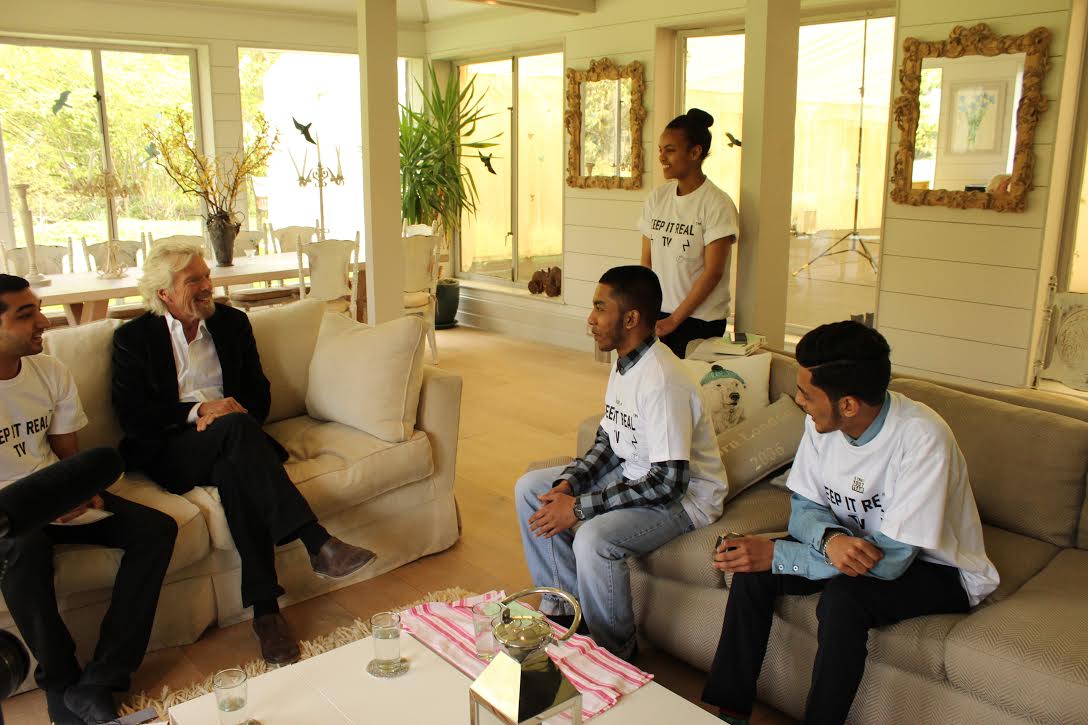
Renaissance Foundation’s Young Leaders had the privilege to be welcomed by Richard Branson at his private home for a unique interview in which he unveiled the secrets to success.

Fiona Hiyabu, Wahid Uddin and Abdul Qasim, are the 17 year old college students who where chosen to take part in this once in lifetime opportunity, as a reward for their hard work and engagement with the Foundation.

They are part of RF’s Young Leaders initiative, a stage they reach after going through a 3 year personalised support program that includes mentoring, educational attainment and experiencing inspirational world-class opportunities like this one.

Showing their leadership skills and abilities learned at the Renaissance Foundation’s workshops they prepared a series of questions for Sir Richard Branson.

They asked him advice for Young People like them.

Richard Branson gave really positive and personal answers, opening up about things such as his dyslexia and his difficulties in school, something that many kids struggle with today.

His advice will surely serve as an inspiration for Young People everywhere, which like him, want to achieve great things.
In this visit Richard Branson proved to be a very positive role model with a lot of wisdom to offer on how to succeed in life through: hard work, team effort and positive thinking.