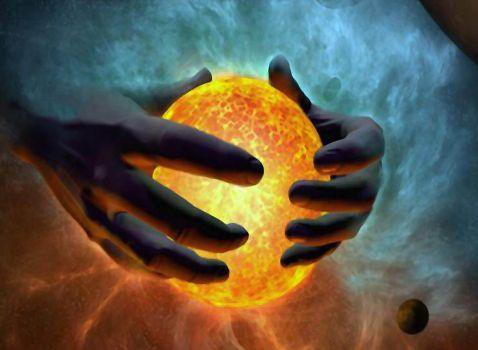
LONDON STONE BETWEEN TWO WORLDS

London is a city which today contains about 9 millions of inhabitants. Do you think all of these, or at least English ones, know the history of their own territory? 

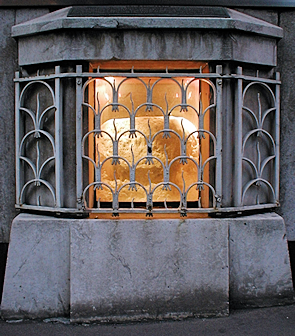
Actually it looks like a lot of people don’t know one of the most important object of London: the London Stone, an irregular block which one can see at Cannon Street, 111, in one of the richest district of London.
There are many interpretations about its story. According to widespread theories of the 18th century, this block has been objects of worship by druids. There is always someone who tries to repropose this ancient stories in literature. Among those ones it is possible to remember Elizabeth Gordon, a writer who in 1914 published the book “Prehistoric London: its mounds and circles”.
The most believed legend about the London Stone, diffused by some writers during the romantic period, told the stone was a part of the London Palladium, similar to the Troy’s one, built in order to defend the city from every kind misfortune.
Another legend recount that the Stone is a talisman. Today, many people, living in a city which never stops its progress, think that something of ancient, a part of their own origins, assures safety and wellness to the territory of London.That is demonstrated by the fact that now the stone is embodied into a casing which really gives it a commemorative value.
Another story exists about the London Stone: according to this one some archaeologists, after the Second World War, presumed that the London Stone was a stone of a big Roman building.

Anyway, this Stone is just and example of the presence of ancient and new together, as it may be found also in the architectonic landscape, This aspect is one of the most interesting of the English capital: the old and new, living together without any conflicts, creating a progress in all fields, as has never been before.

A VERY DEBATED EVOLUTION

 These times are very stranges for humane, infact one can note him to make progress both as individual and as society, contrary to the primordial instinct which emerges sometimes in our life.
According to some psychological theories every person would have a sort of “cave” within itself, but there is also a “cage” around us, formed by traditions, education and predominating ideals in own country, which induces, maybe, every person to think humans are different compared to other creatures living in the world.

One of most important studies in this field belongs to the famous scientist Charles Robert Darwin.
He became really interested in natural science after his travel around the world by ship.

Thanks to his great research about first creatures, he discovered many anatomic information about humans, that before were unknown.
Beginning with embryologic studies, he compared the development of human’s fetus to bat and gibbon’s one and resulted that their conformation was different, but growth not.

Then he also noted a great connection between human and monkey, especially regarding the intellectual field.
Nowadays the Darwin theory is still object of debate by religious believers, because Darwin’s opinion is in contrast with what is written in the Bible. For this reason all religious believers are not disposed to accept the scientific realities; however, those who aren’t really convinced about one of these are inclined to search alternative theories, such us stories that connect Darwin to secret societies.

These followers are even bishops and priests, trying to preserve the most important dogma of Christianity .For example, according to Christian religion the world was created by an intelligent and superior being, God. Otherwise, scientific research found that world was generated by the Big Bang and the process is considered continuous during the time. So one can understand that scientific opinions are in contrast with the existence of God, as the Jew- Dutch philosopher Baruch Spinoza declared.


Considering what said above, it would be easy to understand why that Catholic Church would suffer a great ideological defeat in believing to Darwin’s theories, even if these ones are now accepted by official science. At the same time, some scientists don’t succeed to alienate themselves from Catholics dogma, because of popular traditions and superstition, as well as Charles Darwin during his youth.


MORE ARTICLE


What is the Human Being doing?

  What is the Human Being doing?

Since the Industrial Revolution, the human being began to destroy the environment where he used to l… READ MORE

Friezes of Parthenon: England or Greece?

London- The British Museum has some areas dedicated to civilization that influenced the progress of humankind. For example, there is an area dedicated to the Ancient Greece which actually is one of the most visited areas of the Museum. 

Located in the Ancient Greece section there is the frieze of the Parthenon, which is now object of discussion between Greece and England. The Greek government wants to have back the sculptures since they historically belong to Greece. Otherwise, the British Museum doesn’t want to give them away.

If you are wondering why the Parthenon frieze is in the British Museum, here there is what happened. Lord Elgin went to Greece and brought it with him back in England. But during the travel, the ship wrecked and the frieze went lost. Someone found the piece near Marseille (France) and delivered to the British authorities.

According to the opinion of British Museum visitors being interviewed, British people would prefer the Parthenon frieze to remain in London, since they are an integral part of the Museum. Also British feel like a part of their the myth already discussed about the transportation of the frieze from Greece to London.

However, there are someone who would give back the frieze to Greece: those people think friezes are a symbol of Greece and a reason of pride. Taking also into consideration the current difficult situation in Greece, returning back the frieze could be seeing as a positive initiative in a period of dark.
A little percentage of visitors interviewed did not answer to the survey, because they considered the situation difficult to judge: the frieze contribute to attract tourist at the British Museum, but, at the it is an important part of the Greek history, able to restore the ancient beauty of the Parthenon.


British women in the Second World War …

British women  in the Second World War  :WVS

London – During the Second World War british women tried to value their condition. Before this perio… READ MORE

British women in the Second World War :WVS

London – During the Second World War british women tried to value their condition. Before this period they just were housewives, but then they started to work in factories, in fields, as volunteers. This changing was possible because men were employed as soldiers in the war and the companies needed to replace them to avoid to stop the British economy. 

As a proof of this changing, an area of the Imperial War Museum is dedicated to a voluntary association founded by Stella Isaacs: Women’s Voluntary Service.

The WVS was a voluntary organization, founded to involve women in civil defence, which helped to move millions of people out of the cities. Women worked in hospitals helping in the preparation of food, which provided refreshments in bombed-out areas. The founder of the WVS, had a simple philosophy: “If the job needed to be done, it was done”.

In the Museum there are posters that illustrated the emancipation of the figure of the woman, uniforms that prove their hard work and the roles the covered in the war. Also, there are photographs that testify the participation of women in the war.


Thanks to the hard work of these women during the Second World War, the situation of the female figure evolved, letting women to be considered as equal to men. However, nowadays, in some areas of the world, the female gender has less power then the male gender.For this reason it is still important “to fight” to defend the rights conquered by women during the Second World War.


MORE ARTICLES

Friezes of Parthenon: England or Greece…

 Friezes of Parthenon: England or Greece?

London- The British Museum has some areas dedicated to civilization that influenced the progress of … READ MORE

Secret agents : fake or not?

– Which person, during the last 55 years, has never seen a film of 007 agent James Bond?

Today we have been in the famous “Imperial war museum” of London to discover the story of real “007 agents”, who are defending the population of UK from enemies. The site dedicated to those agents is situated at the second level of the Imperial war museum,
Despite the important role of secret agents, many people think the history of these agents is not true. Also, people say that UK authorities hide most of them tasks to the civil population.

However, people have to be inquired better and for this reason we decided to investigate better about them.
Among the most famous secret agents one could remember: ‘MI5’ and ‘MI6’. MI5 represents the service of Britain’s defence against its enemies into the national territory, while the famous MI6 seeks information about foreign enemies.
Many people make a great confusion between real story of these real secret agents and the famous James Bond . Consequently most of the public opinion mixes the stories and considers all the history about secret agents as a fake story.

foto 007 2
To clarify this situation it is possible to simply remind the war cabinet memorandum, written by the Lord President of the Council “The Prime minister has further decided after consultation with the ministers concerned, that a new organisation shall be established forthwith to co-ordinate all action, by way of subversion and sabotage, against the enemy overseas.”

Photo right [ guns and objects of secret agents English years 40/50 IWM]

It is important to underline also that being a secret agent is a work just for men: between 1930 and 1950 many women joined the UK secret society. Military authorities gave them a lipstick as an instrument for spying. Also women introduced a new way to communicate with other spies: they made a cut on the cork’s stopper, putting there many small tickets and giving them to other spies.

CLASSICAL OR MODERN ART?

The Tate modern is one of the greatest museum of modern art, a part of the complex Tate. It is situated in the district of Bankside, into an ex electric power station, that was closed for a small period of time, between 1981-1985.

The museum has been inaugurated the 12th of May 2000. the artworks has never been exposed in a chronological order, but in thematic sections, such us cubism, futurism , surrealism, post impressionism.
De Chirico

There are different and conflicting opinions about the paintings and artists exhibited. According to the greatest part of the visitors modern art is an expression of the depth of the human mind. However those visitors who are more interested in classical art claim to not understand the message of modern art. Why? Because classic art is more foreseeable than the modern one.

Among the most significant pieces there is the famous “The cut” of Fontana. a clear white canvas with one definite cut in the middle.

The masterpiece, simple and difficult at the same time, provokes different emotions and opinions among the visitors. Some observers declared the cut is obviously a great search of further artistic novelties, whereas others claimed that anyone could cut a canvas. The artist himself replied to this kind of provocations saying: “I have constructed, not destroyed”.
In conclusion, the majority of visitors interviewed agree with the opinion of Fontana.

L. Fontana

Discovering Modern and Pop Art at the Tate Modern

London -Millions of tourists visit the Tate Modern Museum in London every year. Contemporary art creates curiosity and interest, especially if it is based in a former bankside power station in London. Tate Modern, thanks to its collections is able to inspires both artists and visitors.

At the Tate Modern one can find hundreds art works from known and less known artists. However the visitors try not to miss the most famous ones, suich as Pablo Picasso, Salvador Dali and Andy Warhol.

Tourists are simply fascinated by their masterpieces, indeed, they are a ‘must see’. Picasso, intrigues the observer with his cubical shapes and dark shades, the Spanish Dali’ charms the onlooker with his surrealistic paintings. Whereas the American Warhol bewitches the visitor with his ‘straordinary ordinarity’, nvertheless his fame is due to the silkscreen work ‘Marilyn Monroe’.


This painting is composed by 50 images of the diva and it is divided in two parts: bright colours on a side and black and white on the other. According to the Tate Modern, the repetitivity of the same image highlights the continuous presence of Monroe in the media of the time.

The artwork is also the emblem of the 60’s movement Pop Art, a cultural revolution developed in a postwar world, full of controversies. Despite the consumerism and the turbulences, Pop Art inspires people thanks to his bright colours, using everyday objects; creating something extraordinary out of something utterly ordinary. Although Warhol was in the spotlight, another artist knowns as Roy Lichtestein came through the walk of fame, becoming a legend with the colourful comic strips ‘Whaam!’ and ‘Explosion’.
The reason why Pop Art is still attracting the newest generations and it is imitated by many is still a mystery, maybe the mere use of everyday objects allows the observer to feel closer to the art works, reducing in this way the gap between the beauty of being real and being realistic .


More article


CLASSICAL OR MODERN ART?

CLASSICAL OR MODERN ART?

27 AUGUST 2015


Beyond the frontiers of Science

Whoever would learn the secret of altering things must know that everyone can influence everything magically if he falls into a great excess of love or hate or the like.  Albertus Magnus (1193 – 1280) – De mirabilibus mundi.

Since the dawn of every civilization there has been a grey area between proven fact and that which falls within the field of the inexplicable, labeled Magic.
The Roman Code of the Twelve Tables (ca. 450 B.C.) stated, “ When grain or crops are prevented from growing by means of magic, the perpetrator shall be sacrificed to Ceres ” and “ Poisoning another person or rendering him ill or inactive through the exercise of magic or diabolical arts is a capital crime punishable by death.”
The Latin writer Apuleius (c. 125 – 180 C.E.) was accused by his wealthy wife’s relatives of having seduced her by magical means. To counter her family’s charges in court, Apuleius wrote his
‘Apologia’, or ‘Defense’, in which he draws a careful distinction between black magic, or necromancy, where the intentions are evil, and white magic, or theurgy, practised by him so as to purify his soul and attain divine wisdom.
The duplicity of magic has itself been tackled in a duplicitous way by the Christian Church. Pope Sylvester II (999 – 1003) was alleged to have practised alchemy, a branch of magic, and had to swear before a special council that he himself was no sorcerer. Albertus Magnus, Bishop of Regensburg, on the other hand, despite being a declared alchemist, was officially recognised as a Doctor of the Church and eventually even canonised as a saint (though not until 1931). The reason for the Church’s ambivalent approach is that alchemy can be seen, not only as an early forerunner of chemistry, but also as the spiritual path leading to inner discipline where matter and soul achieve equilibrium. Ultimately, however, Pope John XXII did in fact outlaw the practice of alchemy in his papal bull of 1317: “ Poor themselves, wise in their own conceit, they fall into the ditch they themselves have digged.” Nowhere has alchemy, as the overarching form of magic, had an easy passage. As early as 144 BC and again in 60 BC the Chinese Emperors banned it, as did the Roman Emperor Diocletian in 296 AD, while King Henry IV declared it illegal in England in 1406.
Physics and chemistry have long marched ahead, leaving the traces of their arcane origins to fade into oblivion and abandoning all reference to the psyche, originally inextricably bound up in the practice of any magical art. Everything that cannot be explained through the canons of proven experiment has been confuted and excommunicated from the field of scientific research and denied as untrue. Thus phenomena such as psycho-kinesis, geomancy, telepathy, foresight and so on have been kept alive only in myths, sagas and legends and are seen only as old-fashioned superstitions.
Carl Gustav Jung attributed the origin of paranormal phenomena, known also as extra-sensorial perception (ESP), to an erratic and peculiar activity on the part of the human psyche not explicable through the laws of science, whose laws are suitable only for macrophysical quantities.
‘There are things,’ he said, ‘that people do not talk about for fear of exposing themselves to thoughtless ridicule… I was amazed to see how carefully their secret was guarded.”

One well-reported case of psycho-kinesis is that one of the Capuchin friar, Joseph of Cupertino (1603–1663), who in the grip of extreme ecstasy was said to levitate and fly. The friar was interviewed by the Inquisition on a charge of witchcraft and sent into isolation in one monastery after another, where he kept on levitating until his death. Centuries later Joseph was canonized as the patron saint of travellers, aviators and astronauts.
The movie ‘The Water Diviner’ has drawn public attention to a facet of geomancy, once widely practised in the countryside all over Europe. When looking for underground water for irrigation purposes, farmers would call on the assistance of experts, known as water diviners.
Telepathy is implicitly a concept of everyday life, witness the old expression ‘you have just read my mind’. The experiments conducted by J.B. Rhine, the Father of Modern Parapsychology .


(1895–1980), at Duke University, North Carolina, have shown that ‘telepaths’ can read a series of cards before they are turned face up but boredom or lack of interest in the course of such experiments are negative factors. As Albertus Magnus said, the genuine alchemist should choose his days and hours for labour with discretion. Furthermore, in keeping with Jung’s theory of the psychic relativity of time-space, distances in time or space do not appear in any way as inhibiting factors in the outcome of experiments.
And now we come to the most inexplicable facet of the whole paranormal conundrum. How is it that our minds are capable on occasion of slipping backwards and forwards in time so as to read past and future events?

The English engineer J.W. Dunne (1866–1949), when serving in the Boer War, foresaw the catastrophic volcanic eruption that was so soon to destroy Martinique thousands of miles away in the Caribbean. He explained this paranormal experience in his book, “ An Experiment with Time. ”
Dunne and others tried to give precognition some sort of scientific basis but the most intelligible hypothesis would seem to remain the one provided by Carl Gustav Jung, namely that ESP phenomena are connected to the absolute knowledge of our collective unconscious, where space and time are contracted to almost zero. These paranormal phenomena display an erratic and unforeseeable pattern, being singularities similar to those occurring in physics.
In the unrelenting search for the laws that govern matter, the old magic has been bypassed, dismantled, explained away. Alongside mankind’s growing dominion over matter, a sort of modern black magic has been building up: nuclear radioactivity, biochemical arms, pollution, deforestation and so on, and we have neglected to focus on the human psyche, which, through its where’s and when’s, makes relative any intended scientific objectivity. It is high time we looked for a fresh white magic and that we investigated our common ancestral pattern of unconscious fears, wishes, dreams and nightmares. In doing so let us go back to the ancient magic riddles and start again from the dictum of the Delphic oracle: “ Know thyself. ”

Gianni Leone, Alitalia Country Manager UK: about Alitalia

Gianni Leone is the Alitalia Country Manager UK, he speaks of the present, and the future of Alitalia, the goals adn  the new brand….

Would you tell us something about the new guise of Alitalia?

June 4 in Rome a great presentation of the new Alitalia brand took place in the presence of the president of the company, Luca Cordero di Montezemolo, of the CEOs of Alitalia and Etihad, and of the Prime Minister Matteo Renzi. The new livery of the aircrafts has been presented, too: anyway, it keeps some historical elements, for example the “A”, that has been since ever the logo of the elevators, and that now will cover them in full. In the belly of the aircraft has been added a writing with the name of the company; furthermore, the traditional green line – that Alitalia has been having for 46 years – has been removed and replaced by some pearled white lines, giving the aircraft a sense of dinamysm and velocity.

Does this new guise deal with new future for the company?
Absolutely yes. Our project is to make Alitalia become one of the greatest airlines companies in the world, maybe the best. Not only the livery has been changed, but also the interiors, and the new visual identity of the company, together with the new Business Class and Economy Class.

Have you received any feedback?
The project will be concluded next March 2017. We’ve just started with the refurbishment of long range aircrafts – it will be completed on March 2016, on September we will launch the new uniform of personnel and on December a new concept of Vip Lounge. Changes will also deal with the quality and the variety of food on board qualità – inspired to the great tradition of the Italian cuisine –, and with the entertainment, as all the airplanes will be equipped with wifi. In the new Business Class, passengers will live a comfrotable experience: seats, covered with leather e designed by Frette, like blankets and pillows, will be completely reclinable.

What about the strike that has stopped a lot of people?
Actually, in Alitalia, we think that the reasons of the strike have been inconsistent. On July 22, few days before, a meeting had taken place and a deal had been signed. Inconveniences were not so many and quicky things got back normal. The 95% of our pilots and flight attendants was regularly in service.

In your opinion, why Italians keep on relying on low cost companies? Can Alitalia become a low cost companty?
I most cases people do not choose Alitalia, because low cost companies offer a lor of destinations in our country. On the contrary, Alitalia chose to focus attention on its hub, that is to say in the airports of Fiumicino, Malpensa e Linate. This is the first reason. Then, for sure, Alitalia is perceived as a more expensive air carrier. Nevertheless, company is fightig against low cost companies, thanks to a lot of offers: on July, for example, we launched the light tariffs.
How much does it cost a Rome-London with this tariff?
With this tariff you can travel spending 93 pounds, included return. A price among the lowest of all time in the English market. This tariff offers the possibility to leave form the biggest Italian and international airports with a cabin baggage. And you can bring about you, on board, a laptot case, too. Drink and snaks are included in this price. You can do the check in on line or the fast check in at the airport, and – if you want to add another baggage – you just have to pay 15 euros per jouney.
This is a great innovation for our company: it will let us become competitive with companies like British Airways, for example. Actually, in the last year, Alitalia gained good results in the English market. The demand has increased and the company has been able to absorb it.

Can Alitalia be again an Italian company?
Air transport has been suffering a dramatic evolution in twenty years. Today, all the great companies are part of global alliances. That’s why I firmly believe that Alitalia will not become a 100% Italian company.

Alitalia and Expo. Would you tell us something more about this?
Alitalia and Etihad Airways are the official carrier of Expo 2015. Thanks to us millions of people can move towards Milan for the exposition. From Milan we offer 560 worldwide destinations. We have created an Alitali – Etihad pavilion, too, with two flight simulators (you can book a flight on the website), and cookery demonstrations with the greatest Italian cooks.

What about Italian airports?
Italian airports must become work class airports. I think that good investment could save them: this way they can be in line with the greatest international airports. In great airoports, you can generate: you can create employment.

What about the deal with Etihad?
It’s a very important deal. Etihad invested in Alitalia about 1,758 millions of euros. Alitalia, will have a bright future: today it’s a global partner, also due to the deal with SkyTeam, thanks to which it’s able to serve 1052 worldwide airports.
Company will expand itself: on June 4 we launched Seul, in Corea, and we are going to lauch Beijing next November. Not least, between 2016 and 2017 we will launch Santiago of Chile, mexico City, San Francisco and maybe other destinations.

 

WIN TICKETS EXPO WITH ALITALIA and Italoeuroepo

Alitalia banner

WIN TICKETS EXPO WITH ALITALIA and Italoeuroepo


WIN TICKETS’S EXPO WITH ALITALIA

Alitalia – Società Aerea Italiana (alitalia.com) is Italy’s largest airline and commenced operations on January 1, 2015 after acquiring the operational activities of Alitalia – Compagnia Aerea Italiana, now named CAI.

The quality of its service, the attention to the passenger experience, the high level of professionalism, the consistent training of its crew, service technicians and all its staff have always been the hallmark of Alitalia.

The distinctive Italian style comfort and elegance are always present on board Alitalia’s aircraft: from award-winning menus featuring regional Italian cuisine, to linens designed by Italian luxury brand Frette, tableware designed by Richard Ginori, and an amenity kit with personal care items by Salvatore Ferragamo.

From London, Alitalia offers up to 10 daily direct flights to Rome Fiumicino and Milan Linate from London Heathrow and London City Airport. Once in Italy, passengers can choose from a further 24 Italian cities and a host of destinations worldwide.
Prices to Italy start from as little as £93 return, taxes included.


ALITALIA AND EXPO MILANO 2015
Alitalia, together with Etihad Airways, is the Official Global Airline Carrier for EXPO MILANO 2015.
This extraordinary global event will give visitors a real trip around the world, through the histories, cultures and innovations of more than 140 participating countries.
The event runs until 31 October 2015.


WIN EXPO WITH ALITALIA
Don’t miss this global event!
Answer the question below for your chance to win two entry tickets to EXPO MILANO 2015
“Why would you like to visit EXPO MILANO 2015?”

To take part, please leave your details and ANSWER THE QUESTION


NAME
SURNAME
E_MAIL
PHONE
ANSWER 


TERMS AND CONDITIONS
4 pairs of EXPO MILANO 2015 entry tickets
1 pair of tickets will be given away each week
Flights to Milan are not included
Winner will be notified each week by – Italoeuropeo.com  or LondonONEradio.com