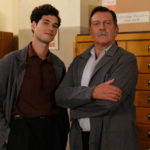
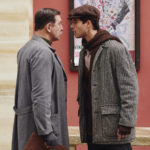
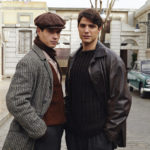
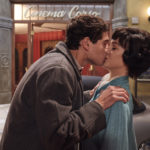
GIANCARLO COMMARE – “I dream of Tornatore and Sorrentino”

by Stefania Del Monte

Rising to prominence with the roles of Edoardo Incanti in the Netflix series Skam Italia and Rocco Amato in the daily Il Paradiso delle Signore (Ladies’ Paradise), Giancarlo Commare is on e of the most interesting promises of Italian cinema. Twenty-eight years old, Sicilian, his face framed by a mass of dark curls, he was able to conquer the public thanks to his simplicity and innate sympathy, as well as his great talent.

We asked him to tell us about his professional career: let’s try, through his words, to get to know him a little better.

Giancarlo, in 2002 you started studying modern and Latin American dance, graduating a few years later in Hip Hop dance. You then made your debut in 2008 as principal dancer in the play Pinocchio. How did the transition to acting come about?

In reality, it was not a transition. Between 10 and 11 years old I played my first role: King Herod. An event that revealed to me what my destiny should be: to become an actor. Since that evening a fire has lit up inside me that made me feel alive and that still burns with the same intensity. In my village, at the time, I didn’t have many chances to try the same feeling again, if not shortly thereafter with the discovery of dance. Then the following year, in high school, during the general auditions of Beauty and the Beast, the director pointed to me, saying: “try it”. It was for the role of Tockins (the clock). And the magic was back.

I would say my acting career started there. So, I repeat, I would not call it a transition, much less a return but rather an “advancement”. For me, the study of the body – which I discovered and dealt with since the first day of the Academy and which continues to this day – has been fundamental: in this, dance has proved invaluable.

Since 2016 you have started appearing in several advertisements. At the same time the roles in some short films and in different fiction arrived but you also continued your theatrical journey, participating in various shows. Therefore: dance, theatre, cinema, advertising, television… and you are also very good at singing. Is there a context in which you are more comfortable?

Maybe my answer will be obvious but the first love is never forgotten. The first thing I did recently, on the occasion of my return home, was to go and say hello to what I consider my artistic cradle: the Selinus, the municipal theatre of Castelvetrano. Every time I enter a theatre, for me it is like entering my home and it is beautiful, because shape and decor may be different but the warmth is always the same.

In the theatrical field, you have also tried your hand at directing with Io sono A.N.D.R.E.A., a show inspired by Pirandello and his concept of mask. What exactly is it about?

I’ll keep it short, otherwise I’d have to talk about it for hours (smiles, ed). It was an experiment that, initially, was called A.N.D.R.E.A. and then, in a second phase of recovery and development of this show, it was renamed Io sono A.N.D.R.E.A. (I am A.N.D.R.E.A.). The plot sees, in the centre, a man who enters his mind and meets all his masks. The show begins at the exact moment in which the individual enters a coma and while there, inside his head, he realises that he has not lived his life but the one created for him by the masks he has always had to wear. Overwhelmed by all the evil he has committed and which, at the same time, he has self-inflicted, he finds himself overwhelmed by his monsters and, unable to free himself from this “cage”, he is swallowed up and becomes a mask himself. To make you understand better: the story could be defined as a dark version of Inside out.

In 2018 you joined the series Skam Italia, in the role of Edoardo. How did you get the part?

To tell the truth, I did the audition in October 2017 and after a few days I found myself on the set, so the process did not happen gradually: on the contrary, I was practically thrown on the set. It was a very strong emotion: I was very happy, of course, but my legs were shaking, because within a few days I found myself having an enormous responsibility on my shoulders. Before that, I didn’t know the world of Skam. Not even the time to realise where I was, and already Bessegato, the director, was shouting “Action!”. Even today I thank him because, if I embarked on this wonderful journey, it is above all thanks to him, who wanted to bet on me for the role of Edoardo Incanti.

At 25 you found yourself playing the role of a teenager. Have you encountered any particular difficulties? In general, how did you live that experience? Already in 2015 I had played a teenager in Provaci Ancora prof 6 (Try it again Prof) and it was a truly unique experience: it was the first time I had been working on a set for a long time. On that occasion, I really began to understand the differences between a theatre stage and a TV or movie set. Niccolò Peretti (the character I played in the series) has a very fragile soul and the fear of not being accepted for what he is, first of all by his father and then by all the others. I approached the set in the same way that Niccolò, at that moment, was facing his life: scared, but with a great desire to go all the way and reach my goal.

Skam Italia is a remake of the Norwegian series of the same name, which ended in its fourth season. However, the story still seems to have a lot to tell. Do you think there will be a fifth season, and if so, would you like to be a part of it?

I think a fifth season is needed, so I hope so. And yes, I would definitely like to participate! I am a huge fan of what Skam represents in its entirety and I would like to not only see, but personally participate in more projects with the same strength and urgency conveyed by this beautiful series.

You are currently engaged in the role of Rocco Amato in Il Paradiso delle Signore (Ladies’ Paradise): a completely new character compared to those you have played so far. How did you dive into the part?

An equally magnificent journey, that of Rocco Amato: I prepared the character inspired by the movements and attitudes of my grandfather Benito, to whom I owe a lot and to whom I want a world of good. My grandfather is more evolved than Rocco but he is equally stubborn and – just like the character – a bit clumsy: and this is a side of him that I enjoy a lot. Moreover, he has an unconscious sweetness, which is the thing I appreciate most and that I absolutely wanted to transfer to Rocco. My grandfather hardly says “I love you”. In fact, I think I’ve never heard him say it, but he doesn’t need to say it: it proves it.

From a contemporary series like Skam Italia to a period one, in costume and with a completely different language and dynamics, like Il Paradiso delle Signore. Was it a difficult transition?

No, in fact I was immediately enthusiastic about it! I understood that I would have the possibility, as it happened later, to explore a totally different world and to transform myself completely; so, I jumped into it, and I can assure you that it’s a lot of fun!

What do you like most about Rocco and which aspects of his character do you love least?

Being an actor, I don’t like judging the characters I play, looking for their negative and positive sides. In general, I can say that I like that side of his character that I recently compared to my grandfather, that is, his unconscious sweetness, while I am certainly far from the character’s initial convictions towards women.

How would you like your character to develop in the future?

I cannot anticipate anything but I hope that he will soon find his way.
Edoardo and Rocco have made you very popular, even internationally. What changes has this success brought to your life and your relationship with the public?

Drastic! Now I find myself taking selfies more frequently with people I don’t know, rather than with those who are part of my life. Joking aside, I am immensely grateful to the public for all the affection they constantly show towards me, especially when this happens thanks to my work. This great professional appreciation gave me confirmations that I had been seeking for a long time. In this sense, success has greatly influenced my person and I am happy about it, because it is an important recognition for my work and repays all the passion and energy I dedicate to it. And then I like the idea that now, when I leave the house, I have more friends to say hello!

You speak excellent English and French. Would you like to act outside of Italy?

Unfortunately, I haven’t practiced languages ​​for some time and, in fact, I would soon like to find a way to get back on track. But yes, absolutely: working abroad would allow me to realise another dream.

You are passionate about swimming and fencing. Do you spend a lot of time in sports or do you prefer other hobbies?

Swimming and fencing are sports that I practiced more as a kid than now even if, when I can, I don’t hesitate to practise them. I played various sports but, as a child, I always approached them with phlegm. Today, however, training at least four times a week has become a routine and I feel all the benefits. At the beginning it is hard, as with all things, but sport helps to live better and each of us should practice at least one.

Is there a director or actor in particular you are inspired by, or would you like to work with?

Many have inspired me and many have made me think: “I would like to be as good as him/her”. Among all I could mention Marcello Mastroianni, Totò, Leonardo Di Caprio, Meryl Streep, Tom Hanks, and I could go on and on. I would love to be able to work with Pier Francesco Favino and Elio Germano: two actors that I always watch with great admiration, to the point of taking notes while I observe them. Speaking of directing, however, I’d love to work in a Tornatore or Sorrentino film. I hope that at least one of them is reading these lines: you never know!

On the cover: Giancarlo Commare
cover and images © Riccardo Riande
images from Il Paradiso delle Signore © Pierfrancesco Bruni, Mauro Sostini
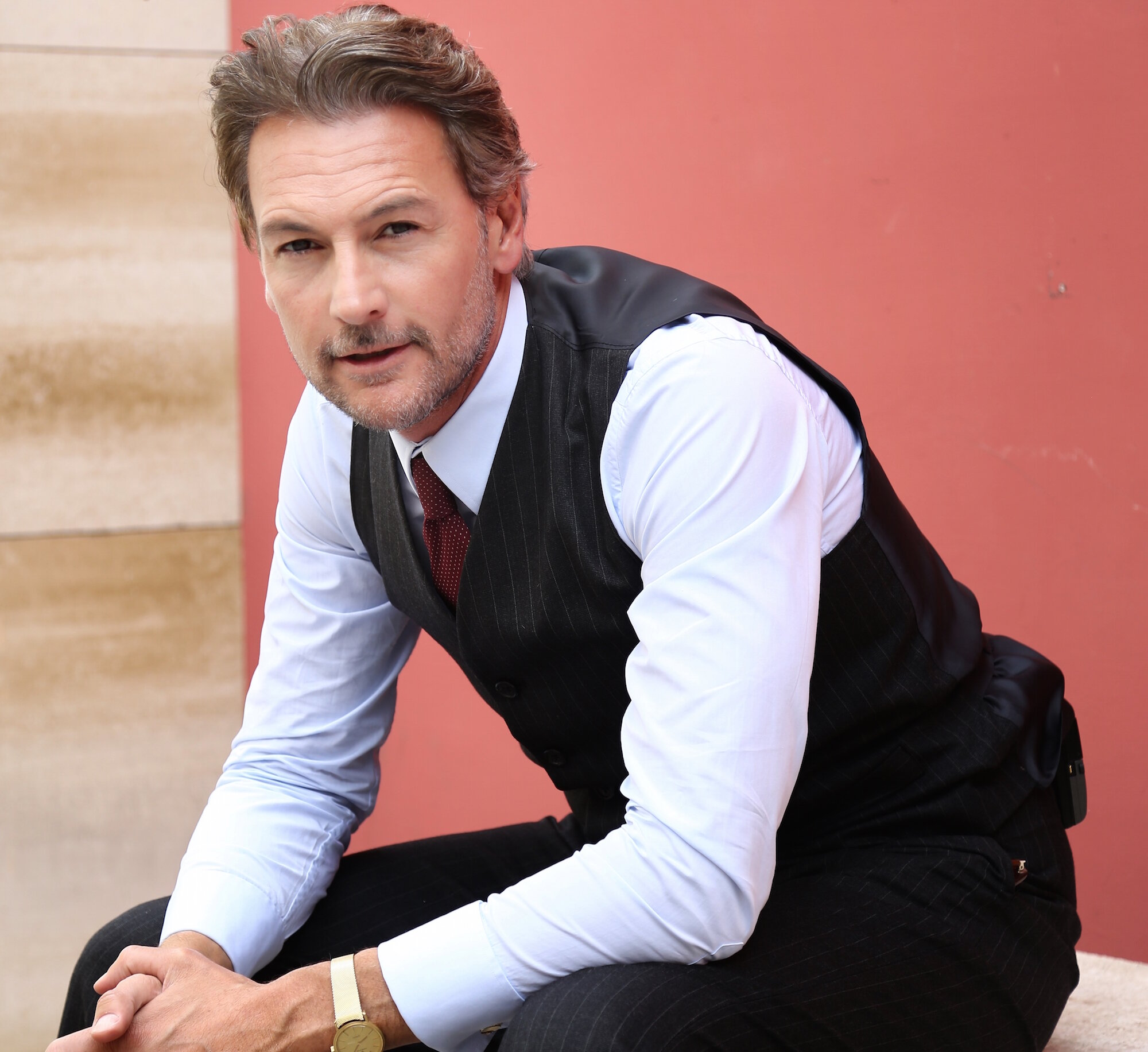


ROBERTO FARNESI – The actor with a passion for cuisine

(by Stefania Del Monte)

Actor and entrepreneur, Roberto Farnesi made his debut as a model and photo novel actor for the magazines Lancio and Grand Hotel. In 1998 he obtained the leading role, alongside Monica Guerritore, in Femmina, a film by Giuseppe Ferlito. Later he divided himself between cinema and television working, among others, with Franco Zeffirelli in A tea with Mussolini. He currently holds the role of Umberto Guarnieri in the Rai1 daily Il Paradiso delle Signore and for some years he has also been working as a restaurateur alongside his acting career.

It is he himself who tells us about this “double life”, which fills him with satisfaction.

Roberto, can you tell us a little about yourself?

Good question! Compared to a few years ago, today I am a much calmer, more serene person. Achieving serenity is a bit of everyone’s goal: perhaps reaching it 100% is a utopia but trying to get closer is a good ambition. Without taking into account the events that have upset the life of each of us in recent months, I can say that I am experiencing a rather peaceful phase of my life. I no longer lead a worldly life, or almost. I live between Pisa and Viareggio. I am lucky enough to have a wing of a farmhouse, in front of a park. I really like nature. I like to live a quiet life with my partner, with whom I have been for almost 6 years, including 5 of cohabitation. I have a business that employs several people and a partner with whom I feel very comfortable and with whom I have been sharing this wonderful experience for several years now. Social networks, in this, are highly effective because public relations, my presence, my image, are amplified exponentially. In short, I lead a much quieter life than a few years ago, but that’s normal, I think. I am 51 years old and, although I feel in great shape, my way of dealing with life has inevitably changed.

How did you get into acting? Was it always your dream or did you have other aspirations?

As a child I loved Sergio Leone‘s films, Spaghetti Westerns. My father used to take me to the cinema to see them, because he loved that genre. He passed it on to me and I relived it in the garden of my house: every now and then I even had some small accident! Other than that, becoming an actor was just a dream for me. Today, with social networks, it is much easier to get closer to this world but once everything was further away and Pisa, in this sense, was light years away from Rome. At first I fell into it almost by chance and then I deepened my preparation in a school in Florence, with Giuseppe Ferlito, who was also my mentor on the first set, shared with an extraordinary actress like Monica Guerritore. That was my first film for the cinema: a good stroke of luck, since I made my debut as a protagonist. A great “full immersion”: afterwards I attended school for another two years. After graduating, I enrolled at the University but without success. As a boy I took things more lightly but, after the death of my father, I decided to turn my acting career into a profession, I moved to Rome and slowly I succeeded.

You have always moved between cinema and television. Do you have a preference?

No, I honestly don’t distinguish between cinema and television. Of course, a film, being shorter, must be more accurate, have more details. In television series, ten scenes are shot a day while in the film two or three are shot, so in the film there is generally more care for the character, but it is not certain that the results are always better in one of the two parts. Even on the set there are no particular differences, apart from the timing. When there is more time to work, obviously the quality is better but it is not so obvious. For example, at Il Paradiso delle Signore we have an extraordinary production system that combines the two: it seemed impossible, but the producers managed to combine quality with extremely fast production. Clearly, playing a film character who is in my heart is always a great ambition but I will never deny having chosen the path of ‘long seriality’ which, in many cases, gives even greater popularity to that of cinema.

Among the great characters you have worked with so far, there is also Franco Zeffirelli. What did that experience leave you?

We had a friend in common with Zeffirelli, a very nice make-up artist: that’s how I met him. I had the honor of shooting under the direction of the Maestro in A Tea with Mussolini and I remember that while we were shooting with Cher – the extraordinary Oscar-winning actress – the scene where we danced together after she had sung Smoke in Your Eyes to me, throwing the smoke on my face, he tapped me on the shoulder saying “Be quiet!”. Franco Zeffirelli was a giant but also a very humble and nice person: I remember him like this.

What is the best moment you remember as an actor?

There are many beautiful moments that I remember from my career but certainly the best one concerns a summer night (at 2 or 3 am) in the middle of nature, while I was shooting a series of great quality and to which I am very attached: Questa è la mia terra, whose female protagonist was Kasia Smutniak, flanked by an amazing cast that included Catherine Spack, Remo Girone, Massimo Poggio, Glauco Onorato, Francesco Venditti, Miriam Catania, Francesco Pannofino and many others: in short, a truly extraordinary group of actors ! I have a beautiful memory of those nights in the Agro Pontino: the story told the reclamation of the Pontine area during the Fascist period and those nights were truly magical. The emotionally strongest sensations, however, I think I experienced on the set of Femmina: the scenes were very engaging and working with an actress of the caliber of Monica Guerritore was really fantastic!

Speaking of your current commitment to the fiction Il Paradiso delle Signore, what prompted you to work on this series?

I immediately understood that it would certainly be a flagship of Rai, as it later happened. A project that, despite being in costume, embraces the future: the first of a long series available on the Raiplay platform, with great feedback. A very ambitious project, with an exceptional care for images, photography, costumes, sets, writing, and with very good actors. It is a project that I immediately aspired to: I was lucky enough to get into it and for this I am also very grateful to the artistic director who wanted me, after having attended my audition. A project far exceeding my expectations, which were already very high.

How difficult is it to play a cynical and ruthless character like Umberto Guarnieri?

It is difficult but also rewarding. As an actor, it is always stimulating to play characters who are a little out of line, like Umberto Guarnieri. Difficulties, in my opinion, exist in any role. There is nothing easy or obvious and playing a “negative” character can be a lot of fun, even if Umberto is a very charming villain, who reminds me of certain extraordinary characters from the television series I saw as a child. The villains, however, also have to be there to give substance to the story, and viewers end up fond of them too.

The series has reached its fourth season and is gaining more and more success. Can you tell us something about the events of your character?

I can’t anticipate anything, also because the working method is deliberately “work in progress”, so I myself discover the evolution of my character day after day. However, I have the impression that in the next few episodes all the knots left open from the previous season will be dissolved and we will see some really good ones!

For several years you have also owned a restaurant: the Ristoro la Bottega del Parco in Pisa. How did the idea for this project come about? What type of customers do you target?

Yes, as a second job I am an entrepreneur: certainly, in this sense, there is a parallelism with Umberto Guarnieri. It’s been nearly eight years now. I am fortunate to have a very competent partner who knows how to manage even a small company like ours, with 18 employees and seven rooms above the restaurant. We have a large number of indoor and outdoor seats: in short, an activity that gives a lot to do, every day, but which also offers many personal and business gratifications. We went through the period of closure provided for by the anti-Covid decree in a critical, sad way, but we emerged well, confident: we took advantage of the closure to do some work in the kitchens that were necessary. The idea was born after having toured for a long time in restaurants because of my work: there, was born the desire to have one of my own, and experience that conviviality up close but also to use my popularity, my image, with those who initially come to visit us for that reason but then find an excellent quality/price ratio, a fascinating environment, service and competence: all fundamental components for the success of a company like ours. If there weren’t those, popularity alone would certainly not be enough.

What, in your opinion, must be the essential qualities of an actor and which of an entrepreneur/restaurateur?

An actor must have a good technical training or a good experience, which then becomes technical over time but I believe that there must also be something innate, which makes the difference. You may be lucky enough to embrace popular projects, which give great visibility, because moving forward, for an actor, also means acquiring ever greater popularity, which is necessary for the journey, but an actor cannot do without talent. The career of a restaurant entrepreneur, on the other hand, is made up of seriousness, rigor and a little “hair on the stomach”, as we say in Italy: you can’t be scared but you have to throw yourself into it; naturally always with awareness, rationality and careful to make the right choices but for that it takes a nose… So, I would say that the essential quality of an actor is talent, while that of an entrepreneur is flair.

Dreams to realize?

Finding a good balance and being able to become a father. That would really be a great dream to fulfil. Let’s see … hopefully this is the right time!

Cover: Roberto Farnesi
Images © Pierfrancesco Bruni/Mauro Sostini
Click here to read the interview in Italian


BARBARA PANETTA – Chloe’s Promise

(by Stefania Del Monte)

Barbara Panetta is the author of Chloe’s Promise, an alluring new children’s book and video initially raising funds in favour of the NHS and now supporting Momentum Children’s Charity.

Originally from Italy, Barbara is currently based in Richmond, Surrey, where she lives with her husband, two children and a golden retriever. This is not her first book: her language studies and interest in psychology drew her to write her first novel Ricordi in movimento (2015). She also curated several publications.

We are eager to find out how the idea of Chloe’s Promise was born:

It was all very sudden! – reveals Barbara – One day I was in my garden listening to one of my daughters practising the piano, when I noticed a column of ants struggling to collect a biscuit crumb that had fallen to the ground. This set my thoughts in motion and the idea for Chloe’s Promise germinated”.

Author Barbara Panetta

Once the story had been outlined, Barbara worked together with children’s psychologist Giovanna Campolo to ensure that the words used and the morals were appropriate for children of three years and above. The result is a charming, illustrative work that is sure to engage any child.

The story – she explains – is about a little ant named Chloe and her brothers and sisters. The main focus is the relationship between adults and young children, and especially the ways in which they both learn to trust and respect each other and the choices they make”.

The book is enriched by beautiful illustrations sketched by Barbara, who is not an illustrator but used her passion to produce some pretty drawings. She has used watercolour rather than digital processing, to keep it as simple as possible.

Later, graphic designer Aurelio Scalabroni intentionally added spots of colour in most of the pages, giving the impression of an unfinished work and sharing with readers the idea that nothing is perfect.

Through such illustrations and the use of simple language, children can therefore identify with the main characters, comparing themselves to hard working, determined and disciplined ants.

Chloe’s Promise aims to raise charity funds:

“Since the beginning – affirms Barbara – my intention was to support storytelling at home between parents and children during the COVID-19 crisis. I believe that at difficult times we can all contribute, in different ways. I also really wanted to help children in need, therefore all profits generated from the book are donated to a local registered charity called Momentum Children’s Charity, who is supporting children with cancer or life challenging conditions. I wish my book could bring a big smile to all those unfortunate children”.

This is both a print and a video book benefiting from the collaboration of Ben Shephard, presenter of ITV’s Good Morning Britain and Tipping Point, who proudly agreed to narrate the story, and musician Alessandro Viale, author of the soundtrack.

Viale talks enthusiastically of this special project:

It has been a lot of fun! – he says – This involved composing, selecting and performing. Because of the lockdown, I had to find creative ways to work without moving from home. This is why I ended up recording on a very ancient English Broadwood square piano made in 1815. I tended to play different pieces according to my mood and, when inspiration struck, compose something new. Therefore, I identified with the little ant Chloe and with all the feelings emerging from the story. She loves Chopin (and Tchaikovsky) but, sometimes, she just reacts to what happens by putting her hands on the piano and improvising”.

Barbara, whose daughters both play the piano and the cello since they were three years old, agrees with Viale in believing that it is very important for children to familiarise with music from an early age:

“I think music can help to express the vast amount of new emotions that a child undergoes while growing. I am very happy that little Chloe decided to spend her day relaxing and playing the piano: no surprise that the day after she was able to work even harder!”.

Featured image:
The illustrated cover of Chloe’s Promise


KATHERINE KELLY LANG – The Bold and the Beautiful and her love for Italy

(by Stefania Del Monte)

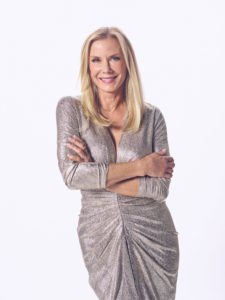
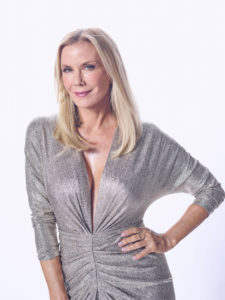
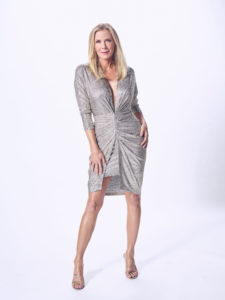
Emmy Award nominated Katherine Kelly Lang is known to the general public for her role as Brooke Logan Forrester in The Bold and the Beautiful, a character she has played since the show’s first airing, March 23, 1987. Katherine is the only actress of the initial cast, together with John McCook (Eric), to still work on the series.

The famous CBS soap opera – which has become the most popular ever in the United States since 2020 – tells the story of the Forrester family, owners of a fashion house in Los Angeles. First aired in Italy in 1990, the show celebrates its thirtieth anniversary in the boot on June 4th.

The B&B’s troupe seems to have a special bond with Italy, where the set has moved several times, and Italian fans have reciprocated this affection by showing constant loyalty over time. Even today, in fact, the series is followed in Italy by over 3 million spectators per episode.

Over the course of three decades, audiences have seen co-star Ridge Forrester marry 13 times, 5 of them with Brooke Logan, a woman who never ceases to surprise us.

In real life, Katherine Kelly Lang is an internationally renowned star and mother of three, grandmother, woman in love, sportswoman and promoter of various charity causes. Let’s find out a little more about the incredible woman who hides behind the historical TV personality, asking her directly to tell us how she manages to live such a dynamic life, continuing to work with enthusiasm without, however, giving up enjoying her affections.

Good morning, Katherine! We are here to celebrate thirty years of broadcasting in Italy but B&B, The Bold and the Beautiful, is actually airing today in 100 different countries, with over 36 million spectators per day. When you first started, were you expecting such a success?

We knew that creator Bill Bell was a master storyteller, and he had so many previous successes, so we had an idea that the series would probably be successful. But we couldn’t have imagined how successful it would become, and how many seasons it would last. Those first weeks of filming were magic. The sets, the costumes and the feeling of excitement around the set were all extraordinary. We knew something special was happening… and here we are, celebrating thirty years of broadcasting in Italy!

The soap was actually shot in Italy on several occasions. What were your first impressions of the country and the Italian fans?

The Bold and Beautiful location shoots in Lake Como, Venice, Portofino, and Puglia have been some of the best experiences of my life. The first few times I went to Italy after the show became successful, it was such a surprise to experience the exuberance and warmth of the Italian people. They expressed their love and affection so openly and freely, shouting across a courtyard and running toward us to give us a big bear hug. It was something I’d never experienced before. The people are just wonderful. Every Italian is a chef and also an artist, always creating something magnificent, from dramatic architecture to grand gestures. Italians are bigger than life, and it’s wonderful. I would love for the series to shoot in Italy again, and I’m sure we will again, once things settle down a bit.  Maybe sooner than we think.

Have you visited Italy again, for holidays?

Italy holds a special place in my heart. I love it there: the people, the food, the history, architecture, the art—everything. My family and I visit Italy as often as we can, both for work and for pleasure. I love Milan, Rome, the Alps, the Amalfi Coast, Sardinia, I could go on and on. We’ve met so many wonderful Italian artists and business partners. Some have become close friends. I suppose it’s starting to feel like Italy is a second home for us.

We all know Brooke Logan Forrester but who is Katherine Kerry Lang in real life? What are your interests and your passions?

Surprisingly, there are ways I am like Brooke: we both love our children. We are businesswomen who are ambitious and driven. We are very passionate and competitive, and we have a determination to be happy. We are sensitive and feel our emotions very deeply. We are celebrities. We live in Southern California and work in a creative industry. But we’re different in many ways. I have always put my family’s and my children’s needs first and, for the most part, I feel I’ve made the right choices for them. There’s a lot less drama in my life, thank goodness. I also dress differently from Brooke. She’s more buttoned up business casual and I’m more boho chic: no make up, jeans and a tee shirt. And I’m into sports. Before, it was long distance horse-racing and now it’s triathlons. The main difference is that I’m a real person and she’s a fictional character I play. I have my priorities straight. I know what really matters in life, and I know how to create balance. I’m not sure about Brooke. I like that social media have made who I am more available to the people who watch me play Brooke on The Bold and the Beautiful.

What do you think of Brooke? What are her strengths and her weaknesses?

Brooke follows her heart and she can’t fake it. She’s authentic. She’s a woman who’s not afraid of being completely empowered that way. When she’s in love with a man, she goes for it. She doesn’t wait for him to pursue her. She’s ambitious and follows her professional dreams and achieves them too. She is unapologetic about her choices. At the bottom of her heart, she’s a good person, and she loves her children passionately. Sometimes she makes the wrong choices, but it’s not because she’s self-destructive or self-defeating. It’s because she’s human. One of the most surprising things about Brooke is how she can find redemption even after making grave mistakes. I think that’s a positive message for everyone. We are all human and we all make mistakes, but we can always find forgiveness and make a new beginning.

What keeps your enthusiasm alive in playing Brooke, even after so many years?

Brooke is a wonderful character. It has been an incredible privilege to be able to go to work every day and play her for so many years. She is never boring. When I get my scripts, I’m always surprised by the challenges she is facing today. Every story is different, even though they sometimes may at first seem similar.  She’s so familiar and part of me that I can’t imagine life without her. This role has given me so much and, coming to work every day and fulfilling my passion to be an actor, is priceless.

Who is your favorite character in B&B?

Brooke, of course. She doesn’t get cynical about love. Her heart is always open to it. She’s always ready for a new adventure.

And your favorite actor?

They are all my favourites and I have chemistry working with each of them in a different way. Susan Flannery (Stephanie) was so disciplined and powerful as an actress and she always challenged me to be at the top of my game; John McCook (Eric) is so funny, even when he tells the same corny joke for 30 years; Thorsten Kaye (Ridge) is a manly man who is a sensitive poet at heart; and Annika Noelle, who plays my daughter, Hope, is such an amazing actress. Our entire cast is inspiring, but these are the people I have had most of my scenes with, so they are the people I’m closer to.

In addition to portraying Brooke in The Bold and The Beautiful you have done many other things. For example, you recently starred as Elizabeth Morgan in the romantic comedy Stan the Man. Is working in a movie very different from working in a soap opera? 

The pace of filming might be different. There might be only one camera in a film, while in the soap we use three at the same time. Things like that but, apart from the technical differences, the work of an actor is the same. What’s fun for me is to play new kinds of characters. It’s great that the shooting schedule of B&B has a lot of time off we can use to do outside projects. Brad Bell allows me to take time away from the show for that, too.

You have been constantly at work for over 33 years. Has it been difficult to be a professional actress, a woman and a mother of three at the same time?

It hasn’t always been easy. I was pregnant three times during the filming of The Bold and the Beautiful. Brad Bell and the production were always great about either hiding my pregnancy (wardrobe, props and camera tricks), or writing it in, and giving me time off to give birth and take care of my new-born baby. The show is so family friendly that I’ve been able to bring my children, when they were babies and toddlers, to the set. Sometimes they even played Brooke’s fictional children on the show. That was great, because I could be close to them while I was working. Then when they were older, I tried to be there as much as I could. I would do anything for my children, and while my daughter Zoe was pursuing tennis, I passed on a lot of extra traveling for work so I could travel with her to her tournaments. The production has been pretty flexible overall, so that’s one of the reasons why I’ve stayed for 30 years. I could be a mother and an actress.

You are very much involved in charity work. Can you tell us a bit about it?

I hope to be able to do more for others this coming year through the charities I’ve made a commitment to support, Women for Tri and Breakaway from CancerWomen for Tri is an organisation that encourages women to participate in and train for triathlons. Before, mostly men competed in triathlons, but now participation by women is growing. I am so honoured to have been a part of Women for Tri from the inception. I love supporting women and do that whenever I can. There has been a huge jump in numbers since we started this. A lot of women are now becoming involved in triathlons all over the world and signing up for races. Breakaway from Cancer is a national initiative to increase awareness of important resources available to people affected by cancer – from prevention through survivorship. I’m a national spokesperson. My father died when I was 13 years old from colon cancer, and both of his parents also passed away from colon cancer as well, so I always knew I wanted to get involved and help with cancer awareness, prevention, and treatment.

Do you have any unfulfilled dreams? Something that you still haven’t done?

I will always push myself to continue to discover new limits and try new things. I just became a grandmother for the second time. I would love to run a marathon one day. We just opened a clothing store in Beverly Hills, Benheart USA, where we sell handmade Italian leather goods. I hope to keep launching new jewellery and triathlon gear lines, and I also hope to do more for others this year through my charities. I hope to be acting in new films, and maybe even producing.  And I never want to stop working full time as Brooke on The Bold and the Beautiful. I’m looking forward to some great storylines for her in the second half of 2020. Life always has some new experience waiting around the corner, and I’m up for it.

Cover: Katherine Kelly Lang
images courtesy of the interviewee

Read here the article in Italian


CARMEN PIERRI – “Music makes me feel free”

(by Stefania Del Monte)

Seventeen years old originally from Campania, Carmen Pierri was the winner of the sixth Italian edition of The Voice of Italy. Let’s hear, directly from her, the dreams and projects of this talented artist who, despite her young age, proves to have already very clear ideas.

Carmen, tell us a little bit about you.

I am a simple girl, who lives through the chills of music: it is the only thing that makes me feel free, excites me and amuses me at the same time. Nobody in my family has ever been a musician, so in all honesty I don’t know where my natural disposition came from. Indeed, perhaps it was born even before me, since my mother made me listen to Beethoven and Mozart from her belly when she was pregnant. At the age of five I was taking piano lessons and then I started studying singing. I come from Montoro, a town in the province of Avellino, and in addition to music I have a thousand other passions: I like reading, writing, but I feel a particular love for science: in fact I attend scientific high school. One day I wish I could become a doctor.

Yours is a very particular voice. When did you understand you have musical talent?

Going back to music, well, I never understood it. I never said: “from today I start making music”, but I have always heard it and year after year I realised that I had something different from my other companions: something that for me is special. There has never been a choice, neither on my part, nor on the part of my parents, but everything has evolved spontaneously.

Where did you study and what is your favourite genre?

I have been taking singing lessons for several years and studying piano; in addition, I attended various academies where I perfected myself, with the help of record producers and vocal coach. I feel very comfortable in the Soul world but I have always tried to do something different than usual, in fact I like to experiment with various genres. In my music I space from Pop to R&B but I also listen to American Rap, even if it wouldn’t be said.

How did you come to participate in The Voice and how did you experience your triumph? By the way, you have not even been able to collect the prize in person, since the program ended after midnight…

It’s true! I watched my proclamation from the hotel TV, so I felt more like a viewer than a competitor on the show. Actually I never imagined being able to participate in a talent, but at some point in my life I felt the need to get involved and make my music known to a few more people than in the small environment in which I lived. As a child I always watched The Voice, in fact I knew the winners of all the editions and if someone, then, had told me that one day I would go up on that stage, and even win, I probably would not have believed it. Obviously I would like to thank all the people who believed in me right away, and perhaps even before The Voice, because without them I would never have experienced all of this. This is the proof that dreams come true, if you believe it.

What did you like most about that experience?

The part that the audience does not see at home, the backstage, remains in my heart. I met many professionals, many artists, my teammates with whom I had the opportunity to confront and grow, I sang with Arisa, I learned to be on stage and in front of thousands of viewers. To be honest, I miss the jokes we organized to Gigi D’Alessio so much!

What did you do after?

I was immediately overwhelmed with work: already the day after the victory I found myself catapulted to the Arena di Verona at the Seat Music Awards. There I met many artists including Mahmood, Alessandra Amoroso, Emis Killa and many others. Then I participated as a guest at the Universiade at the San Paolo Stadium in Naples and at the Castrocaro Festival, where I had the honour of singing with Gigi D’Alessio and Maurizio Vandelli. Immediately after the summer I started working on my first album, which we had to stop publishing due to the Covid emergency.

What is your relationship with the public? Do you like performing live?

Before treating people who follow me like fans, I like to think of them as my friends who spend time supporting me and listening to my music. I am very grateful to them. Of course, I love to perform live to highlight my personality, but since I am a very shy girl, sometimes I feel awkward: it is an aspect of my character that unfortunately I will have to accept!

In your career, is there an artist you are inspired by?

Not one, but a myriad! I listen to everything but my greatest idols are Alicia Keys, Stevie Wonder, Corinne Bailey Rae and Michael Jackson, to whom I entrust myself in all respects, even in the way of dressing a bit in the 90s style. It is useless to mention my musical goddess, my absolute idol: Amy Winehouse, who is for me a source of inspiration, a religion, a guardian angel. Despite this, however, I realize that she and I could never have been friends, because we are very different.

Different in what sense?

Well, if she was here today, and I had known her, I am sure we would not have made friends because our personalities are very different. She tended to make her ego prevail, she was full of herself and so outgoing with people and, in this aspect, she would be my opposite: I spend much more time before getting to know a person and being able to joke. Maybe we are similar in terms of style and extravagance, but the character is another story. Many ask me “why do you like her, if you are so different?”, and I can never answer this question. Maybe because I feel attached to her in some way; I admire her because we probably look alike in a way that I will never understand. I believe it is precisely this aura of mystery that draws me towards her. After all, what would be the taste in admiring someone like us? Instead, I learn from her every day.

What is your biggest dream?

Is that to duet with Alicia Keys too big? Okay, maybe yes! I would also love to duet with Elisa, or even collaborate with her on some musical project. Ah, and then one day sitting on The Voice’s chair as a coach would not be bad!

What are you working on now?

Now I’m working on the production of my first album, whose publication shouldn’t be too far away. For my part, I’m experimenting with new things, new musical genres, new styles that I can’t wait to add to future musical projects.

What are your plans for the future? Are you going to continue your studies?

Of course, I will continue both musical and scientific studies. I would like to make my dreams come true and not only to keep them as such, but with my feet on the ground and working hard, as I have always done. I would like to go to university to study medicine and obviously continue playing and singing.

Do you think you can reconcile your musical career with academic commitments?

Yes of course, at least I’ll try! I study music from an early age, so let’s say that I soon learned to reconcile the two. I hope to continue as long as I can!

On the cover: Carmen Pierri
Audiovisual material courtesy of the artist

Click here for the Italian version

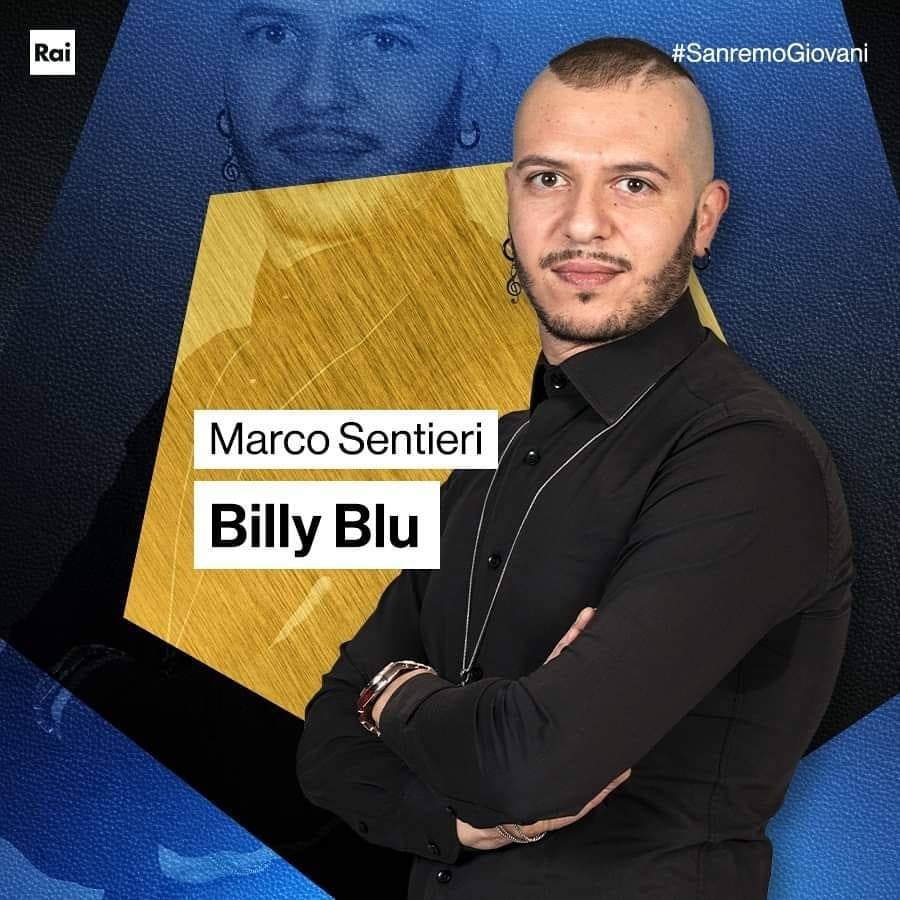
MARCO SENTIERI – Billy Blu, from Sanremo to school desks

(by Stefania Del Monte)

Among the undisputed protagonists of the last Sanremo festival, with the song Billy Blu, there is Marco Sentieri. Married with two children, his real name is Pasquale Mennillo. The choice of the stage name is due to a combination of factors:

“This pseudonym – reveals Marco – was born around the year 2000, when I decided to pursue a solo career. My name seemed too common and therefore from the union of Marco, a name that I had always liked since I was a child, and Sentieri, inspired by the soap opera of the 90s that I watched together with my mother, ‘Marco Sentieri’ was born”.

Born in Casal di Principe, in the province of Caserta, on 11 June 1985, Marco joined the music scene at a very young age: at only 16 he left his native land and moved to Rome. His career officially begins precisely in this period, with the establishment of the Quarto Senso group and the subsequent participation in Sanremo Rock Giovani:

“Let’s say – he confirms – that with Quarto Senso we started doing more national and important things, compared to the previous 3 or 4 years, in which I was already making music anyway. Quarto Senso was the first band I formed and with which, in fact, we reached the finals of Sanremo Rock in 2002”.

After a great wealth of experience accumulated in the music field, in 2016 the participation in Romania, in the bootcamp of X-Factor, arrives. Here Marco’s career undergoes a surge:

“In Romania I received a lot of affection! – he declares, enthusiastically – There, they love Italians very much and I am still being followed assiduously, through my social pages. On a personal level, working in that context did not represent major differences compared to Italy, mainly because the X-Factor format is the same throughout Europe, but the warmth of people has been truly unforgettable”.

Upon returning to Italy, Sentieri starts a series of collaborations with artists of the same genre and opens concerts for names like Rocco Hunt, Clementino and the Gemelli Diversi group. Someone called his music a mixture of rap and trap, a genre that definitely meets the tastes of the new generations. Marco, however, is keen to specify:

“I think my music is more of a pop-rap. I don’t think I’m getting closer to the trap world. Among the various definitions, I was particularly struck by the one in which I was considered ‘the glue between the old and the new generation’, capable of arousing emotions in both age groups: I really like this way of being seen by the public”.

At the last Sanremo festival, Marco Sentieri competed in the New Proposals category against names such as Eugenio in Via Di Gioia, Fadi, Fasma, Gabriella Martinelli and Lula, Leo Gassmann (later winner), Matteo Faustini and Tecla Insolia. His song Billy Blu bears the signature of a great author, Giampiero Artegiani, who passed away in 2019, and addresses the topic of bullying. We are curious to understand Marco’s link with Artegiani:

“Unfortunately – he reveals – I have never known him personally. One of his best friends, Maestro Adelmo Musso, asked me to listen to the song and I immediately felt a strong emotion. I still didn’t know who the author was, but I decided at once to try my hand at the project, making Billy Blu become ‘a song of mine’, sewing it on me, and I think this thing was noticed. The song – he continues – was welcomed into the world of music as I never expected. First among young people on Spotify, in the week after the festival; then, with thousands of reviews on social media. I was defined by the press as the moral winner of the festival. In short, I would say that better than that it could not go!”.

Among other things, the song emphasizes that the phenomenon of bullying is the mirror of an increasingly life frantic, which diverts the attention of parents away from their children.

“I think one of the major causes is precisely this” – reiterates Marco.

And exactly with the aim of bringing young people closer to this theme, immediately after the Sanremo festival Billy Blu became a traveling project for Italian schools, unfortunately temporarily blocked due to the Coronavirus emergency.

“We had already started planning the tour for primary and secondary schools – confirms Sentieri – bringing Billy Blu on school desks to try and sensitize the kids. Now schools are closed, but as soon as possible we will continue what we started. We need to talk a little bit more about this phenomenon, because it can be a really ruthless form of violence.

In the meantime, not even isolation stops Marco Sentieri:

“I’m working on my new album – he reveals – and I hope it can be released later this year!”.

Images courtesy of Marco Sentieri

CLAUDIO GUERRINI – Once upon a (first) time

by Stefania Del Monte

RDS radio presenter, correspondent for La Prova del Cuoco on Rai1, presenter and commentator on TV programs,  collaborator of the weekly magazine Vero, animator and deejay of musical and cultural events and, recently, also author with the book C’era una prima volta (Once upon a first time): Claudio Guerrini, one of the most well-known and appreciated voices on the Italian national radio scene, is a polyhedric and versatile figure. We met him to talk about his professional career, mirror of a multifaceted and unstoppable personality.

Claudio, you made your professional radio debut, quickly joining national radio networks. Is that what you always wanted to do or did you have other dreams as a child?

I had many, maybe too many dreams. In a few years I cherished the dream of being a tennis player, commentator, journalist, deejay, radio and television presenter. I was a little confused, I admit it. I tried to do everything, some things I did well, some others I didn’t. But it could have been worse…

Your program within the RDS program is very popular. Can you tell us more about it?

It’s a program born when I started conducting early afternoon, first alone, then with Rosaria Renna. Over time, the first imitations, the first squabbles, the first columns were born almost by chance. We immediately had an excellent response from the public and so, when Rosaria abandoned me to go to RMC, I asked the management to continue the journey with Roberta Lanfranchi: she and the company accepted and for three years we have been on the air with the Guerrini & Lanfranchi Show.

This year marks your twenty years of collaboration with RDS. What has changed in the way of doing radio, from 2000 to today?

Really??? So many! I didn’t know, thanks for the news! The main difference is the increasing interaction with the web and now with social networks. Once when I played music I rested, now I take pictures, stories, manage Facebook or Instagram both for the radio profiles and for my personal. Practically a double job!

In 2006 you made your television debut. What attracted you to the small screen?

The ability to express myself in different ways. The radio is always fascinating but more repetitive, it is based precisely on the familiarity and affection of listeners. On TV you can happen to do completely different things, sometimes opposite. I acted in the candid camera, I was a columnist, a judge, I recited poems, I conducted a program on cinema, a sportsman, I worked for La prova del cuoco and Buono a sapersi on Rai1. .. I like to express myself in different ways, I believe that versatility is one of my (few?) strengths.

Besides doing radio and television, you also do a lot of other things. Can you tell us about them?

Well, to be able to speak directly with many people, first of all you need to get informed, so I read everything, I get daily information from the websites of the main Italian and international newspapers. Then books, films (especially from the 60s and 70s), sports and, of course, I keep my social profiles updated.

Your first book was recently released, entitled C’era una (prima) volta/Once upon a (first) time. What is it about?

It is an almost educational book. Thanks to the direct testimonies of the protagonists, I have told the professional beginnings of many successful characters, from Enrico Mentana to Giuliano Malagò, Noemi, Sandra Milo, Paolo Genovese, Michele Guardì, Dario Ballantini, Paolo Rossi and many others. Funny, moving stories came out, all very interesting.

How was the idea born?

From the questions of many listeners and followers, who often ask me how you can start making radio or TV. Instead of responding individually to each of them, I came up with the idea of ​​writing a book, telling not only my story, but also that of many personalities who have been successful in their respective professional fields.

Of all the characters interviewed in your career, is there anyone who has impressed you more than others?

The story of my friend Francesca Stella, the least known but the strongest of all! Her battle against a terrible disease, first discovered a year ago, is a wonderful example for all of us.

Can you share with us some curious anecdote?

One of many is that of Paolo Genovese, who won his first short film competition thanks to a sensational mistake by a technician. So he went from the deepest discomfort to the first big success of his life. From which his great career started. So never give up!

Are there any new projects on the horizon?

Many, but this mandatory quarantine must first pass. I am taking advantage of it to write, plan, imagine. Meanwhile, I conduct the radio program from home and every night at 9 pm I interview many characters live on my Instagram profile. A big good luck to all of us to start again as soon as possible.

(Images courtesy of the interviewee)

Click here for the interview in Italian


GIANLUCA MECH – The guru of personal wellness

(by Stefania Del Monte)

Gianluca Mech is the only heir to an ancient tradition that has seen his family at the centre of the arts and secrets of herbal medicine in Italy for centuries. In 1987, as soon as he was of age, he took over the reins of the company: thanks to the teachings of his father Giovanni and his grandmother Adelaide, and thanks to the experience gained in the field of food and herbal medicine, he managed to give new strength and impetus to the company, even beyond national borders.

We met him to find out more about his story.

Gianluca, what is Phytotherapy?

The term “Phytotherapy” derives from the Greek “Phytòn”, which means “plant”, but at the same time also “creature”. This twofold meaning encompasses the essence of phytotherapy: plant and man. In a general sense, it is the practice that involves the use of plants or plant extracts for the care and maintenance of mental and physical wellbeing.

Your company has been operating since 1911 and you have been part of it for over thirty years. What exactly do you do?

It is a herbal company, whose strength is precisely that of using the properties of plants in our proposed weight loss programs. In particular, we are producers and distributors of products obtained from Decottopia, or the therapy of the “ten plants”. It is an ancient process of officinal herbs processing, handed down over the centuries from father to son, up to me, the current custodian of the industrial secrets that are the heart of the company activities: extracts that base their uniqueness and exclusivity thanks to their absence of alcohol, sugars, preservatives and gluten. From the experience gained in the Decottopia, specific dietary foods were then developed which constitute the innovative “Global Tisanoreica diet program”, developed and tested in collaboration with the Mech Lab of the University of Padua.

Can you tell us more about both Decottopia and Tisanoreica?

Of course! My family has a 500-year-long tradition of observing, experimenting and using the properties of plants. Our green ketosis has allowed us to enhance, through the detoxifying properties of plants, the slimming effects of the diet proposed by us, reducing side effects to zero. From the decottopia, according to the method already explained above, decottopyrics are obtained: food supplements proposed to improve the nutritional status, optimizing the general well-being condition and promoting, at the same time, the normal physiological functions of the body. These can be combined with the diet but also taken outside of a real diet program. You can also drink pure or diluted with water.

The products of Decottopia are fundamental throughout the whole journey of the Tisanoreica diet protocol. Our body, in fact, in addition to needing to lose weight, needs to cleanse itself every day to keep fit and above all to give us that feeling of wellbeing that we seek so much. Associating Decottopia with the Tisanoreica diet phases means choosing extraordinarily pure and totally natural products not only in the formulation, but also in the processing and conservation processes.

The absence of preservatives, alcohol, sugars and gluten also makes Decottopia ideal for different categories of people such as diabetics, children over 5 years, celiacs, the elderly and vegans.

We recently saw you on television with Ricette all’italiana (Rete4) and L’ingrediente perfetto (LA7). What did you draw from those experiences?

These are experiences that have allowed me to get to know and collaborate with great personalities from the world of entertainment such as Davide Mengacci, Anna Moroni and Roberta Capua, who have also proved to be generous and helpful people. Thanks to these two programs, moreover, I had the pleasure of sharing the set with producer Elio Bonsignore, a professional who always favours quality. On the basis of all this, it is easy to guess that both broadcasts have helped to consolidate my television path too.

Would you like to repeat them?

Obviously yes, since both experiences are part of my present. For example, with the perfect ingredient, together with the excellent Roberta Capua, I will return to La7 at the end of March. Recently, with Roberta, we also shared a beautiful event at Casa Sanremo, during the Sanremo Festival, focused on the importance of plants for the voice, which was also attended by conductor Claudio Guerrini and specialist in Otolaryngology and Audiology Marco De Vincentiis, and it was a great success. Now, however, I can’t wait to embrace her again on the set to enter, once again, into the homes of many viewers who continue to follow us with affection and interest.

Your company profile describes you as the ‘personal wellner of the stars’. We could therefore define you as a kind of wellness guru. What exactly is the role of a “personal wellner“?

My mission has always been to help others stay healthy, directing them towards a healthier lifestyle, which allows them to achieve a good quality of life. This healthy lifestyle is even more sought after among celebrities and the show business. The variety of our natural and scientifically tested products, combined with personalized suggestions, allows people to better face and manage the difficulties and stress during the change process, aimed at achieving psychophysical wellbeing.

Being a specialized nutritionist, what do you recommend to people who want to get in shape in time for the summer?

It’s simple: take care of yourself through good purification, take care of the quantity and quality of the food that you introduce into your body and, if necessary, follow a dietary path by being directed by specialized personnel. For example, our experts can help to achieve the established results, not only quickly but also in perfect health.

In the cover: Gianluca Mech
images courtesy of the interviewee


FERNANDO VAL GARIJO – A talk on Brexit

(by Stefania Del Monte)

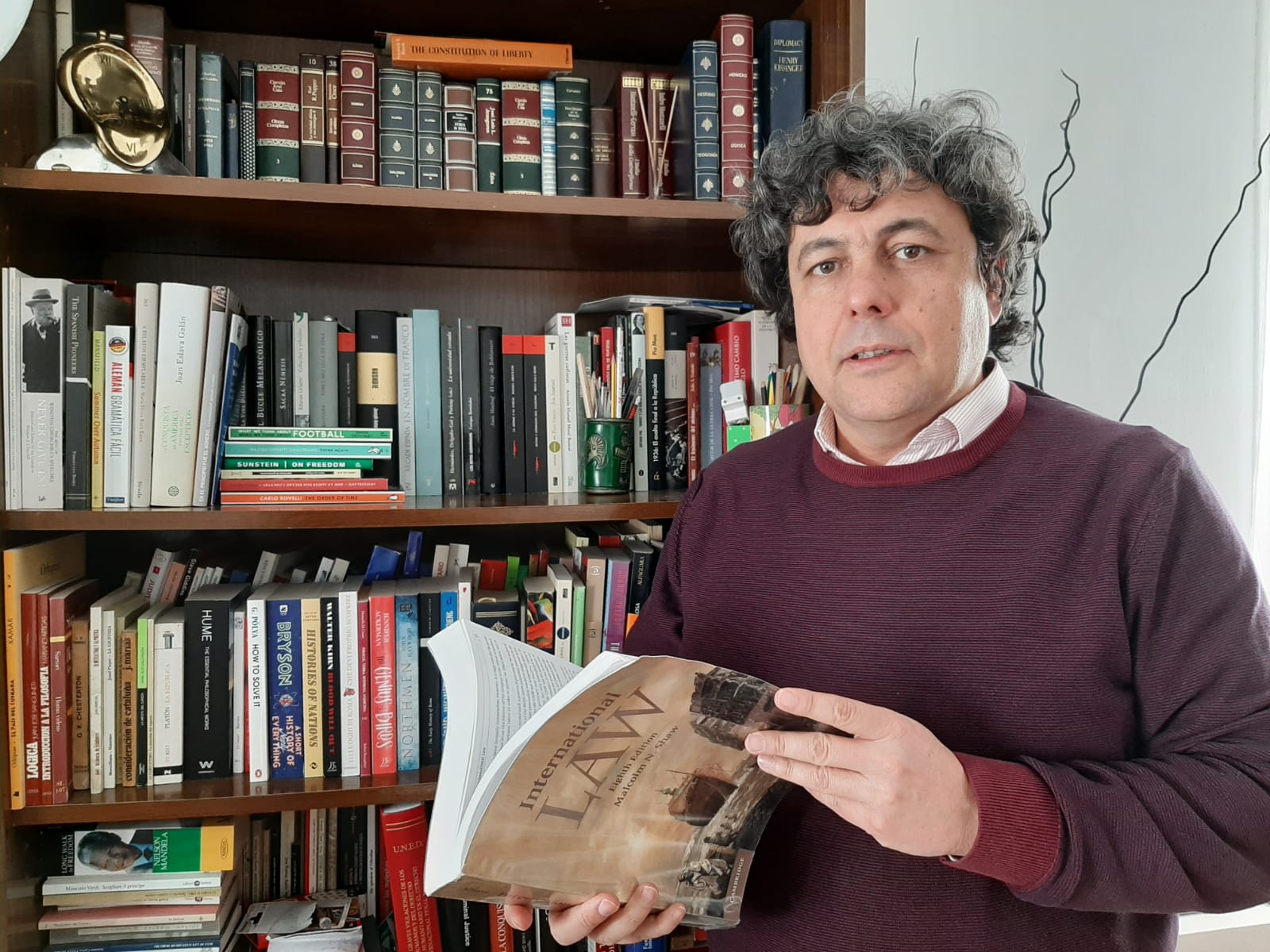
Fernando Val Garijo is Associate Professor at the Public International Law Department of UNED (Faculty of Law). He received a PhD in Law from UNED, and a Master’s degree in EU Studies from Universidad Politécnica de Madrid. He has taught courses on International Law and EU Law at UNED, the Spanish Diplomatic School, FRONTEX and CEPOL, as well as International Law seminars at La Sapienza and East London University. His research has focused on International Criminal Law, International Humanitarian Law, Human Rights and International Organizations, with special regard to European Union issues. He has served as external legal counsel for the Spanish Ministry of Foreign Affairs and Cooperation (2008-2011), and as legal assistant of one of the Special Rapporteurs of the International Law Commission of the United Nations in Geneva (2015, 2016, 2017 and 2019). He is also author of The Impact of Brexit on the Spanish and European Health Care Systems (2017, in Spanish).

We have met him to talk about Brexit.

Professor Val, as an expert of International Law and especially of EU issues, what is your personal opinion on Brexit and what is the most realistic scenario we can expect, five years from now?

Five years is a long time in politics and international relations. Many scenarios are possible in this time frame, and I tend to avoid either worst-case or best-case scenarios. I would say that it is reasonable to expect that the EU and the UK will have agreed on a stable relation focused on trade and, hopefully, on some security issues. However, neither the EU nor the UK will be better off after this agreement. Membership was better than any future agreement, especially for the UK, but also for the EU. In this regard, I see Brexit as a lose-lose situation.

This is why, in my opinion, Brexit is a bad idea, whose supposed benefits have never been credibly explained. The UK, of all member states, had no need to leave the EU. It was one of the big, influential member states. It benefited greatly in areas such as services trade or the funding of scientific research. It had used the opportunities given by the flexibility of EU integration: opt-out regimes in areas such as the euro and social policy. In a way, when it was a member state, the UK could “have its cake and eat it” in certain respects. It will no longer be the case; it will be either no cake or no eating, contrary to what some brexiteers still say. One of the absurdities of Brexit is that it wasn’t necessary at all, even from a Eurosceptic perspective, Of course, it was from a Europhobic perspective, but then phobias are very powerful forms of irrationality. Brexit seems to me like a self-inflicted blow.

However, although the impact on the EU-27 will be less, I also think that in the long run the EU will be worse off without the UK. In spite of being reluctant EU members, the British made valuable contributions to European integration, providing an alternative to Franco-German views and advocating a flexibility in the EU integration process that is one of its strengths. Brexit is everyone´s loss, even if the loss will be greater for one side. It still fills me with sadness.

While Wales has voted in favour of Brexit, Scotland, Northern Ireland, and even London have never hidden their disagreement on the subject. Should they decide to pursue a different path, would they really have any space for manoeuvre?

This is more a question for a British constitutionalist lawyer, or for British political commentators. But it seems to be the case that Brexit weakens the unity of the United Kingdom, and that EU membership was a source of internal stability. EU membership has that effect in other member states, Spain being a case in point. If a second referendum of independence took place in Scotland now, independence from the UK would probably win, and Scotland could become a new EU Member State. But that referendum is very unlikely to be held in the near future. The new British government has some time to try and win over sufficient Scottish voters for the UK not to lose Scotland. At the same time, the prospect of a united Ireland has never been as credible as now, as the issues relating to the border between Northern Ireland and the Republic of Ireland are showing. British political leaders do not really know how to solve the Irish conundrum, at least not yet. Having said this, a break-up of the United Kingdom is not to be expected soon. One should not underestimate the strength of a union like the United Kingdom. The political bond between the four nations cannot be broken as easily as some think, although Brexit will, in my modest opinion, weaken that bond. Seeds of dismemberment have been planted during the Brexit process but that kind of fruit is far from ripe today.

Officially, there are over 1.2 million British nationals currently living in the EU, including over 300,000 in Spain (actual figures might be well over 2 million). How do you think Brexit affects them?

At the moment, there is a transition period set out in the Withdrawal Agreement, which lasts until 31 December 2020. Until that date, most things will remain the same as they were before 31 January 2020 (official Brexit date). A positive development is that the Withdrawal Agreement guarantees UK citizens who have registered as residents in a EU member state broadly the same rights as they enjoy now in terms of living, working and travelling. These rights will cease after a leave of absence of more than five years. Even during the transition period UK citizens can move to the EU and consolidate these rights. For example, UK citizens living in Spain or moving here permanently before 31 December 2020, will have life-long healthcare rights in Spain, provided they continue to be residents. Of course, with UK citizens who are not residents before that date the situation will be different.

Do you expect any other of the EU countries to follow the example of the UK, any time soon?

I do not, mainly because the benefits of leaving are still not obvious to anyone. The British case is an example of how difficult it is to withdraw, especially after more than forty years of membership and integration. EU leaders are determined that the EU-UK agreement on their future relationship does not leave the UK in a better position than when it was a member. In this regard, EU member states have so far shown a remarkable unity and resolve. At best, some member states may be adopting an attitude of “wait and see” regarding Brexit. The EU is imperfect, at times, irritatingly so, but for Member States it still solves more problems than it creates. The same cannot be said of Brexit, an option that still has to prove its alleged blessings.

Do you believe there is still a future for the European Union?

I am strongly pro-EU integration. I believe the EU enhances the possibilities of Member States and of the citizens of Member States in areas like trade, protection of the environment, defence and security, influence in foreign policy. It also consolidates common standards in areas like fundamental rights (including employees’ rights), consumer protection, food safety, health regulations, and several other topics.

EU citizens would benefit from more education on EU issues and the EU system. When I teach EU law and EU integration I perceive the average level of knowledge on the EU is very low and surprisingly inaccurate among undergraduates. It is at times even worse with the media. EU leaders, EU institutions, schools, academics and the media have a responsibility in bringing the real EU closer to EU citizens, so that they can decide whether they want it or not. I think this is, in times of populism and fake news, a crucial challenge. But it is a beautiful challenge too, one that can shed a positive light on the European realities of today.

In the cover: Prof. Fernando Val Garijo
image courtesy of Elisabetta Bagli

TOMMASO BASILI – From Empire to Paradise

(by Stefania Del Monte)

The name of Tommaso Basili occurs more and more often in the television and cinema panorama, both Italian and international.

The actor was born in Tempio Pausania, Sardinia, in 1980. His father, originally from the Marche, grew up in the United States and his mother was born and raised in the Franco-Portuguese colony of Madagascar. He spent his childhood between Milan and Lake Como, before continuing his higher studies in Switzerland, the United States and Spain, where he graduated.

His approach to acting came late, first training for three years in Milan, at the Michael Rodgers Acting Studio, and then in New York, at the Stella Adler Studio of Acting.

His first professional experiences saw him engaged in several commercials directed by excellent directors such as Gabriele Salvatores, Stefano Sollima, Silvio Muccino, Luca Lucini, Fausto Brizzi, Francesco Fei, Sidney Sibilia and Tom Hooper.

His first official role came with 1993, a Sky Atlantic fiction. After that he took part in the film Il Vegetale and in the Rai1 fiction La Strada di Casa 2.

Subsequently he got more and more relevant roles, as in the Canale 5 fiction L’Isola di Pietro, with Gianni Morandi. In January he arrived on Netflix, in the American series Rise of Empires: Ottoman, where he played the role of Constantine Palaeologus XI, the last emperor of the Eastern Roman Empire.

He is currently in the cast of Il Paradiso delle Signore 4, an acclaimed television series broadcast on Rai 1, with the role of Ennio Palazzi, a young entrepreneur from northern Italy, as well as in the fiction Don Matteo 12, where he plays an architect with a very complicated life. We will also see him soon in Medical Report, a new project coming out in March on Rai 1, alongside Luca Argentero and Matilde Gioli.


Tommaso, the first part of your life and your studies took place in a multicultural context. Only after graduating in Spain did you approach acting. How did this decision come about?

It was a decision that I tiptoed, almost apologizing to myself. For some reason it was difficult for me to admit that I wanted to take this path. But even before that, there was a lot of confusion about what I really wanted to do in life, and some shy and awkward approaches towards the art of acting. Then there were several clues along the way that gave me the determination to follow my instincts. It is an eternal discovery, a continuous attempt to improve without having future certainties.

What attracted you to this world?

There are many things that have always attracted me to this world. Audiovisual in general has fascinated me since I was a child. The combination of images and music is something with immense power: from cinema to advertising itself. In fact, as a graduation thesis (I don’t know how successful I was, but the attempt was sincere) I focused on the use of music in television advertising in the 1980s. And then cinema, story-telling and the unique ability that cinema has to make the ordinary extraordinary, poetizing every aspect of life. Cinema gives me the same amazement in observing the reality of when I was a child.

Once you embarked on this path you had to start over with your training, which took place between Milan and New York. Was it tiring?

Yes, it was. But mostly because I am my worst enemy, so through the study of acting I had to deal first with myself and then, possibly, with lyrics and characters. In Milan I had an extraordinary teacher: Michael Rodgers (leader in training for actors, ed.). It was first a school of life and then acting. New York, instead, gave me that typical dynamism of Americans, capable of being extremely serious and meticulous through the atmosphere of the game.

On a professional level, you got off to a very good start, with high-level commercials. How did the transition to television and cinema come about?

Advertising gave me a way to understand how a set worked, what it meant to be in front of a camera and observe great professionals at work. In the meantime, I was studying and it was a nice way to go from classroom to work. The transition from advertising to television occurred when Paolo, my agent, decided to believe in me and to help me have my first chance. It is so important that someone believes in you, especially in the beginning, when you are even more fragile. I am eternally grateful to everyone who has given me a chance, and the list is long.

After a series of participations in Italian-based fiction, Costantino’s role in the Netflix series Rise of Empires: Ottoman arrived. An international production, in which you are the only Italian in the cast. How did you prepare for this role and what kind of difficulties did you encounter, during the shooting, compared to your previous experiences?

I have to be honest: I had just over two weeks to prepare for the role of Constantine XI. I was in total panic! For a complex character, really existed but of which there are few historical sources available, and for a story so full of events, I tried to make life as simple as possible and I focused on some basic aspects of the character, first of all the voice. I had to decide his timbre, and his walk: it certainly must not have been that of a modern-day boy. And I was also afraid of ending up representing the archetype of the Emperor and therefore something stereotyped and, consequently, fake. The truth, I hope, I found it in the middle. The difficulties on the set, I must say, have been very few. I felt very comfortable with everyone. A lot of work, but with great enthusiasm, and sometimes many but many laughs: to such an extent that it has often been unnerving to try and get serious again.

Is this the first time you play a historical figure?

Yes, and I couldn’t have wanted more.

Is there much difference in the Italian way of working, compared to an international context?

I didn’t find any particular differences. In Italy, lunch breaks are longer!

At the moment you are also engaged in Il Paradiso delle Signore 4, where you play the role of Ennio. Can you tell us more about this character?

Ennio Palazzi is a determined, romantic man, a dreamer, but also a pragmatic entrepreneur. I really like this duality, especially if immersed in that world, that of Italy in the 50s/60s where being polite was compulsory. I think Il Paradiso delle Signore does a masterful job in representing this aspect of the society of that time, and much more. I am delighted to be part of it. Besides, there is a fantastic working atmosphere and I believe that the results of the series prove it!

Are there other projects in the pipeline?

I have a project in the pipeline but for superstition I prefer not to talk about it.

Do you have a secret dream?

Continue to grow by working.

On the cover: Tommaso Basili
images courtesy of the interviewee

Click here for the interview in Italian