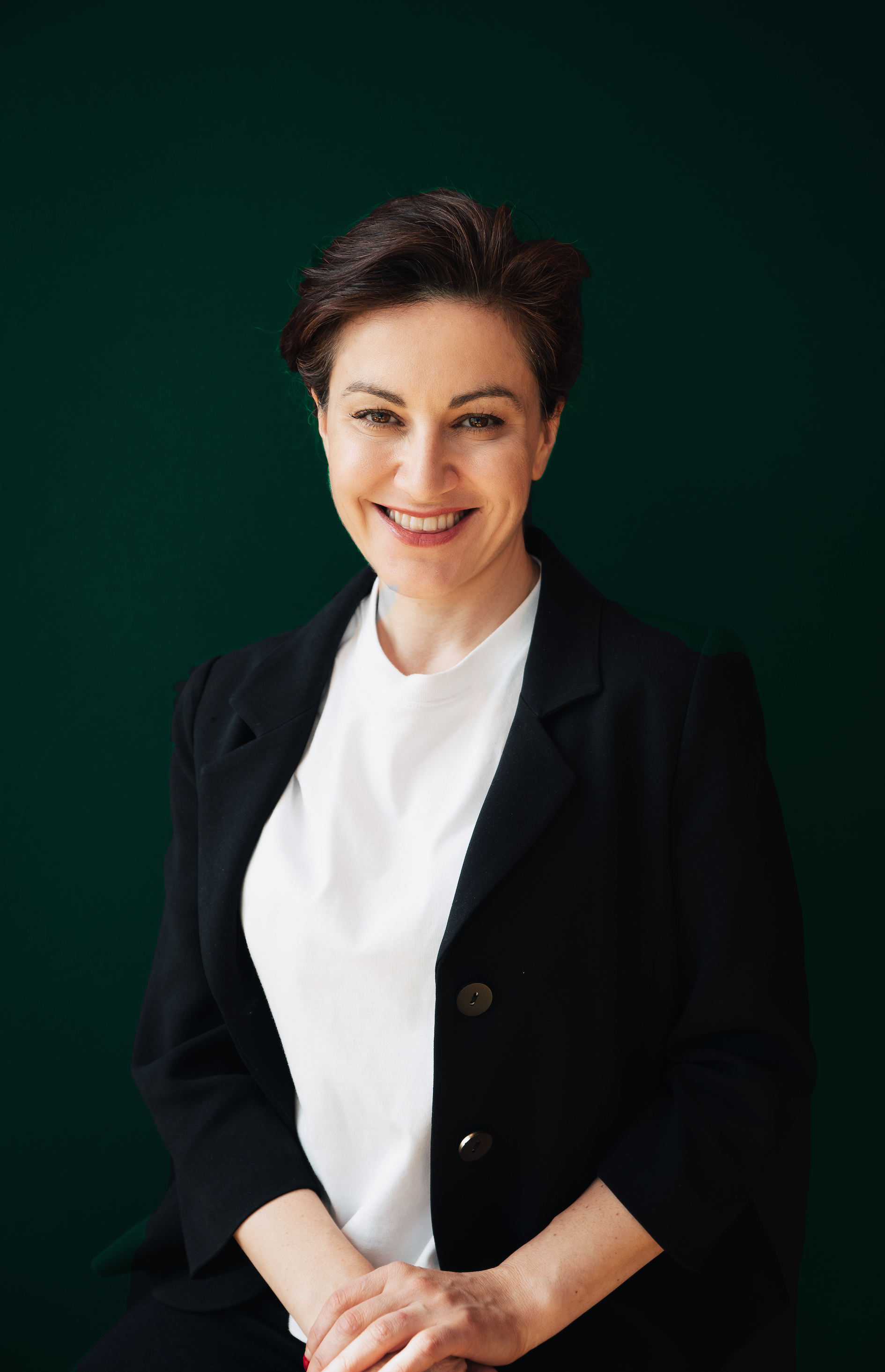
MARTA SIMONETTI – Everything we need to know about climate change

(by Stefania Del Monte)

Marta Simonetti is an experienced green finance director based in London. She worked in the City of London, initially in marketing and then in development and transition banking for the European Bank for Reconstruction and Development. In 2017 she set up her consultancy, Globalfields Ltd, which specializes in green finance and sustainable leadership.

From August 2017 to date she has carried out several assignments at senior level for the Green Climate Fund, WWF-US, GIZ, IPC GmbH, Absolute Energy Capital, as well as for private equity companies and governments. She is now focusing on the green transformation of financial markets, working with governments, financial institutions and the consultancy sector in Europe, Africa, Central Asia and south-east Asia.

In her work thus far she has been leading bilateral and multilateral structuring and negotiations in climate and conservation finance, including with the Green Climate Fund, the Global Environment Facility, the NAMA Facility, the German bilateral cooperation agency (GIZ) and multilateral banks, as well as for private companies. Her main skills are in fund management (legal and institutional structuring), blended finance structuring (mixed participation equity and loans; revolving funds; guarantee funds), resource mobilization, programme structuring in climate and environmental finance. She also offers pro-bono work for the delivery of presentations and leadership training programmes specific in the areas of green finance, climate change and environmental degradation, in particular for schools and in careers events at universities in London.

We have met her to try and get a better understanding of this very complex matter.

Marta, your academic and professional experience in the climate and environment field is impressive but we would like to start with a very basic question. We often hear the expressions global warming and climate change. What exactly are they and what’s causing them to happen?

Many thanks for this question, which is not that simple at all! Climate science is an important aspect of our work in green finance as it gives us the evidence of the anthropogenic factors (i.e. the man-made role) in temperature warming vis-à-vis normal patterns of change. It reinforces the fact that we can make a concrete impact in our work with clients.

Specifically, global warming refers to the long-term rising of the average temperatures of Earth’s climate system observed since the pre-industrial period (i.e. the period between 1850 and 1900) due to human activities, primarily fossil fuel burning, rapid urbanization and loss of ecosystems. With time, those have increased heat-trapping greenhouse gas levels in the Earth’s atmosphere.

When we look at historical temperature changes, we see a succession of warm patterns followed by ice ages over the earth’s geological history. Thanks to the analysis of Antarctic ice-cores carbon dioxide (CO2) concentration alongside the study of temperature changes, we know that warm periods, with some exceptions, are periods of high atmospheric CO2, and cold periods, geologically, have been periods of low atmospheric CO2.

After the industrial revolution we see a 40 per cent rise in CO2 atmospheric concentrations during the 20th and 21st centuries. When we look at temperatures between 1880 and now, the ten warmest years ever recorded are within the last 17 years. The hottest temperatures ever recorded were in 2016, 2019, and 2015. There is a lot of convergence on these data among major research organization, including NASA, the Hadley Centre for Climate Science, British Antarctic Survey and the Oceanic National Oceanic and Atmospheric Administration.

(data from ossfoundation.org)

Because of this pattern change in temperatures and CO2 concentrations, we are also experiencing new weather patterns that have remained in place for an extended period of time and cannot any longer be considered as isolated occurrences. This change in the Earth’s climate system is climate change. For example, we are now experiencing an increasing number of extreme weather events, such as violent storms, heavy or irregular precipitation patterns, unprecedented floodings, more frequent and longer-lasting heatwaves, droughts.

In 2020, and with all the research available on the subject, we are still faced with a large number of deniers. How is that possible? Do we have to believe Greta Thunberg or Donald Trump?

I find Greta’s message very powerful because it is really seeking to achieve what we (the older generation) haven’t done fast enough: i.e. bringing about systemic change across all sectors. A crisis such as that we are witnessing now is indeed unprecedented. Think about the bush fires in Australia, the snow-free Christmas day in Moscow, or the current above-average temperatures in England followed by three weekends of storms and torrential rains. Those occurrences used to be abnormal, rare events. Now it is the new normal. Greta would say: Your house is on fire. And rightly so, because we cannot any longer think that those are remote problems that will not affect us. Yet…every crisis brings fundamental questioning, and the way we answer those questions, the motivations we bring behind our answers are the real catalysts for change. I think we are now at the right juncture to substantially speed up climate and environmental action. Our awareness and knowledge of the issue have increased, because the problem is so in our face that we cannot turn away from it.

Climate deniers thrive on instilling doubt and misinformation. We need to remain very aware that the most prominent deniers out there receive significant financial backing from (predominantly) the oil and coal industries, and then also from farming and heavy industries. What I find dangerous in this rhetoric is their effort to disenfranchise and disengage people from the actual conversation. If we are not responsible for climate change, then it follows that we shouldn’t worry so much about what we do because nothing we do actually matters. This is an abdication of responsibility! This is an abdication of our true human nature and our ability to bring change and meaning, in our own lives, as well as for the environments and communities we live in.

The real conversation has another focus. We have the technology to move away from fossil fuels. This is happening faster in some countries and not so fast in others. In a way we can say that it is important to remain mindful of the complex socio-economic transitions that are needed to decrease reliance on coal, oil and gas, as those have a price, expressed in the affordability of clean energy. Yet this transition needs to happen, globally. At the moment, while technology costs are coming down, we still have entry barriers, for example in mismatches between policies on the one hand, and regulation on the other; or political uncertainties which then translate in higher insurance costs or may act as deterrent to investment.

We have two major paradoxes here. Short-termism is now pervasive, in politics and in business. For many politicians it is impossible to think past the next election. This jeopardizes the ability to accept short-term costs for longer-term gains. In business, we want to see quick returns on investments and short pay-back times. When we work in climate action or in sustainability, the work is fundamentally long-term. We seek long-lasting impacts.

The second paradox is that while we seek to reduce emissions through clean energy generation and resource efficiency practices, we have rapidly become a more electrified, digitalized society. Think about how many tasks we now do digitally that were previously done without electricity: paying bills, writing letters, studying, billboards. Who goes now to the post office to pay, say, the water bills? Or when was the last time we sent a friend an actual letter written by hand, using pen and paper? While we may still have books, online content is now so efficient that it can really save us time and energy. And what about money? Here in London, where I live, there are shops that do not accept cash any longer. Now we have smart houses, big data, machine learning, predictive technologies. This is all very useful. It all needs electricity. So, as the population grows, any efficiency gain in carbon mitigation, water efficiency, or resource efficiency that we may achieve through new technology is eroded by the growing rate of consumption of that resource. This is the Jevons paradox, very much used in environmental economics. Before we start thinking though that any efficiency improvements in climate action is futile, let’s add another perspective here: i.e. the growing role of environmental conservation and stewardship of the planet. This is why now more than ever we need to find and implement applicable solutions.

So, when I look at Greta I really see progressive politics fighting against regressive government. In Greta I see the spark for systemic change rather than clinging to the status quo. For our future, the future of our children and humankind, for the health and preservation of the earth systems, we need to choose climate action!

It is too late to prevent climate change?

Climate change is already happening. What we can do now is to make sure that we decrease emissions, and fast. GHG emissions in fact increased in 2017 and 2018, and stabilized in 2019, according to the International Energy Agency. An important concept here is the planetary boundaries of the earth systems. In some instances, we have made useful progress, for example in the reduction of chlorofluorocarbons to slow down stratospheric ozone depletion thanks to the Montreal protocol and more recently the Kigali Amendment.

But in other areas – namely climate change and biosphere integrity – we may have already gone beyond the boundary. What does this mean? That we are fast approaching a tipping point, beyond which certain changes may become irreversible, such as loss of ice cover in polar regions, with subsequent sea level rises; or loss of ecosystems. Some people may find the extinction of some species irrelevant, or may be unmoved by an emergency thousands of miles away from home. Those events, though, are neither unrelated nor irrelevant, because ecosystems are interconnected, planetary boundaries are interconnected and ultimately, we are also connected (to ourselves, to others, to the contexts we live in). Do you remember John Donne’s poem ‘No man is an island entire of itself…’? The balance is in humankind’s approach to become aware that we are all part of a whole system, and that this interconnection is not a new concept or new-age mumbo-jumbo. It is real.

What do you think are the most important priorities, in order to tackle the climate crisis?

There are four key areas of priority where I believe we can bring substantial changes and impacts.

  • Financial support. For many countries, there is still a need to bridge the gap between the technical and impact potential of a project, and its commercial viability. This is where I see still a steady role for public interventions given as blended finance in the form of concessional lending, guarantee instruments and subordinated positions in financial instruments (e.g. first loss and tiered funds). We definitely need a little bit more risk-taking in order to bring new technologies on the market, which can be achieved through concessional equity in incubators and accelerators funds, as well as for venture capital. Supporting the supply of viable projects can strengthen the arguments for the business case of investing in green and SDG-linked products, which is paramount to speed up divestment away from fossil fuels.
  • Technology solutions. There are two ways to look at this: a solution as a new product, design or process (e.g. gravitational technologies for energy storage); and as a system change, i.e. green connectivity, circular economy and cradle-to-grave solutions, ‘green-digital’ urban designs and urban adaptation practices. To name a few…
  • Nature-based solutions. This would include conservation efforts, resource preservation and management, re-building of ecosystem. In this area we have solutions at hand, for example in carbon sequestration through reforestation and afforestation practices. Those solutions need to be implemented at a faster pace that the on-going destructions of those same ecosystem, which is very challenging.
  • Applicable awareness. I hear too often people feeling disempowered: how can one person make a difference? Well, let’s bring awareness to this issue and see what we can do, as individual, as part of a community, and in the bigger political arena, then we are not anymore acting as one but as humankind. As we prepare for next Conference of the Parties (COP26), co-organized by the UK and Italy and taking place in Glasgow in November 2020, we can take the opportunity to learn more about what’s happening and empower ourselves to bring change.

For example, what are some key changes we can bring into our lives?

I would like to give some suggestions… Switch energy supplier to full renewable energy; reduce meat consumption; join a vegan / vegetarian group for inspiration and recipes; reduce food waste; seek bulk or unpacked shops where you can use and reuse your own containers; increase energy efficiency by, for instance, switching all lights off, as well as through efficient lighting, windows and walls; join a clothes swapping group or sales apps; use sharing services rather than owning a product (e.g. car sharing); vote with your wallet by deliberately choosing which product and company you want to support and which you don’t; participate in tree-planting exercises and other sustainability activities organized by your council; use public transport to move around; vote for those candidates who have a clear pro-climate and sustainability agenda.

How can your expertise make a difference?

At Globalfields we look at climate change and sustainability practices in businesses from a variety of angles. We are interested in the interconnectedness of the issues and therefore we are able to offer holistic approaches. As I was mentioning earlier on, clean energy generation and efficiency gains cannot be taken in isolation from conservation efforts and stewardship of the planet. We need to think about energy and resource efficiency solutions alongside their wider impacts. We need to align corporate efforts with the sustainable development goals and with international agreements such as the Paris Agreement.

Globalfields was incorporated almost two years ago, and in this relatively brief time we have worked very closely with a number of governments, public and private-sector institutions to create processes or policies to implement green finance practices.

In particular, our work includes supporting organizations in drafting green finance strategies and roadmaps for their implementation; in designing framework for a company’s alignment with the SDGs; supporting the work around frameworks for green loans and SDG loan certifications; advising on financial instruments in green finance, with specific use of concessional and blended products for developing countries; fund-raising and structuring of funds.

More recently we have also worked on green finance training and made our first investment in small-scale hydropower. Two additional investments are under consideration as we speak.

Most of our work is targeted at corporate level, but we have also designed frameworks for coaching for transformational ‘green’ leadership, delivered individually or in small groups. This is where we aim to empower people to not only understanding the subject matter but also to design the most appropriate pathways for them to become transformational leaders in their organization. Working at corporate and individual levels is in my opinion a necessary undertaking in order to bridge the gap between science, policy and action.

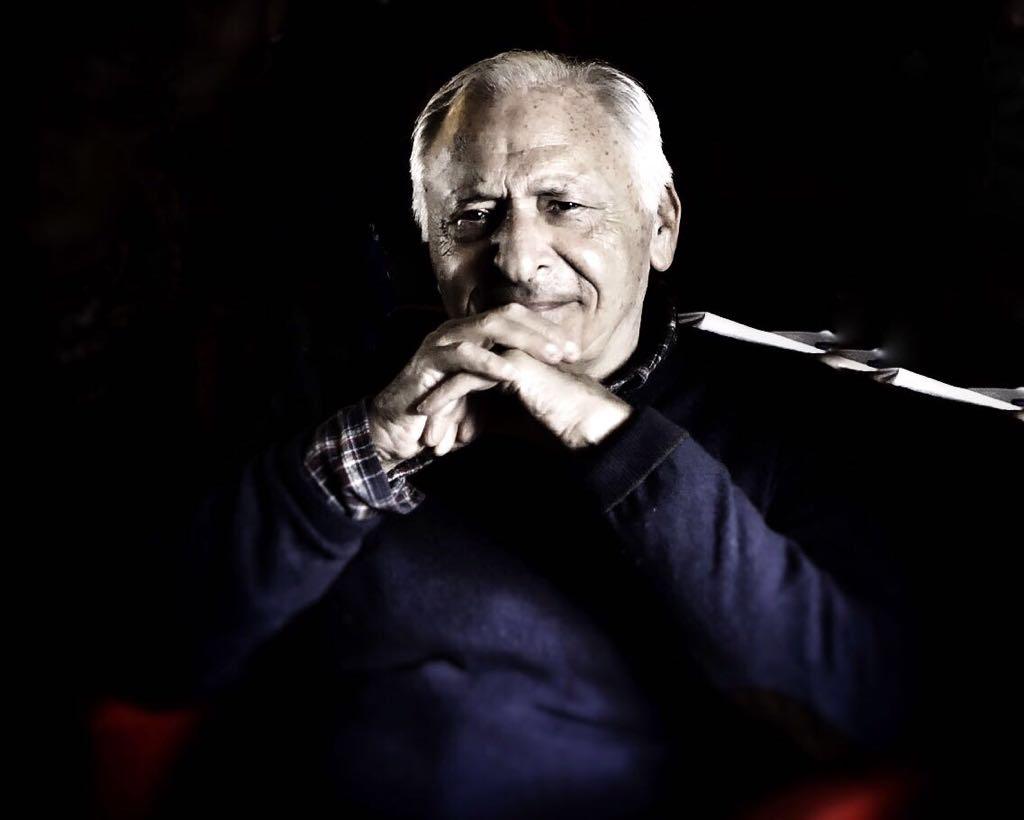
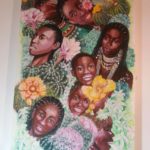
Cover image: Marta Simonetti


PAOLO ROSSI – How long it lasts a moment

by Stefania Del Monte

He was an idol and was disqualified. He returned and became the Pablito of the Spanish Mundial in 1982. This is, in short, the story of Paolo Rossi who, from 1980 to 1982, from the punishment for football betting to the victory over Germany, lived the two hardest and most exciting years of his life. A fairy tale with a happy ending, imbued with striking successes alternating with lacerating pains, with strong surges and ruinous falls, with dreams come true and deep wounds, with precious awards and injustice. It is the black and white of an exceptional existence, the perfect script of a film that has enchanted generations and continues to be reviewed and relived by the public.

Written in collaboration with the journalist Federica Cappelletti, the book Quanto dura un attimo (How long it lasts a moment) is the autobiography of a boy who has defied fate to become a legend, realising his dream as a child and writing immortal pages of the history of universal football. Of this, and many other things, we speak directly with the protagonist of this extraordinary life: Pablito!

“How long it lasts a moment”: a book written in collaboration with your wife, Federica Cappelletti. How was the idea born?

The idea was born over a coffee. It was a grey morning, it was raining, and the sound of the falling rain reminded me of the cleats that beat on the floor in the tunnel that separated the changing rooms from the Bernabeu Stadium in Madrid. It was the 1982 Spain final: Italy-Germany. I still have chills on my skin. My wife asked me to go ahead with the story and then tell it to the world, in a book, so that it could become everyone’s heritage.

What inspired the title?

The moment has always been my characteristic. For me, it meant anticipating the opponent. Get there first. Score. But the moment is also the happiness I felt in those eternal moments of the World Cup in Spain.

Have you always wanted to be a footballer or did you have other dreams as a child?

My dream was to become a footballer. I had an idol. His name is Kurt Hamrin. He had my characteristics; he was an opportunist on the field. I liked him. But I also thought about being a doctor. Rather, my mom wanted me to be an accountant.

Before turning into legend, your career had undergone several jolts, causing strong reactions from the press of the time to the news of your call to the World Cup in Spain. How did you experience that period before arriving in Iberian land?

I suffered a great injustice in my life. I was disqualified (despite being innocent) for two years for not reporting a teammate and two fixers who wanted to combine a game. The Perugia-Avellino in which I scored two goals: but only because it was what I knew how to do. They paid me to score goals. I scored many. So the call to the World Cup in Spain was meditated by Enzo Bearzot and in the end apt. I repaid the coach for his boundless trust and I’m proud of it.

And what, on the other hand, is the most beautiful memory you have of that extraordinary adventure that was the 1982 world championship?

The team. The coach. The sense of family. Home. The affection I felt by everyone. And then, the three goals in the match against Brazil. I became a legend thanks to them, but they also gave me the strength to start again. And I became the top scorer, world champion, golden shoe and golden ball.

Among others the book is dedicated to Enzo Bearzot. How important was his figure to you?

I owe a lot to Enzo Bearzot, I owe him my rebirth. He knew what I was made of and challenged everyone by proving he was right. He is in my heart, where he will remain forever.

The victory in Spain helped to bring colour back to an Italy that tried at all costs to leave the darkness of the Seventies behind. How did the Italians welcome you on their return?

The return to Italy was a tricolour feast. Italy, with that World Cup, has found confidence, raised its head, the Italians have returned to smiling. Sociologically it was an important victory: one of the most important in history.

Among the legendary companions with whom you had the privilege of playing, was there one to whom you were most attached?

I have been and I am deeply attached to everyone. But Antonio Cabrini and Marco Tardelli remain the closest. Also today.

And the most feared opponent?

Brazil, without a doubt. But only before the final, at least for me!

Your best goal?

The first I scored to Brazil definitely unlocked me. But the others weren’t bad either!

Among the prestigious prizes and awards obtained, which made you happier?

The Golden Ball, certainly. In Italy we are only five to have won it: Omar Sivori in 1961 (born in Argentina but national team at the time of recognition); Gianni Rivera in 1969; then I in 1982, Roberto Baggio in 1993 and Fabio Cannavaro in 2006.

What did you do once you “hung up your boots”?

I am a commentator, I have a resort in Tuscany (in Poggio Cenina), I was a builder, I produce oil and wine. I write books with my journalist wife (laughs).

Do you like today’s football? How much has changed in forty years?

I like today’s football: it’s faster. The changes have been many, profound, starting with the management of cards and players. But rightly so, football is also adapting to modernity.

Do you see yourself in any football player today?

There aren’t many players with my characteristics. Perhaps one who resembles me a bit is Mertens of Napoli.

Do you have any regrets?

None. I did what I wanted to do, I made a dream come true, I won everything there was to win.

Cover: Paolo Rossi and Junior, Italy-Brazil, Spain 1982
visual material courtesy of Paolo Rossi

Click here to read the interview in Italian 


MOGOL – “Emozioni” on stage

by Stefania Del Monte

With over 1,500 songs published and a myriad of collaborations of great international prestige under his belt, Giulio Rapetti Mogol is one of the most prolific and by far the most successful author on the Italian music scene.

Known by everyone simply as Mogol, at the age of 83 – including over sixty of artistic career – he is a man who has always known how to live his life in depth and then tell it in his texts as a friend, revealing human truths and intimate thoughts.

Calling him a lyricist would be an understatement. The world of this great character is in fact dotted with social commitment, family loves, sports (football and horse riding above all), travel, mentoring, entertainment and much more.

His songs, however, are the ones that more than anything else define him and – even after fifty years – continue to arouse the same, identical emotions as ever in the general public. And it is no coincidence that his new theatrical performance is called just like this: Emotions (Emozioni in Italian, ndr).

Turin, Macerata and the Ancient Theater of Taormina will be just some of the stages touched by the tour. We talked about it directly with him: the legendary Mogol.

On 26 March Emotions will be staged at the Colosseo Theatre in Milan. Can you tell us about it?

It is a theatrical performance in which, together with the interpreter Gianmarco Carroccia, we make a journey through my songs with Battisti. A 16-piece orchestra will perform a real musical biography, while Carroccia will interpret the songs and I, present on stage with him, will tell anecdotes and curiosities about the birth of some of those songs. There will also be three songs by Gianni Bella: Il profumo del mare, Il patto and Quello che non ti ho mai detto.

Why did you prefer a theatrical performance to a concert? What does theatre offer compared to other forms of entertainment?

The show alternates parts of the concert – with lyrics projected in the background and an audience that actively participates, singing with passion – and my more discursive interventions, where I tell a little bit about the circumstances in which certain songs were born. It is a type of representation that offers great interaction with the spectators.

This year marks the 50th anniversary of the release of the Emotions album and the songs it contains continue to be very popular. Why do you think these songs are so loved by the public?

These are songs that have remained in people’s hearts and memories. My lyrics are often autobiographical but many Italians recognize and identify themselves in the thoughts, words and, above all, in the emotions told in these passages.

Speaking of emotions, one cannot help but think of your artistic collaboration and, above all, of your long friendship with Lucio Battisti. How do you remember him?

Between us there was a relationship of great friendship and mutual esteem. He called me the poet and for me he was the best musician I had known. I remember that we had established a habitual way of working, almost a routine: Lucio came to my house after composing the music of 10-12 songs. We started around 9 in the morning: he played the guitar, singing in macaronic English and I, lying on the carpet, composed the lyrics. In less than two weeks the job was ready. Many of the songs were born within an hour.

Gianmarco Carroccia, your co-protagonist in the theatrical show, is an artist who trained within the CET Centro Europeo di Toscolano. Can you tell us more about this academic project of yours?

CET is a non-profit association that I founded in 1992 with the aim of enhancing and qualifying mainly new pop music professionals, people sensitized to the importance of popular culture and the ethical needs of communication. The centre is located in a complex of over 120 hectares in the heart of Umbria. CET, however, is first of all an academy that has prepared and prepares artists of the highest international level. Last year I taught courses in the United States, Berkeley and Harvard, and there they gave us a lot of compliments for our teaching methods.

Gianmarco Carroccia, in fact, was a pupil of CET between 2010 and 2011 but to tell the truth I didn’t remember him. Then one day I heard him sing in one of his concerts, in front of an enthusiastic audience and, from there, planning a show together was almost inevitable. He is a great showman and knows how to involve the public. But not only that: he is also an incredible performer and his shows are always sold-out.

Looking back on your first steps into the world of music, what did it mean to be an author in the Sixties? How have musical tastes evolved and what is the public looking for today compared to that period?

Look, I am lucky enough to have sold over 523 million records worldwide, with 151 hits that placed in the top ten of the charts and of which, more than half, are songs composed with Battisti. These are incredible numbers and I myself, when I first heard them, found it hard to believe it. I think this success is due to the fact that I write for myself and not following the tastes of the public.

How do your songs come about?

My characteristic is that I never have a prepared subject: I listen to the music and recognize what it is telling me.

Your repertoire is vast. Of all the songs published, is there one that has a special meaning for you?

Yes: it’s the song Anche per te. It is a text that, I believe, everyone would have liked to write. It was inspired by three lonely women, whom I would have liked to help.

During your career you have collaborated with many world-famous artists: from Mina and Celentano to Bob Dylan and David Bowie. Among today’s names, is there an artist you admire more than others?

I would say Cristicchi: a great artist, both musician and theatre, with whom I also had the opportunity to collaborate.

Cover: Mogol
Audiovisual material courtesy of Mogol

Click here to read the interview in Italian


ERIKA BEZZO – A coach for expats

by Stefania Del Monte

Erika Bezzo, owner of ChangeXperience, is a strategic and intercultural coach with ICF (International Coach Federation) certification, specialised in helping those who leave their home country to start a new adventure abroad. Her thirteen years of experience as manager in marketing and communication led her to live and work in Italy, Germany, France and Spain. She holds coaching sessions in Italian, Spanish, French, German and English and has just launched a new version of her website, now available in English, Spanish and Italian. We met her to learn more about her role and understand how she can help expats in their transition.

Erika, what is, exactly, the role of a coach?

Imagine having a nightmare while sleeping. You are trapped in a reality from which you cannot get out, you are sick, you are looking for a solution but you cannot find it. The malaise grows, you run, you struggle in an attempt to put an end to that anguished situation, but nothing, you cannot do it. Suddenly someone wakes you up and you are in a new reality, which allows you to observe from the outside, from a new perspective, the “nightmare reality” that seemed to you to be dead end. The Coach is the one who “wakes you up”, leading you to explore reality from a new perspective, from which you discover paths and solutions that were previously not visible. And it accompanies you on this journey of discovery until you reach the goal.

How do you carry out your business?

With my private customers, who live almost everywhere in the world: the sessions are mainly online. With companies, I generally go to the client, for individual and group training and/or coaching.

How much did your previous work experience help you to become a coach and professional trainer?

My experience in the company has been fundamental. When your customers are managers, entrepreneurs, freelancers or employees who every day have to deal with an organisational structure, hierarchical relationships, power games … having lived the company life allows you to understand closely what they are talking about.

Did the fact of having lived in different countries help you?

Moving on average every three years leads you to experience continuous and constant change exponentially. Expatriation is the only event in life that leads you to face so many challenges and changes simultaneously: work, language, country, culture, friends, colleagues. In my case, the first transfer also coincided with my wedding. Expat life is an experience as exciting as it is destabilising: when I help my customers in the transition, I know exactly what they are experiencing because I have tried it on my skin, several times. And they feel it. Once, a French manager of a large German multinational said to me: “I chose you as a coach because you are a woman, a foreigner; you know what it means to work in this country (ed. Germany) and you speak my language”.

How did you deal with the inevitable changes that accompany every move?

The first time, with the blissful unconsciousness of a 27-year-old girl. Later, with greater awareness, great curiosity, desire to discover and learn new languages ​​and new cultures, but also with organisation, determination and stubbornness.

What did you take with you from the places where you lived?

From Germany the essentiality of the content, from France the value of the form, from Spain the value of lightness, in the positive sense of the term. The Spaniards have the great advantage of knowing how to smile even in difficulties; it is a great force.

And what about Italy?

I lived in Italy till the age of 27. This is the place where I developed my core identity. From my home country I take a lot of cultural peculiarities, but probably the most distinctive one is the art of getting by.

One of the most important aspects of your work is the intercultural one. What pushed you in this direction?

As soon as you arrive in a new country, you don’t know its culture, values, customs. You therefore continue to behave as you would in your country of origin. Misunderstandings arise that generate anger and frustration. If someone gives you the keys to interpret the behaviour of others in the host country, your ability to adapt to the new cultural context is much faster. The desire to help people feel comfortable and quickly find their new balance is what prompted me to put at the service of others what I have learned in recent years as an expat, in addition to my intercultural studies.

In 2014 you founded Italia Altrove. What is the purpose of the association?

I could no longer hear: “Ah, are you Italian? Pizza, mafia and mandolin …”. Pride and the desire to promote the best of the country had me started, to communicate a different image of Italy. The Association, through art, literature, music, theatre and Italian talent in general, aims to export one of the best versions of our country.

What kind of activities do you organise?

Among things, we invite contemporary Italian authors to present their books, organise musical and theatrical events, have a reading club that meets monthly to discuss a book by a contemporary Italian author.

Can you reconcile all these commitments and get some space for your free time? What are your interests?

Well, family is a priority. After the birth of my second daughter, I left the corporate world and moved on to the freelance profession in order to manage my time in a more flexible way. Like everyone, I am constantly looking for the right balance between private and professional life: I apply the techniques I use with my clients first of all to myself. When I am travelling, I am away even for a whole week, but when I am at home I try to be very present. Much of my free time is dedicated to volunteering through Italia Altrove. The rest I dedicate to reading (I am a compulsive reader) and to sport. My two hours of pilates a week are essential. When I was in Germany, in addition to pilates, I was jogging in the woods near my home. Since I am in Madrid I have not yet managed to resume this routine in a stable way, I miss both the woods and my jogging companions, but I am working on it. This is also part of the constant adaptation of expat life!

Click here to read the Italian version

Discovering Eton College

London, Maria Vittoria Bognetti
Eton College was born in 1440 from by King Henry VI who desired to found an institution that would shape and educate the next british ruling class in the English Language, aiming at creating a natural ‘bridge’ between high school and university education level. It started as a charity school which provided free education for seventy poor boys in Windsor, Berkshire, who then continued their scholastic career in the exclusive 70 colleges between Oxford and Cambridge, leading universities in the world.

For the first time, Eton College opened his doors to an Italian production team, London One Radio, allowing us to perceive the unicity and the peculiarities of this institution in its whole beauty. Dr. Marco Liviero has been the voice who guided such tour in the numerous rooms of the college, by providing insights on what distinguishes them from other boarding schools. He explains that Eton College was love at first sight: he visited the school during an academic trip, and already passionate about the British culture, theatre and Shakespeare, he pictured himself in this institution. A dream that came reality as, for the past 19 years, he has been the Professor of English Literature at Eton College.


Eton is not like any other boarding schools, students are developed in toto. As Dr. Marco Liviero explains, “Excelling in school is not enough. Being passionate is an essential quality, and what is mot important is to be willing to invest effort and time in these”. The academic part is indeed just a small component of the education that student receive from Eton: they develop their passions, initiative spirit, and sense of responsibility through the many extracurricular activities from sport, to music and theatre.

The Farrer theatre, the creative heart of Eton College, is one of the most magical places in the boarding school. And the very essence of theatre allows Eton students to grow as human beings, touching the many spheres of an inclusive development: it allows to “understand who you are and who you can become”, key elements in the receipt to disclose the full potential of each student. It is not surprise that many brilliant actors passed from here, from Hugh Laurie, the Dr. House protagonist, to Eddie Radmayne, who recently won the oscar for his interpretation of Stephen Hawking in the Theory of Everything.

Eton’s traditions have been lasting for more than six centuries, and it is the combination of such solid and extraordinary background, academic excellence and a constant innovation that allows this school to be the most prestigious boarding school in the United Kingdom, if not the world.

“The school master’s skill is understanding the different talents of each pupils”, a quote by Quasiliano, found in a fresco in the Head Master Chamber, the office of the Head Master in XIII century, well embraces and expresses the spirit of this brilliant institution.

JESUS CHRIST SUPERSTAR – Interview to Ted Neeley

by Stefania Del Monte

Jesus Christ Superstar is a unique story in the musical theatre scene. The famous work by Andrew Lloyd Webber and Tim Rice does not suffer from the signs of time; indeed, it is attracting a constantly increasing number of spectators: over 300 thousand those who, only between 2014 and 2016, in Italy and Europe have chosen to see the production by Peep Arrow.

And if, after so many successes, this show continues to excite both the public and the critics, the credit goes to the great artistic and productive work of Massimo Romeo Piparo and his team, who were able to transport the driving force of a universal story with skill on the scene, but also and above all the unquestionable artistic excellence of the cast, first of all Ted Neeley, protagonist of the historical Norman Jewison film of 1973, which gave an indelible mark to the role of Jesus.

It is he, the legendary and timeless Ted Neeley, who tells us about this incredible experience, and more.

Life b.C.: Your career as a singer started back in the 1960s, after moving from Texas to New York.  How did you go from your debut to becoming Jesus Christ?

Before my journey in New York began, while I happily sang and played drums in our Rock’n’Roll Band from Texas, I was chosen for my first professional theatre experience to play Claude Hooper Bukowski in the amazing Rock Musical, “HAIR” in Hollywood. Then came “Superstar” on Broadway, then The Who’s “TOMMY” in Hollywood, then “Superstar” in Hollywood and then came the Norman Jewison production of the first Rock Opera to be made into a feature film, “Jesus Christ Superstar”!

After performing Jesus over 5,000 times in the last 46 years, you declared in an interview “you would love to be able to do this show another 2,000 years”. What drives you after all this time?

Everything within the success of Jesus Christ Superstar exists because Andrew Lloyd Webber and Tim Rice had the courage and unique collaborative talent to create this adaptation of the last 7 days in the life of the Man called Jesus of Nazareth, as seen through the eyes of his friends and his adversaries. And they composed it as a modern day Rock Opera. I am inspired by every heartfelt moment that lives within the powerful music and lyrics we all sing together during each performance. It is always uplifting, always new.

Is there a particular performance that you will never forget or that you consider as your best ever? 

As I stated above, by adapting the 2,000 year old celebration of the Man called Jesus of Nazareth into this modern day Rock Opera, Andrew and Tim created a new, everlasting source for new generations to appreciate the loving, heartfelt, spiritual experience within this celebration of music. For I feel this every night. So, each performance is unforgettable. Therefore, it becomes the best ever.

You starred in the movie JCS in 1973 and in all major JCS musicals since 1971. Each experience must have been different. What aspects of the current Italian production led you to accept the role in the first place?

The renowned Italian theatrical producer, director Massimo Romeo Piparo invited me to take part in his 20th Anniversary Celebration of Jesus Christ Superstar being presented in Italy. “What? You do this Rock Opera in Rome? Are you kidding me?” Of course, I accepted his invitation immediately! And as we began rehearsals for this presentation, I loved every aspect of his concept for this remarkable Italian production.

Career-wise, do you have any unfulfilled dreams?

There are always multiple projects being done at the same time and I am aware of many I definitely would have pursued the chance of being included as one of the collaborators. Yet, when you have already been given the unique artistic gift of participating within this magnificent event, you find you are no longer in the process of thinking about what could be out there on the horizon. You are focusing solely upon what is right, here right now. I began living my dreams during the first experience we discovered together, as we all shared the deeply moving passion living within this emotional Rock Opera.

What sort of challenges, a performer who is moving the first steps in his career now, would be facing? Would it be easier or more difficult to emerge, today?

Pursuing a career in the entertainment industry has never been easy. However, it is the extreme competition that becomes the greatest obstacle we face, no matter what profession we may choose. Therefore, we must accept and be completely prepared to face all of the competition, to rise above all obstacles and without question. We must always believe unconditionally in ourselves and respectfully pursue our purpose in life. We must be absolutely be prepared to achieve our goal. As in the Olympics, it is always the person who works the most diligently in preparation who wins the gold medal.

Who is Ted Neeley in real life? What do you like and how do you like to spend your free time?

I love my family. I love spending all of the time together with them whenever is possible, doing anything. I love my friends, animals, especially dogs, movies, live theatre, live concerts, sports and seeing and laughing with comedians.

I love seeing the sun rise and set, seeing the moon rise and smile, and I love seeing the remarkable cloud formations high above or directly touching the mountains, while they change the flow of sunlight over all of Mother Nature’s creations. And I crave one to one, face-to-face, open subject extensive friendly conversations anytime, anyplace, anywhere.

On May 1st you and your wife, Leeyan Granger, have celebrated your 38th wedding anniversary (best wishes, by the way!). You actually met on the set of JCS. What is the secret for keeping a relationship working, in the hectic life of a performer (or two, in this case)?

Thank you, Stefania! Leeyan and I appreciate your best wishes for our 38th Wedding Anniversary. And with deepest respect for your kind concerns, I can’t say there is a secret for keeping a relationship working. I believe, with all things being equal for and between two loving people, there is a mutual discovery of love and life. I feel there is a continual loving and respectful heart to heart open-minded discovery of our lives together, as one, as we grow even closer with each passing day.  We will always face challenges, which we can always rise above and overcome together. So we can live, love, laugh and continue being happy together, while two loving spirits become as one.

(Images: Margot de Heide)

Go to Ciao Magazine for the interview in Italian


Stefano Potortì: “London is a very competitive market, which rewards successful people”

London – by Chiara Fiorillo

Stefano Potortì, Italian entrepreneur and founder of “The Localist”, was interviewed by London One Radio and he talked about his business, giving hope to many young people who want to become businessmen.

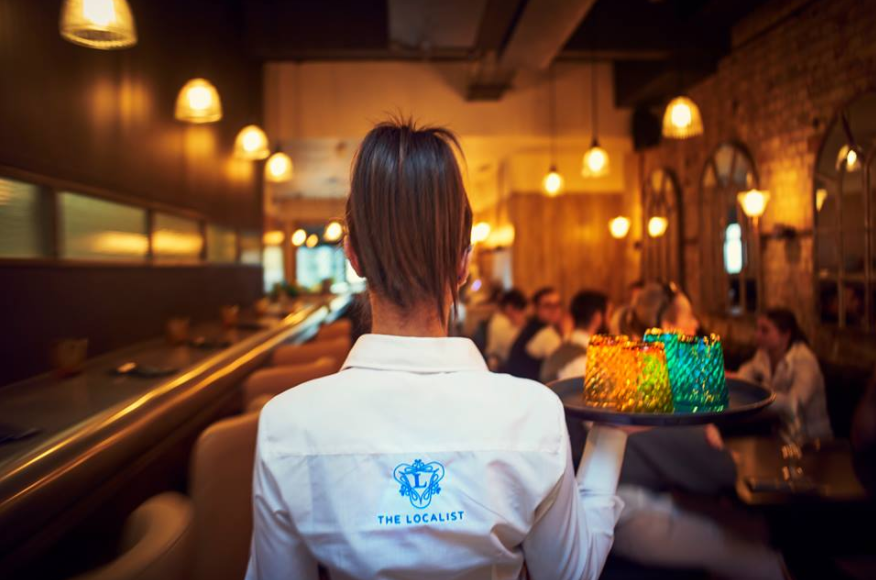
“The Localist” is in St John Street, Farringdon, a very central zone. The closest stations are Barbican, St Paul’s, Chancery Lane and Farringdon. This area has many Italian characteristics and this creates a strong sense of community.

Stefano started working with his company Sagitter One to help London entrepreneurs finding the right location, staff and suppliers, as well as creating a brand and an internet website.

Starting from that experience, Potortì decided to create “The Localist”: it is open every day from Monday to Saturday; it is closed on Sunday.

How was the name “The Localist” created?

Almost by chance. At the beginning, we thought we should create something international, therefore after doing some brainstorming we suggested “The Optimist”. However, later our lawyer found out that “The Optimist” already existed. So, after some more brainstorming, we thought about “The Localist”.

You have been very brave during Brexit.

Yes. Actually, we don’t know where we will be in two years’ time, but we know that in every crisis time there are many opportunities.

I invested a lot and I am quite sure London will still be an open and multicultural city.

What about the menu?

We have a lot of dishes for all sorts of people: from three types of hamburger (meat, fish and vegetarian) to fish & chips, from pasta to meat, from grilled fish to salads. Fried peppers, which you can also eat as an aperitif, as a snack or to go with your cocktail, are our best-seller at the moment.

https://www.facebook.com/thelocalistlondon/photos/a.316207408793728.1073741828.304602326620903/334735900274212/?type=3&theater


And for vegans?

There are two vegan salads and two vegan desserts, that is to say panna cotta and millefoglie.

What’s the mood of “The Localist”?

Everyone is very friendly: the team loves to interact with customers, creating a relaxing atmosphere. Also, the kitchen is in view, so sometimes chefs can talk to clients as well.

And what about music?

We have several playlists to play in different parts of the day and on different days of the week.

From June on, every Tuesday night we will have live music.

We think people should still be able to talk to each other in the restaurant, therefore music does not have to be too loud.

Then, every Thursday night we will have a dj playing from 6pm to midnight.

What would you suggest to a young entrepreneur who wants to kick-start his career?

You must work a lot, being able to offer a different product, being patient and letting other people know about your business. During the first months, you will invest a lot. But London is a very competitive market which rewards successful people.

You can listen to the whole interview here


Giacomo Favero: “Taking care of your mouth brings benefits to the whole body”

London – by Chiara Fiorillo

Giacomo Favero, an Italian dentist in London, comes from a family of dental practitioners. His passion for dentistry made him move to the UK, where he founded Favero Dental Clinic.

Favero was interviewed by London One Radio and he spoke about the importance of the mouth’s hygiene, mentioning products such as mouthwash and toothbrush.

How did you kick-start your adventure?

My adventure began in 2011-2012, when my father decided to expand our brand also in the UK. He decided to do so because the Italian community here is massive and most of the people feel like they need a personal contact with the doctor.

In England, dentists are not seen very positively by the Italian community, therefore we thought we should invest here to demonstrate that people could have someone to trust.

So, I moved to London to run the family clinic. The last five years have been tough, but now they are bringing good results.

Word of mouth is working very well. We have many Italian patients and this shows that we are doing our job properly.

You donate smiles in London.

Yes, smiling is like a business card. The mouth is where the beginning of the whole body starts. Taking care of your mouth brings benefits to the whole body.

How should we use the toothbrush?

In our mouth, we have both good and bad bacteria. It is very important to brush from the top to the bottom and from the bottom to the top, very lightly. Too much pressure may damage the gums.

How many times per day should we wash out teeth?

At least twice a day, in the morning and at night, for about 3 minutes. Mouthwash and Hymalaian salt are very important and useful for the cleanliness of the mouth.

What should we eat to protect our teeth?

Eating healthily is essential not only to keep our mouth clean, but also to keep our body wholesome. I would suggest to eat a lot of vegetables, such as celery: this makes us salivate, which protects our mouth. The food we should avoid is made up of sugars, which create acidity in our mouth.

Mediterranean diet is great. But keep in mind that you should always brush your teeth as well.

Listen to the whole interview here

The Favero Dental Clinic
18 Wimpole Street, London W1G 8GD

Tel: (+44) 020 7323 1960

Email us at: info@faverowimpoleclinic.com

https://www.google.co.uk/maps/place/Favero+Dental+Clinic/@51.5180972,-0.1502266,17z/data=!3m1!4b1!4m5!3m4!1s0x48761ad3975a8cd3:0xf256d92d189a1a96!8m2!3d51.5180972!4d-0.1480379

Four Bright Hands

written by Mirianna la Grasta

Walking through Carnaby Street is a tiny Italian woman. Her meticulous and curious gaze stops on every single detail in the street. “You know what?” she wonders, “London is better than Paris, I feel inebriated by its magic atmosphere.”

But then she stops. She looks up to the grey sky. Her face clouded with disappointment. “This city needs a bright brush stroke.”

Rosa Iacobone is obviously not a common woman. She met Marcella Sacino when she was 20. They were both teaching to their students the importance of colour: “An element that we can only see thanks to the light.” Since then, they have painted together, with “four hands”.

Every afternoon, from Tuesday to Friday, Rosa stands in front of big canvases, surrounded by a selection of warm and bright acrylic paints. Colours, in fact, are vital for her: “They aren’t just a tool to express an idea, they are the message.” Warm and bright colours stand for optimism, they wipe negative feelings out and “push the human mind to overcome the obstacles”, she argues.

The room where she works is often silent, or there is some music in the background. Rosa uses the “four hands-painting” to get away from the “routine of adulthood”. The intimate relationship she has with art satisfies and inspires her life. “Painting is something I always did for myself,” she says, “I never showed my art to the public until a couple of years ago.” So she stands in front of her canvases, and waits for the instinct to guide her.

Rosa takes her brush and chooses a starting point. She moves the brush slowly on the cloth. Then comes Marcella, her “Siamese colleague”. They don’t even need to talk: “We have the same ideas, we work in harmony with four hands and we create the piece spontaneously,” she explains. Rosa always feels to have a “perfect artistic bond” with Marcella. She thinks they are a “one-artist” when they paint: “There’s a sort of telepathy between us.”

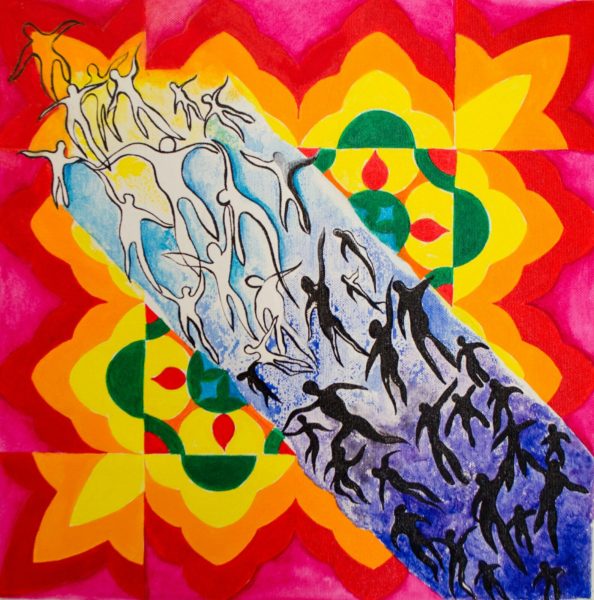
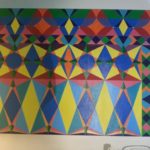
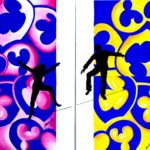
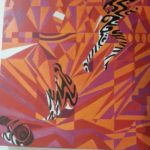
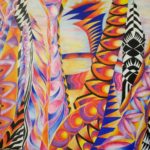
Together with her “second pair of hands”, Rosa experiments various artistic styles, coming from very different historical periods and parts of the globe. Then, she mixes them altogether to create a new contemporary art that looks at humans from an outside perspective. “In Evoluzione” (evolving), a mix of geometries and futurism, is the perfect synthesis of her art. It shows a man going through different emotional stages: he is initially grieving, curled up in the floor, then, he gradually gets up to overcome his obstacles. “The colours are vivid, and they express the man’s will to embrace life,” she explains.

“As a one-artist, we receive serenity through the act of painting, and this is exactly what we want our public to experience,” Rosa concludes.

On her left the blue Italian sky enters the window. All around her thousands of warm canvases adorn the house. “In Evoluzione” is on her right. “Ciao bella!” she says before closing the Skype call. Behind her, a photo of her walking through Carnaby Street.

To discover more about Rosa Iacobone, Marcella Sacino and their paintings visit PITTURA4MANI

Italian Food enraptures the UK: Interview with Jeremy Hunt, Secretary of State for Health

Interview by Valentina Celi, Article by Ilaria Edja Gallo  

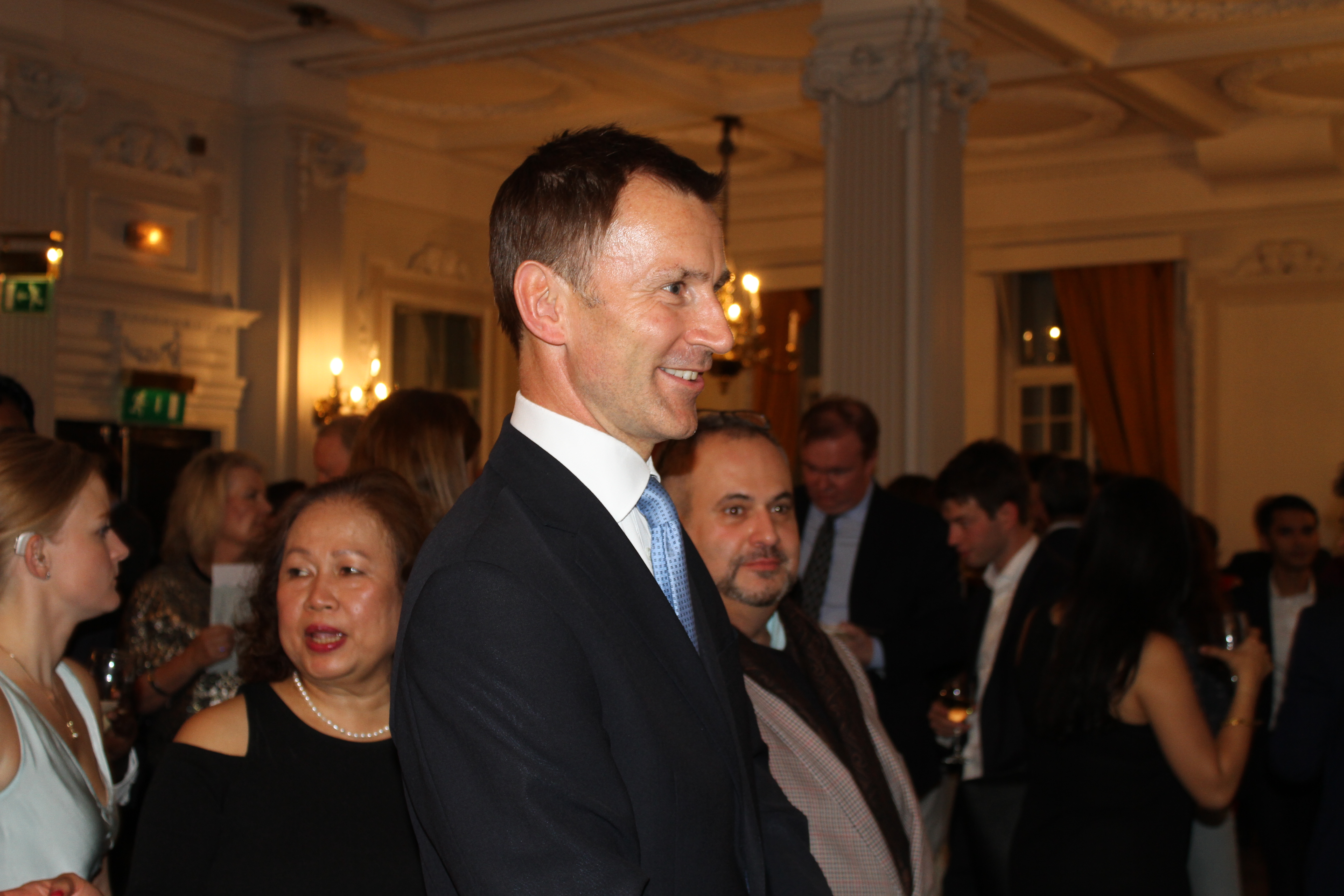
Interview with Jeremy Hunt, Secretary of State for Health.

Last night, Wednesday 28th September, from 6pm to midnight at Le Meridien Piccadilly, we celebrated Italian food, drink and culture. The event has been organised by CLWCA conservative Italian Group 2016 in collaboration with APCI UK, the Association of Italian Professional Chefs in the UK.

Many prominent political guests, such as Jeremy Hunt MP, Secretary of State for Health, Mark Field MP, Vice Chairman of the Conservative Party, Alberto Costa MP, South Leicestershire, Zac Goldsmith MP for Richmond Park & North Kingston and Dr Tania Mathias MP for Twickenham attended this amazing and successful event together with 450 guests.

Zac Goldsmith, LondonONEradio Staff. Photo by Leslie Weir, LondonONERadio- BenTV
Jeremy Hunt, LondonONEradio Staff. Photo by Leslie Weir, LondonONERadio- BenTV

The celebration has been accompanied by the amazing entertainment given by the acclaimed Italian tenor Yuri Sabatini and Giuseppe Mauriello, Laura Araldo, the guitarist Domenico Ranieri and The Tony P Riccio Trio.

LondonONEradio managed to question Jeremy Hunt, Secretary of State for Health about the importance of the mediterranean diet:

Do you think it is important to support the mediterranean diet and to promote it in the UK?

Absolutely, because we now have a huge amount of evidence that mediterranean diet is less salt, less red meat, more fish, olive oil instead of butter and this reduces cholesterol and therefore it reduces the risk of heart disease, cancer, even things like Alzheimer and dementia. So it’s the best way of eating healthily and it’s also delicious. So most of this diet you go on, you have to deny yourself the best things, but actually the mediterranean diet is healthy and delicious so we would love more people to be on the mediterranean diet.

What is your plan of action about obesity? We know that in the past few years Uk developed and faced severe problems linked to obesity.

Well, we have the second largest problem with obesity in the whole of Europe, and we are very worried particularly for children who spend a lot of time behind computers, not as much time as they used to out and about playing. So we have a big plan to change it: we want to get children more active, we want to encourage manufacturers to reduce the sugar content in their food as there’s a lot of sugar in things like frozen pizzas, and actually you can reduce the sugar and not affect the taste. So we want to encourage people, encourage the manufacturers to do that, but we also need to promote understanding among consumers about an healthy diet and certainly mediterranean diet is a big part of that.

So is it possible to say that embracing the mediterranean diet would be the “best thing” for the UK population?

I think that we have to be careful because in this country people don’t like politicians telling them what to eat, so probably if you want to promote a mediterranean diet it’s not helpful to have Jeremy Hunt telling everyone to eat it. But I think you do the best job marketing it yourself. I mean the quality of Italian food that you can get in the UK, now, is transformed compared to 20 or 30 years ago. But I think, what I can do is to encourage everyone to recognize that olive oil is more healthy than butter, that fish is more healthy than red meat, and Italian food is a great way to enjoy those things.

Jeremy Hunt, LondonONEradio Staff. Photo by Leslie Weir, LondonONERadio- BenTV

Last but not least: which is your favourite Italian dish?

My favourite Italian dish? I have absolutely no hesitation in telling you the answer to that. I have a small holiday house in Sicily and the “Antipasti” from Sicily, they are my favourite. I am sorry if you’re from the north of Italy, but they are much nicer than “antipasti” from the North. And my daughter favourite dish,
without doubt, is Gelato, but for me it’s the “antipasti”.

The event had both an educational and charitable aim: in fact, the 20% of profits from the tickets sale will be used to help the people struck by the earthquake in Italy.

The sponsor for this event