There is a way to make your dreams come true and this is called the Wishwall Foundation. The wish of taking part at a special gig or watching out the world from above with a parachute will be not just part of your imagination or hopes thanks to the idea of a woman, called Simonetta Lein.
Credit: Bcproductions215 Photographer – Simonetta Lein, the Wishmaker
The Wishwall in every city is a physical wall where people gather for a two-day event and write down their wishes. It brings together community commitment, kindness, and peace. After the event, The Wishwall Foundation’s Board of Directors selects one wish to grant, and The Wishwall will thereafter become a permanent mural and artistic attraction in the host city.
Simonetta Lein, affectionately known as “The Wishmaker,” utilizes her vast network and persistent optimism to manifest these seemingly impossible dreams, whether it be sitting at the front row of New York Fashion Week or having a street named in memoriam for a lost sister.
So, the Wishwall serves as a forum for individuals from all different backgrounds and experiences to voice their wishes, both big and small.
One of the major examples can be the first Wishwall, hosted in Philadelphia. In collaboration with the city, sponsors, and donors, they granted a very heartfelt wish to help find answers in a fatal hit and run accident. They put up a billboard with a $15,000 reward for information leading to an arrest. They also renamed a Philadelphia street in the victim’s memory. Because of the billboard, the murderer was finally apprehended.
Recently, the Wishwall Foundation have also started a collaboration with FNL Network (Fashion News Lifestyle Network). Based in Los Angeles, the FNL broadcast the exciting worlds of fashion, travel, beauty, health, and reality TV. True stories, spotlights on dynamic industry professionals, and original series reach all four corners of the globe on Amazon Prime.
Therefore, the Wishwall Foundation can be just proud of such partnership as Simonetta stated:
“By going international with FNL Network on Amazon Prime, The Wishwall Foundation can continue its work of uplifting the world and making wishes come true.”
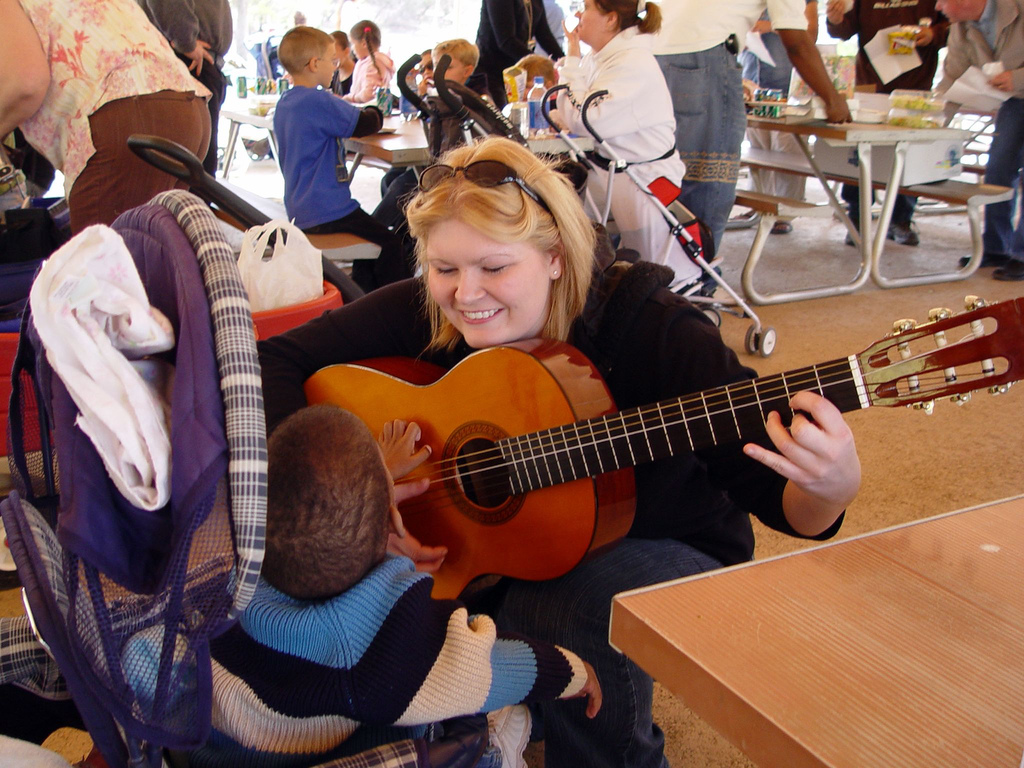
Timothy[1] and Grace are sitting face to face. “Tap.. tap.. tap.. t-tap.. tap..” A five year-old, Timothy keeps is eyes down on his coffee cup, his small fingers tapping on it. And so Grace goes: “Tap.. t-tap.. tap.. tap..” Just then Timothy’s eyes slowly rise to meet Grace’s.
Timothy is an autistic child, while Grace Watts is an NHS music therapist and the Development Director for the British Association for Music Therapy.
“An established psychological clinical intervention, which is delivered by Health and Care Professions Council registered music therapists, to help people of all ages, whose lives have been affected by injury, illness or disability through supporting their psychological, emotional, cognitive, physical, communicative and social needs.”
Ms Watts explains that music therapy in the UK is based on a musical improvisation that takes place between the client and the therapist. But people like Timothy are not the only ones who benefit from this kind of treatment because “music therapy is an intervention for all, from mums to be and their babies to people at the end of their lives”. People usually access it via social care and charitable donations, others are able to pay for it privately.
Being widely accessible and 100% natural, music therapy is becoming more and more popular in Islington, Hackney and Shoreditch.
Located in the heart of Islington, the now BAMT was founded in 1958 by French cellist and music therapy-pioneer Juliette Alvin as the “British Society for Music Therapy”. The charity doesn’t deliver music therapy, but is the biggest point of reference in the field, supporting education, research, therapists and patients.
Schools, in particular, benefit from music therapy services offered by the NHS and the Nordoff Robbins centre. The Richard Cloudesley School, for example, has proved to be one of the most active schools in the area by offering their primary and secondary children a weekly music therapy session with personnel from the Nordoff Robbins centre.
“Music is intrinsic to being human, it doesn’t depend on one’s own education or cultural background,” argues Peter Morrell, singer and Music student at City, University of London.
“What we do as therapists is exploiting the innate musical qualities of people to tap into the problems they have,” says Ms Watts. Music, in fact, is an innate non-verbal language and it’s especially useful to people who struggle to communicate with words. “In this case it benefits both the patients and the people around them,” she concludes.
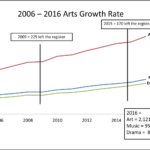
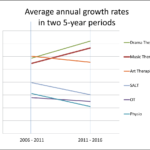
Donald Wetherick, Clinical Tutor in Music Therapy at the Guildhall School of Music & Drama, says that the treatment is so effective that the number of Music Therapists in the UK has almost doubled in size over the last decade, going from just over 500 in 2006 to 951 in 2016. The data is surprising if we consider that Occupational Therapists, Physiotherapists and Speech and Language Therapists are facing a decrease in the number of registrants per year, despite having access to Government funding for their training that music therapists don’t have.[2]
Credit: British Journal of Music Therapy
The treatment is usually run alongside other conventional therapies. “It’s not a cure, but it can help the healing process,” says Mr Wetherick.
Journey into the room of a music therapist…
“We invite the patient, or patients, into a room with accessible instruments,” starts Luke Annesley, music therapist and former lecturer in Music Therapy at City, University of London. The therapist then tries to make the patient comfortable and waits for his response to the instruments. Once the patient starts making some sounds, the therapist would respond and try to create a musical dialogue with the person. “I would always tell people that they are in a therapy session,” he explains, “it’s better to be sincere rather than forcing them to do something they aren’t willing to do.
“Music therapy, however, is a nebulous term,” argues Evan Dawson, Live Music Now Executive Director.
Today “music therapy” is also a synonym of “music as beneficial”. This is the reason why people in Islington, Hackney and Shoreditch perceive listening to and practicing music as something that will “heal mental and physical pain”, “reduce stress and anxiety levels”, “make you feel happier and stronger”, “help you to cope with sadness and loneliness”.
This is exactly what Live Music Now does. The organisation has its main branch in Kings Place and trains professional musicians to play music for children with particular educational needs and older people living with dementia or experiencing loneliness. “We believe that live music can provide significant social and clinical benefits,” argues Mr Dawson. The charity, which runs around 3000 live music sessions a year, has recently launched a new strategy called “Bringing music to life (2017-2022)” in order to gather the community and ensure music plays “a greater role in our society”.
“Playing together also improves social skills, such as communication and respect for the other,” states Chas Mollet, volunteer at Wac Arts. The Hampstead-based charity supports inclusivity in the arts and media training, and works in co-operation with schools and charities in Islington to run state-funded music therapy workshops. Mr Mollet works with avant-garde technologies that enable people with disabilities to play music: “We try to remove all the barriers they might face.”
Whether it’s used as clinical intervention or a beneficial activity, music therapy has had a positive impact within the communities of Islington, Hackney and Shoreditch. “It may not be a cure, but you enable people to have fun, and all the positive effects will come along,” concludes Mr Mollet.
[1] Name has been changed for legal reasons.
[2] British Journal of Music Therapy, Stephen Sandford
Forget the simplistic expression “cutting”, which now stands for all self-harm. Because self-injury (SI) is a lot more than that.
It’s winter and it’s freezing cold. The rain is falling heavily but Malin keeps running in it, careless. She runs and runs, wet and cold from head to foot, until she stops and thinks: “I’ve punished me enough.”
SI is a set of unhealthy actions you do to deliberately hurt yourself. It can include damaging your skin, embedding objects in your body, pulling your hair, head-banging, bulimia, drug abuse, binging, over exercising, drinking and attempting suicide.
“It’s doing things that make you feel awful,” says Malin Therese Mathisen, a 27-year-old Swedish student. “You have a voice in your head trying to convince you that you need to do that.”
No matter the method, self-harm is becoming very popular. It is more common in young adults and in people who identify as LGBT. The Mental Health Foundation estimates that the UK has the highest self-injury rate of any country in the EU, with 400 in 100,000 people self-harming. In the case of LGBT identities, the LGBT Foundation suggests that they are twice as likely as heterosexual people to have suicidal thoughts or attempt suicide, and three times more likely to suffer from depression.
Saya Karavadra – trainee counselling psychologist at City, University of London – explains that today, despite a certain open-mindedness in understanding homosexuality and bisexuality, the sexual orientation of these people is still “widely stigmatised” by society. And this “social pressure”, as she describes it, may cause self-injurious acts, consciously or not, in a subject who identifies as LGBT.
Self-injury comes after an accumulation of bad feelings, such as anger, depression, anxiety and fear. General psychotherapist Phil De Soissons uses the word “turmoil” to describe this state of emotional overwhelming. “Self-harm is a coping mechanism, that is to say a way people react to their turmoil,” he explains.
“It’s personal, hidden and quick.” Zack Xenon, member of the LGBT+ community, thinks of his experience with self-harm as an “internal way” of dealing with sadness, anger and rage: “I find it very difficult to verbalise my negative emotions, so I use self harm as a means of expressing them.”
The alarming aspect of SI is that people who experience it would not immediately realise how dangerous it can be for both their mental and physical health. “People end up inflicting to themselves the pain they would like to inflict to other people, treating the injury as something external to their body,” Ms Karavadra argues.
Even though it helps people to cope with a distress, self-injury has an addictive nature. The calming effect that follows the harm is just temporary and, eventually, the person will face his repressed feelings again. This is why Zack Xenon describes it as a “destructive and sometimes life-threatening method”.
Toby Daniell, a bisexual Psychology student who started self-harming at the age of 11, compares self-injury to smoking addiction. “If you try to prevent a smoker from smoking cigarettes,” he says, “that person will not stop.” Instead, he will “desperately” start looking for other ways to satisfy his desire, and will ultimately find one. “Self-harm was my addiction,” says Toby, “and when I finished I sat there, proud of having found another way to hurt myself.”
“You can’t simply tell people to stop, it will not work,” he concludes.
As Phil De Soissons explains, when helping a person that has self-harmed it is important not to concentrate on the action itself, but to normalise it. “As a therapist,” he says, “I tend to look at the essence of a person, and to identify with him in order to understand what his feelings are.” Psychotherapists, in fact, are less diagnostic and empirical than GPs: by cooperating with their patient they teach him to find healthy coping mechanisms.
Ms Karavadra as well thinks that it is vital to identify with a patient experiencing self-harm. She says that through clinical work therapists, psychologists and counsellors introduce the patient to the “ability of staying present”. This means trying to face their negative emotions, and delay for some minutes the urge to self-harm. “We don’t ask them to stop,” she explains, “but to delay their need, as we know that in 10 minutes the urge they felt before will diminish.” Ms Karavadra adds that, over time, therapy helps people to explore what triggers their urge to self-harm, “and once they know where it comes from, they are in a better position to face the feeling.”
It is important not to force someone into counselling or therapy. It should be up to the person to seek advice and to share their story with someone. The best way to do that is addressing people you trust, counsellors within the education system or social and healthcare communities such as Pink Therapy, Samaritans, Harmless and Elefriends.
“If you realise a friend of yours does self-injury please take action,” says Toby Daniell. Toby, in fact, after dealing with his own problem had to help one of his loved ones, “and for someone who has self-harmed, it’s extremely horrible to see other people going through that.”
“Don’t pity people, don’t freak out like their parents would do. Just stay calm, normalise it and help them find a different way to cope with negative feelings.”
Interview by Valentina Celi, Article by Ilaria Edja Gallo
Interview with Jeremy Hunt, Secretary of State for Health.
Last night, Wednesday 28th September, from 6pm to midnight at Le Meridien Piccadilly, we celebrated Italian food, drink and culture. The event has been organised by CLWCA conservative Italian Group 2016 in collaboration with APCI UK, the Association of Italian Professional Chefs in the UK.
Many prominent political guests, such as Jeremy Hunt MP, Secretary of State for Health, Mark Field MP, Vice Chairman of the Conservative Party, Alberto Costa MP, South Leicestershire, Zac Goldsmith MP for Richmond Park & North Kingston and Dr Tania Mathias MP for Twickenham attended this amazing and successful event together with 450 guests.
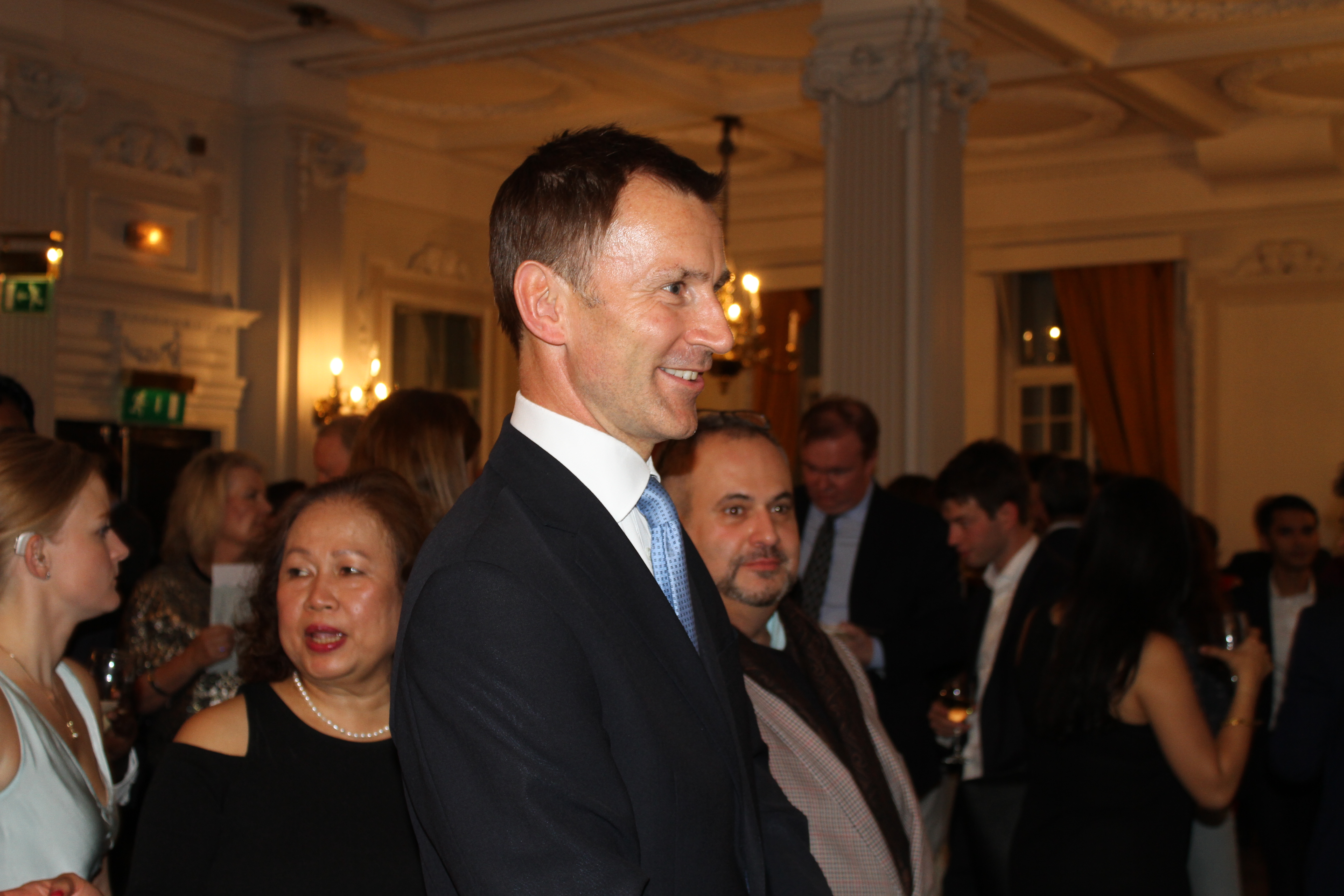
Zac Goldsmith, LondonONEradio Staff. Photo by Leslie Weir, LondonONERadio- BenTVJeremy Hunt, LondonONEradio Staff. Photo by Leslie Weir, LondonONERadio- BenTV
The celebration has been accompanied by the amazing entertainment given by the acclaimed Italian tenor Yuri Sabatini and Giuseppe Mauriello, Laura Araldo, the guitarist Domenico Ranieri and The Tony P Riccio Trio.
LondonONEradio managed to question Jeremy Hunt, Secretary of State for Health about the importance of the mediterranean diet:
Do you think it is important to support the mediterranean diet and to promote it in the UK?
Absolutely, because we now have a huge amount of evidence that mediterranean diet is less salt, less red meat, more fish, olive oil instead of butter and this reduces cholesterol and therefore it reduces the risk of heart disease, cancer, even things like Alzheimer and dementia. So it’s the best way of eating healthily and it’s also delicious. So most of this diet you go on, you have to deny yourself the best things, but actually the mediterranean diet is healthy and delicious so we would love more people to be on the mediterranean diet.
What is your plan of action about obesity? We know that in the past few years Uk developed and faced severe problems linked to obesity.
Well, we have the second largest problem with obesity in the whole of Europe, and we are very worried particularly for children who spend a lot of time behind computers, not as much time as they used to out and about playing. So we have a big plan to change it: we want to get children more active, we want to encourage manufacturers to reduce the sugar content in their food as there’s a lot of sugar in things like frozen pizzas, and actually you can reduce the sugar and not affect the taste. So we want to encourage people, encourage the manufacturers to do that, but we also need to promote understanding among consumers about an healthy diet and certainly mediterranean diet is a big part of that.
So is it possible to say that embracing the mediterranean diet would be the “best thing” for the UK population?
I think that we have to be careful because in this country people don’t like politicians telling them what to eat, so probably if you want to promote a mediterranean diet it’s not helpful to have Jeremy Hunt telling everyone to eat it. But I think you do the best job marketing it yourself. I mean the quality of Italian food that you can get in the UK, now, is transformed compared to 20 or 30 years ago. But I think, what I can do is to encourage everyone to recognize that olive oil is more healthy than butter, that fish is more healthy than red meat, and Italian food is a great way to enjoy those things.
Jeremy Hunt, LondonONEradio Staff. Photo by Leslie Weir, LondonONERadio- BenTV
Last but not least: which is your favourite Italian dish?
My favourite Italian dish? I have absolutely no hesitation in telling you the answer to that. I have a small holiday house in Sicily and the “Antipasti” from Sicily, they are my favourite. I am sorry if you’re from the north of Italy, but they are much nicer than “antipasti” from the North. And my daughter favourite dish, without doubt, is Gelato, but for me it’s the “antipasti”.
The event had both an educational and charitable aim: in fact, the 20% of profits from the tickets sale will be used to help the people struck by the earthquake in Italy.