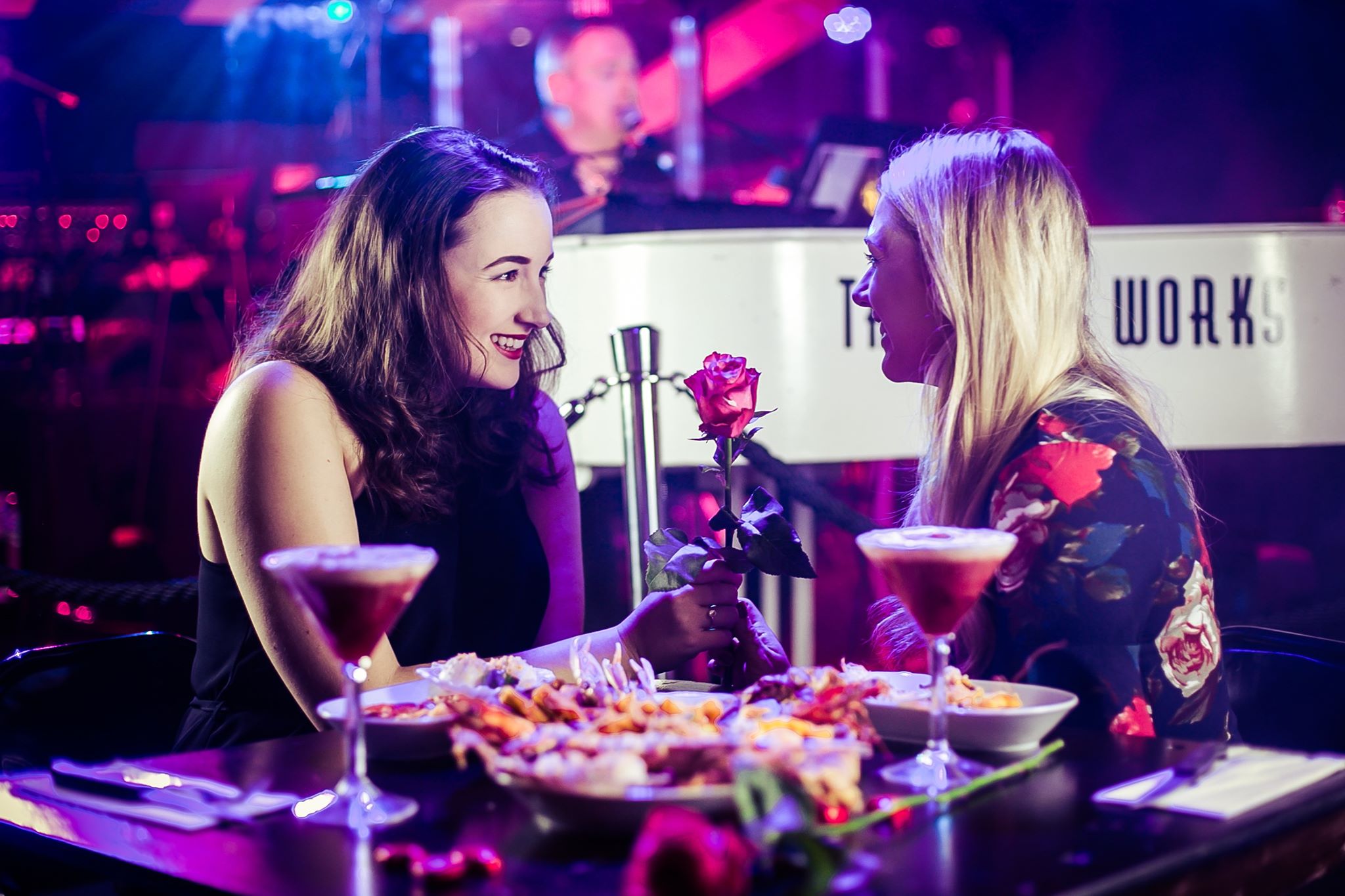
Celebrate your Valentine’s Day atTHE PIANO WORKS by dedicating a song to your partner or simply to someone who catches your eyes.
It will be possible to taste a romantic menu accompanied by the in-house six-piece band that will be ready to call out your request, or you can just join the late-night party (free entry after midnight).
The event is a great opportunity to meet new people: guests will in fact receive a numbered sticker that they are encouraged to wear in order to be recognized by possible secret admirers, so that they can dedicate or be dedicated a song. Once the song is played, it will be possible to trace the number and, why not, to find love.
To increase the possibilities of matching, there will be also a Cupid matchmaker that will help guests in finding the perfect song and shoot the arrow of love. This will ensure an outstanding date night experience, bond over amazing music.
The dinner includes a three-course menu with a glass of Moët & Chandon and a selection of dishes such as tuna tartar with guacamole and wasabi mousse, a sharing sea food platter, or côte de boeuf. Vegans and vegetarians are equally catered for, with delights such as vegan walnut pâté and shepherd’s pie. End on a high note with a pear and liquorice strudel or warm chocolate brownie with salted caramel.
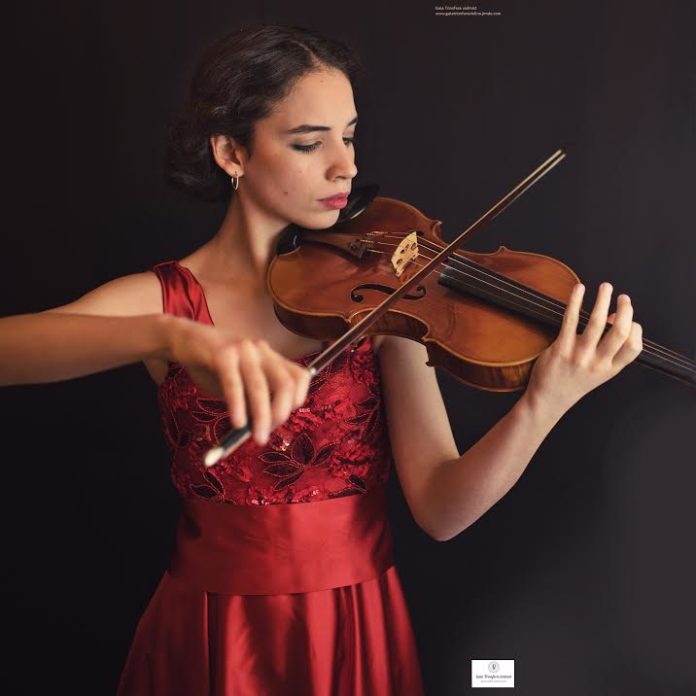
Gaia Trionfera, born in Assisi in 2000, dazzles the international audience with her best friend, the violin, with which plays music written by important musicians such as Mozart, Beethoven, Strauss, Paganini, and who left relevant traces in the music world.
Since she was a child, she has always been interested in classic music that currently leads her to study five or six hours per day, in order to become a protagonist of significant Italian and abroad theatres. In fact, to reach her goal she has already started her career, at her current age of sixteen, by planning gigs and tours around the world.
One of her current and important stages is the Italian Embassy in Vienna, where on 3rd April she performed as a solo. Living in Vienna for already one year is allowing her to understand better the music culture, even thanks to her teacher, Dora Schwarzberg who is very admired by the little Gaia and with whom she spends most of her time.
In fact, her music devotion makes Gaia very busy, especially when her schools commitments interfere between her and her violin. It is required a great daily organisation and this is a peculiarity that distinguishes her from some peers.
It seems there is no time for Gaia’s life, everything flies quickly, but at the same time her music tries to dilate it, as she also confirmed.
Playing requires engagement and constancy, but for who has a deep love towards any jobs, that work becomes pleasure.
Talking about her past and next music experiences, Gaia also tackled and explained, on London One Radio, themes that are deprived into an automated world by revealing part of the current generation’s thoughts.
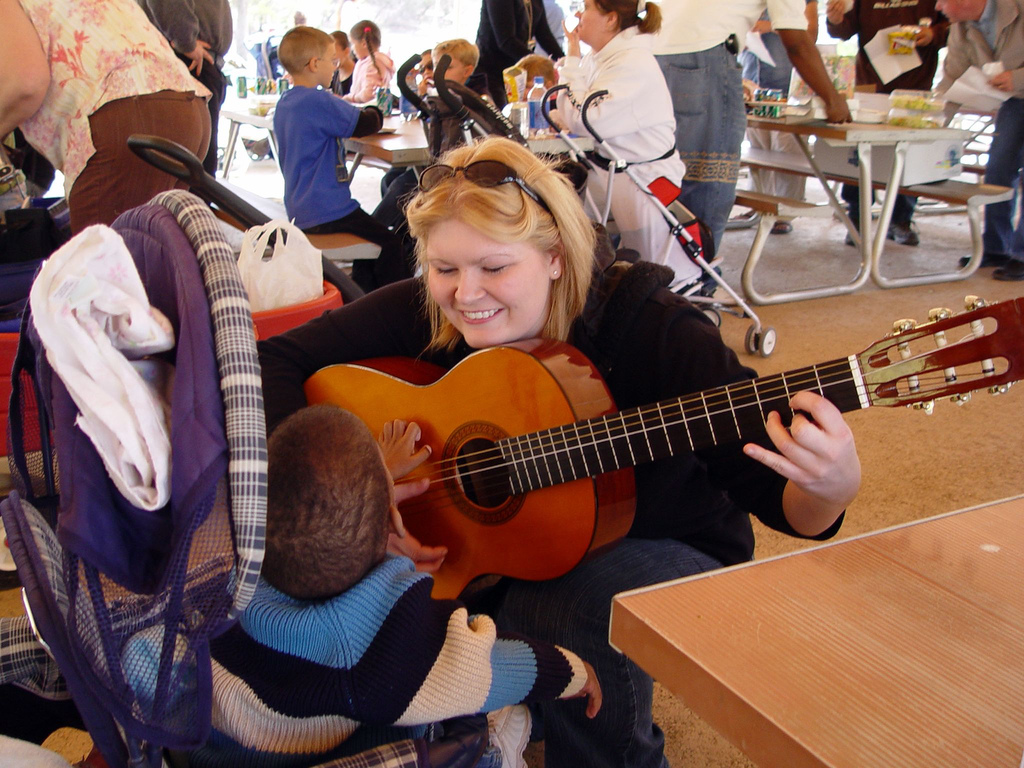
Timothy[1] and Grace are sitting face to face. “Tap.. tap.. tap.. t-tap.. tap..” A five year-old, Timothy keeps is eyes down on his coffee cup, his small fingers tapping on it. And so Grace goes: “Tap.. t-tap.. tap.. tap..” Just then Timothy’s eyes slowly rise to meet Grace’s.
Timothy is an autistic child, while Grace Watts is an NHS music therapist and the Development Director for the British Association for Music Therapy.
“An established psychological clinical intervention, which is delivered by Health and Care Professions Council registered music therapists, to help people of all ages, whose lives have been affected by injury, illness or disability through supporting their psychological, emotional, cognitive, physical, communicative and social needs.”
Ms Watts explains that music therapy in the UK is based on a musical improvisation that takes place between the client and the therapist. But people like Timothy are not the only ones who benefit from this kind of treatment because “music therapy is an intervention for all, from mums to be and their babies to people at the end of their lives”. People usually access it via social care and charitable donations, others are able to pay for it privately.
Being widely accessible and 100% natural, music therapy is becoming more and more popular in Islington, Hackney and Shoreditch.
Located in the heart of Islington, the now BAMT was founded in 1958 by French cellist and music therapy-pioneer Juliette Alvin as the “British Society for Music Therapy”. The charity doesn’t deliver music therapy, but is the biggest point of reference in the field, supporting education, research, therapists and patients.
Schools, in particular, benefit from music therapy services offered by the NHS and the Nordoff Robbins centre. The Richard Cloudesley School, for example, has proved to be one of the most active schools in the area by offering their primary and secondary children a weekly music therapy session with personnel from the Nordoff Robbins centre.
“Music is intrinsic to being human, it doesn’t depend on one’s own education or cultural background,” argues Peter Morrell, singer and Music student at City, University of London.
“What we do as therapists is exploiting the innate musical qualities of people to tap into the problems they have,” says Ms Watts. Music, in fact, is an innate non-verbal language and it’s especially useful to people who struggle to communicate with words. “In this case it benefits both the patients and the people around them,” she concludes.
Donald Wetherick, Clinical Tutor in Music Therapy at the Guildhall School of Music & Drama, says that the treatment is so effective that the number of Music Therapists in the UK has almost doubled in size over the last decade, going from just over 500 in 2006 to 951 in 2016. The data is surprising if we consider that Occupational Therapists, Physiotherapists and Speech and Language Therapists are facing a decrease in the number of registrants per year, despite having access to Government funding for their training that music therapists don’t have.[2]
Credit: British Journal of Music Therapy
The treatment is usually run alongside other conventional therapies. “It’s not a cure, but it can help the healing process,” says Mr Wetherick.
Journey into the room of a music therapist…
“We invite the patient, or patients, into a room with accessible instruments,” starts Luke Annesley, music therapist and former lecturer in Music Therapy at City, University of London. The therapist then tries to make the patient comfortable and waits for his response to the instruments. Once the patient starts making some sounds, the therapist would respond and try to create a musical dialogue with the person. “I would always tell people that they are in a therapy session,” he explains, “it’s better to be sincere rather than forcing them to do something they aren’t willing to do.
“Music therapy, however, is a nebulous term,” argues Evan Dawson, Live Music Now Executive Director.
Today “music therapy” is also a synonym of “music as beneficial”. This is the reason why people in Islington, Hackney and Shoreditch perceive listening to and practicing music as something that will “heal mental and physical pain”, “reduce stress and anxiety levels”, “make you feel happier and stronger”, “help you to cope with sadness and loneliness”.
This is exactly what Live Music Now does. The organisation has its main branch in Kings Place and trains professional musicians to play music for children with particular educational needs and older people living with dementia or experiencing loneliness. “We believe that live music can provide significant social and clinical benefits,” argues Mr Dawson. The charity, which runs around 3000 live music sessions a year, has recently launched a new strategy called “Bringing music to life (2017-2022)” in order to gather the community and ensure music plays “a greater role in our society”.
“Playing together also improves social skills, such as communication and respect for the other,” states Chas Mollet, volunteer at Wac Arts. The Hampstead-based charity supports inclusivity in the arts and media training, and works in co-operation with schools and charities in Islington to run state-funded music therapy workshops. Mr Mollet works with avant-garde technologies that enable people with disabilities to play music: “We try to remove all the barriers they might face.”
Whether it’s used as clinical intervention or a beneficial activity, music therapy has had a positive impact within the communities of Islington, Hackney and Shoreditch. “It may not be a cure, but you enable people to have fun, and all the positive effects will come along,” concludes Mr Mollet.
[1] Name has been changed for legal reasons.
[2] British Journal of Music Therapy, Stephen Sandford
Combining sport and fun is possible: the first fitness night club has just opened in London. Through the combination of music and workout, The Arches seems to be a good alternative to every person’s sport routine. The new initiative, organised by Ministry of Sound, one of the most famous clubs in the City, is called Ministry Does Fitness.
The idea behind it is to create a parallel between sport activities and amusement: music is loud as it is normally in a club, but people wear comfortable clothes allowing them to work out easily. The union of music and sport, indeed, seems to foster people’s wellbeing and to create positive mood.
Every class has a well-organised playlist, aiming to make people work harder and get better results. Classes run from Monday to Sunday and there is everything from sculpting to strengthening, from lengthening to tum-toning, to fat burning. Classes can be booked online and a timetable is available on the website of the club. It is also possible to buy packages which offer weekly or monthly deals to save same extra money.
While doing sport, you can buy and enjoy a protein shake or a coffee from the club’s bar, to help you feel more motivated.
The Arches, whose address is Arches 80 and 81, Newington Court, London, SE1 6DD, seems to be already a successful business, which people who love music and sport in the same way really cannot miss.
“The most dangerous band in the world” is coming back – Guns N’ Roses are going to play a gig at London Stadium on 16th and 17thJune.
After the breakage of the band, they have switched back recently: the guitarist Saul Hudson (Slash) and the bassist Michael Andrew McKagan, known as ‘Duff Mckagan’, decided to reappear in 2016 with their colleague Axl Rose. In fact, they are debuting with one of their first albums, ‘Appetite for destruction’, playing the most sung and known singles of rock music: ‘Sweet Child O’ Mine’, ‘Paradise City’, ‘Welcome to the Jungle’; among their covers there are ‘Knocking on Heavens’ Doors’ and ‘Let it die’.
‘Not in this Lifetime’ Tour has already started at the beginning of 2016, but the Guns N’ Roses have decided to extend the stages in North America, Europe, New Zeeland, Australia, and Asia for the new year. Among the European stages listed in their notebooks there are: Dublin, Imola, Stockholm, Prague, Paris, Vienna, Madrid, Zurich, Bilbao, Lisbon and many others. Videos of the latest concerts are on the web, showing Axl Rose like an old buccaneer: sitting on a great throne with a foot support.
He got an injury to the fifth metatarsal during a concert in Los Angeles. As Rose posted on Twitter: “This is what might happen when you do something that you did not use to do for nearly 23 years.” However, what is not broken is his voice: accompanied by the most famous solos of Slash, he excites the audience.
The adrenalin is also growing in the UK: London is running out of tickets and sales are going up. The countdown is almost over and the lovers of rock are ready to welcome the bad boys, who are as energetic and brilliant as in the past.
 The event is a great opportunity to meet new people: guests will in fact receive a numbered sticker that they are encouraged to wear in order to be recognized by possible secret admirers, so that they can dedicate or be dedicated a song. Once the song is played, it will be possible to trace the number and, why not, to find love.
 ët & Chandon and a selection of dishes such as tuna tartar with guacamole and wasabi mousse, a sharing sea food platter, or côte de boeuf. Vegans and vegetarians are equally catered for, with delights such as vegan walnut pâté and shepherd’s pie. End on a high note with a pear and liquorice strudel or warm chocolate brownie with salted caramel.