“The art of making buildings”, Renzo Piano’s poetry

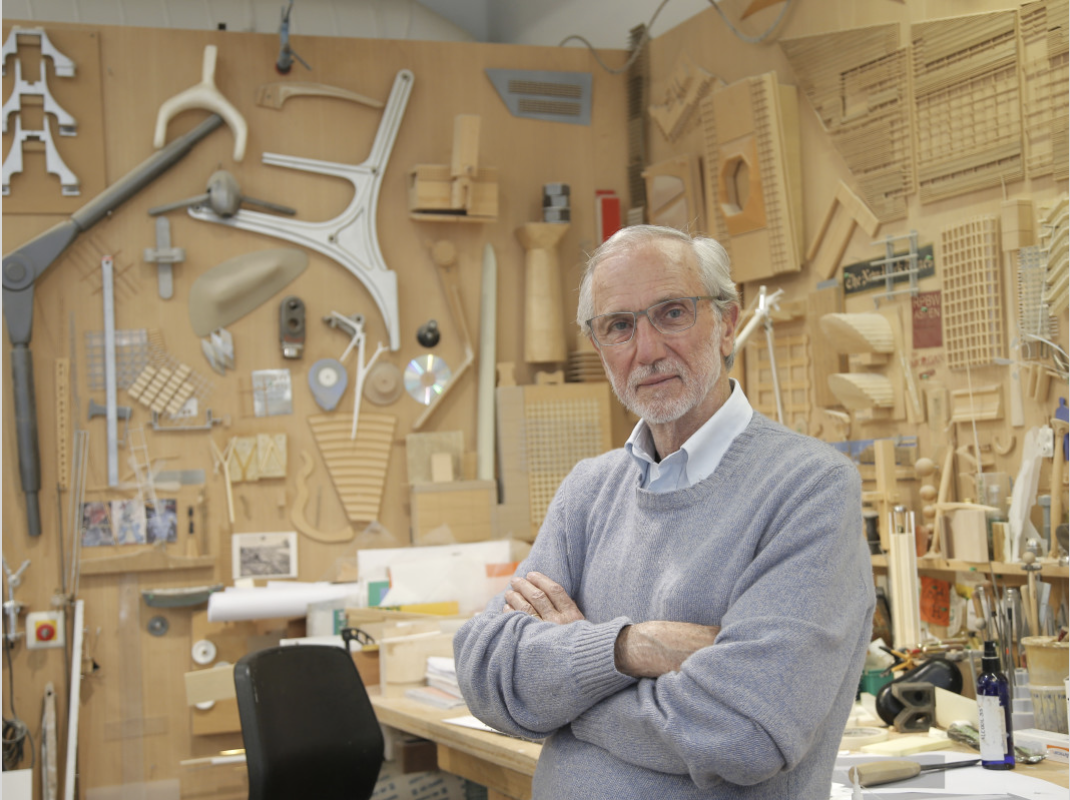
London (Giulia Faloia) – The Royal Academy presented “The art of making buildings”, an exhibition of Renzo Piano’s buildings.

On 12th September the most famous Italian architect was in London for the launch of the exhibition that will officially start the 15th September. It was organised by the Royal Academy of Arts in collaboration with Renzo Piano Building Workshop and the Fondazione Renzo Piano.

The exhibition was born with the idea of following step by step Mr Piano’s career, from the influence of his Genoese heritage and his rise to the meeting with his friend and collaborator Richard Rogers, to current projects still in the making. 

The protagonists of the exhibition are 16 buildings, by which people can easily understand how the Renzo Piano Building Workshop designs buildings “piece by piece”, making deft use of form, material and engineering to achieve a precise and poetic elegance.

Mr Piano himself took part at the presentation on the 12th September by talking about the importance of architecture nowadays and its influence on our daily lives. He focused mainly on what he calls “fil rouge”, the idea that architecture has its continuity in time and space. 

https://youtu.be/FWdQ047i1eI

He also added that the same art must be used for people and that it represents a change in society. Architecture, as he claimed, gives you the illusion that it changes the world, when actually everything and the world itself is under a constant transformation.

Piano also said that he would like that people look at buildings not just as they are, but finding behind their structure something more: “maybe poetry”, in order to catch more than the simple construction.

The architect, as an Italian and as a Genoese, couldn’t avoid to talk about  the tragedy happened in Genoa when the bridge Morandi collapsed.

He said that a bridge falling goes beyond the collapse itself, because it is a symbol of connection that falls. First, a bridge should never fall and walls should be shot down, while nowadays the exact opposite is happening, metaphorically and in the real world.

At the following link you can listen to the whole interview had with the curator and creator of the exhibition, Kate Goodwin.
 

Four Bright Hands

written by Mirianna la Grasta

Walking through Carnaby Street is a tiny Italian woman. Her meticulous and curious gaze stops on every single detail in the street. “You know what?” she wonders, “London is better than Paris, I feel inebriated by its magic atmosphere.”

But then she stops. She looks up to the grey sky. Her face clouded with disappointment. “This city needs a bright brush stroke.”

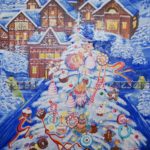
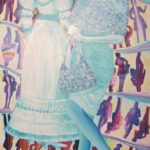
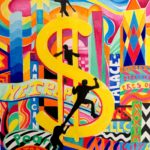
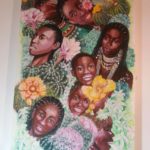
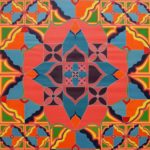
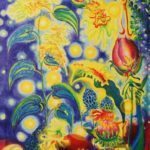
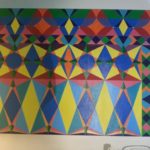
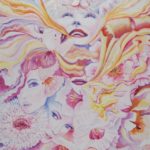
Rosa Iacobone is obviously not a common woman. She met Marcella Sacino when she was 20. They were both teaching to their students the importance of colour: “An element that we can only see thanks to the light.” Since then, they have painted together, with “four hands”.

Every afternoon, from Tuesday to Friday, Rosa stands in front of big canvases, surrounded by a selection of warm and bright acrylic paints. Colours, in fact, are vital for her: “They aren’t just a tool to express an idea, they are the message.” Warm and bright colours stand for optimism, they wipe negative feelings out and “push the human mind to overcome the obstacles”, she argues.

The room where she works is often silent, or there is some music in the background. Rosa uses the “four hands-painting” to get away from the “routine of adulthood”. The intimate relationship she has with art satisfies and inspires her life. “Painting is something I always did for myself,” she says, “I never showed my art to the public until a couple of years ago.” So she stands in front of her canvases, and waits for the instinct to guide her.

Rosa takes her brush and chooses a starting point. She moves the brush slowly on the cloth. Then comes Marcella, her “Siamese colleague”. They don’t even need to talk: “We have the same ideas, we work in harmony with four hands and we create the piece spontaneously,” she explains. Rosa always feels to have a “perfect artistic bond” with Marcella. She thinks they are a “one-artist” when they paint: “There’s a sort of telepathy between us.”

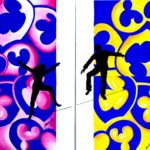
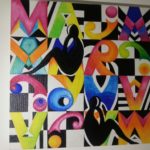
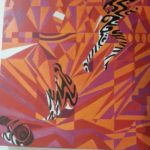
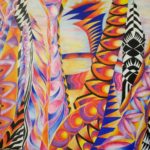
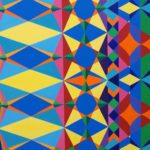
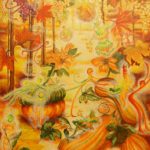
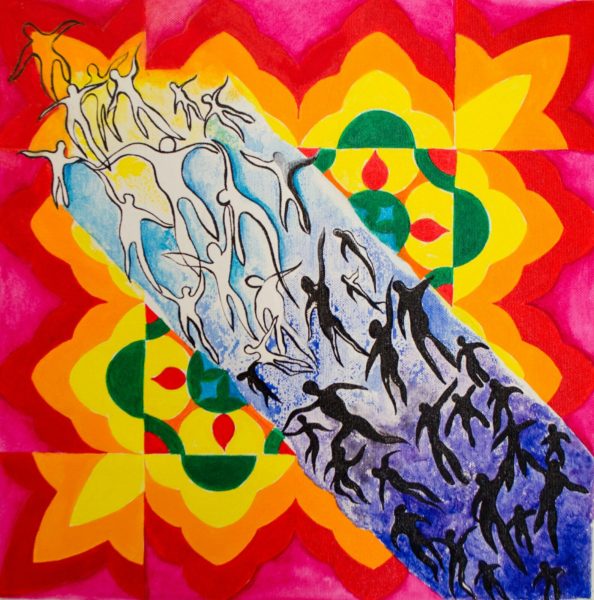
Together with her “second pair of hands”, Rosa experiments various artistic styles, coming from very different historical periods and parts of the globe. Then, she mixes them altogether to create a new contemporary art that looks at humans from an outside perspective. “In Evoluzione” (evolving), a mix of geometries and futurism, is the perfect synthesis of her art. It shows a man going through different emotional stages: he is initially grieving, curled up in the floor, then, he gradually gets up to overcome his obstacles. “The colours are vivid, and they express the man’s will to embrace life,” she explains.

“As a one-artist, we receive serenity through the act of painting, and this is exactly what we want our public to experience,” Rosa concludes.

On her left the blue Italian sky enters the window. All around her thousands of warm canvases adorn the house. “In Evoluzione” is on her right. “Ciao bella!” she says before closing the Skype call. Behind her, a photo of her walking through Carnaby Street.

To discover more about Rosa Iacobone, Marcella Sacino and their paintings visit PITTURA4MANI