International astronomers unlock secrets of intergalactic space blob

An international team of astronomers led by the University of Hertfordshire have solved the mysteries of a giant space blob by witnessing galaxies forming inside the intergalactic gas cloud.

Lyman-alpha Blobs (LABs) are gigantic clouds of hydrogen gas that can span hundreds of thousands of light years and glow far more brightly than scientists expect. And since their discovery, the processes that makes LABs glow so intensely has been an astronomical puzzle, until now. Scientists, led by Dr James Geach from the University’s Centre for Astrophysics Research, have confirmed that young galaxies are forming within the blobs, causing them to glow.

One of the largest LABs known, is SSA22-Lyman-alpha blob 1, also simply known as LAB-1. Within LAB-1 the team of scientists have found that two galaxies are forming and the blob is actually creating stars at a rate 100 times faster than our own galaxy, the Milky Way. It this intense nature of star formation that is lighting up the gas cloud so brightly.

businessinsider.com
businessinsider.com

Lead author Dr Geach explained: ‘Think of a streetlight on a foggy night — you see the diffuse glow because light is scattering off the tiny water droplets. A similar thing is happening here, except the streetlight is an intensely star-forming galaxy and the fog is a huge cloud of intergalactic gas. The galaxies are illuminating their surroundings.’

LAB-1 is the very first object of its kind discovered and was found 15 years ago. It is located so far away that its light has taken approximately 11.5 billion years to reach Earth. It measures 300,000 light years across and is three times larger than the Milky Way.

To monitor such a large mass, the international team, led by the University of Hertfordshire, used the Atacama Large Millimeter/Submillimeter Array (ALMA), a group of highly developed telescopes that can observe light from dust clouds in distant galaxies millions of light years away.

This meant they could accurately pinpoint several sources of radiation and light within the space blob, where they spotted the two young, growing elliptical galaxies. They then combined the ALMA images with observations from the Multi Unit Spectroscopic Explorer (MUSE) instrument mounted on European Southern Observatory’s Very Large Telescope (VLT). This maps the light that is emitted from the blob, known as Lyman-alpha light and it showed that the sources of light are the forming stars in the very heart of the Lyman-alpha Blob.

Then deep imaging with the NASA/ESA Hubble Space Telescope and spectroscopy at the W. M. Keck Observatory showed in addition that the ALMA sources are surrounded by numerous faint companion galaxies that could be bombarding the central ALMA sources with material, helping to drive their high star formation rates.
Dr Geach added: ‘What’s exciting about these blobs is that we are getting a rare glimpse of what’s happening around these young, growing galaxies. For a long time the origin of the extended Lyman-alpha light has been controversial. But with the combination of new observations and cutting-edge simulations, we think we have solved a 15-year-old mystery: Lyman-alpha Blob-1 is the site of formation of a massive elliptical galaxy that will one day be the heart of a giant cluster. We are seeing a snapshot of the assembly of that galaxy 11.5 billion years ago.’
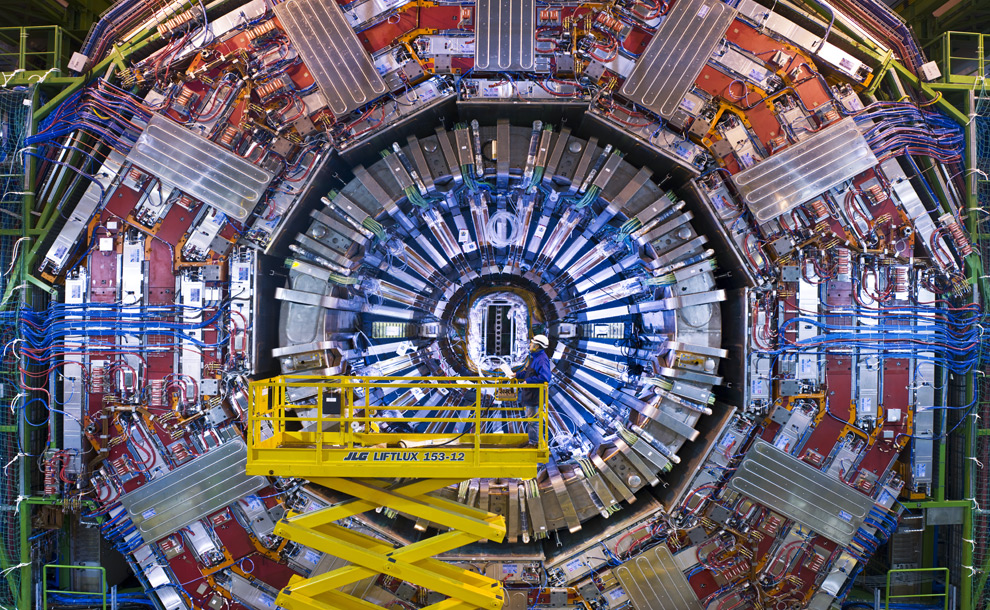
LHC restart update

LHC run 2 is coming ever closer. Seven of the machine’s eight sectors have successfully been commissioned to the 2015 operating energy of 6.5 TeV per beam, and the eighth is not far behind. There will, however, be no circulating beam in the LHC this week. An intermittent short circuit to ground in one of the machine’s magnet circuits was identified on 21 March and is under investigation.

It is a well understood issue, but one that could take time to resolve since it is in a cold section of the machine and repair may therefore require warming up and re-cooling after repair.

“Any cryogenic machine is a time amplifier,” said CERN’s Director for Accelerators, Frédérick Bordry, “so what would have taken hours in a warm machine could end up taking us weeks.”

Current indications suggest a delay of between a few days and several weeks. A full assessment is on going, and a revised schedule will be announced as soon as it is known.

Whatever the case, the impact on LHC operation will be minimal: 2015 is a year for fully understanding the performance of the upgraded machine with a view to full-scale physics running in 2016-2018.

“All the signs are good for a great run 2,” said CERN Director General Rolf Heuer.

“In the grand scheme of things, a few weeks delay in humankind’s quest to understand our universe is little more than the blink of an eye.”

Find supermassive black hole blasting molecular gas

Astronomers find supermassive black hole blasting molecular gas at one million kilometers per hour from a galaxy

 New research led by Clive Tadhunter (Sheffield University) and including Raffaella Morganti, Tom Oosterloo (ASTRON/Kapteyn Institute Groningen University) and Raymond Oonk (ASTRON/Leiden University), has solved a long-standing mystery surrounding the evolution of galaxies, which deepens our understanding of the future of the Milky Way.

The supermassive black holes in the cores of some galaxies drive massive outflows of molecular hydrogen gas. As a result, most of the cold gas is expelled from the galaxies. Since cold gas is required to form new stars, this directly affects the galaxies’ evolution.

These outflows are now a key ingredient in theoretical models of the evolution of galaxies, but it has long been a mystery as to how they are accelerated.

The study provides the first direct evidence that the molecular outflows are accelerated by energetic jets of electrons that are moving at close to the speed of light. Such jets are propelled by the central supermassive black holes.

Using the ESO Very Large Telescope in Chile to observe the nearby galaxy IC5063, the researchers found that the molecular hydrogen gas is moving at extraordinary speeds – 1 million kilometers per hour – at the locations in the galaxy where its jets are impacting regions of dense gas.

These findings help us further understand the eventual fate of our own galaxy, the Milky Way, which will collide with neighbouring galaxy Andromeda in about 5 billion of years. As a result of this collision, gas will fall to the centre of the remnant of this collision, but the jets coming from the central supermassive black hole will, in a way similar to what is now observed in IC 5063, eject the gas from the system, preventing the formation of new stars and growth of the newly formed galaxy.

Clive Tadhunter, from the University’s Department of Physics and Astronomy, said: “Much of the gas in the outflows is in the form of molecular hydrogen, which is fragile in the sense that it is destroyed at relatively low energies. I find it extraordinary that the molecular gas can survive being accelerated by jets of highly energetic particles moving at close to the speed of light.”

“We suspected that the molecules must have been able to reform after the gas had been completely upset by the interaction with a fast plasma jet.” says Morganti “Our direct observations of the phenomenon have confirmed that this extreme situation can indeed occur. Now we need to work at describing the exact physics of the interaction”.

The results are published in Nature on the 6th of July and they are connected to the project ‘Exploiting new radio telescopes to understand the role of AGN in galaxy evolution’, for which Morganti received from the European Research Council an Advanced Grant of 2.5 Meuro last year.


About ASTRON
ASTRON is the Netherlands Institute for Radio Astronomy (www.astron.nl). Its mission is to make discoveries in radio astronomy happen, via the development of novel and innovative technologies, the operation of world-class radio astronomy facilities, and the pursuit of fundamental astronomical research.

The Trilussa’s chicken

The real trouble with this world of ours is not that it is an unreasonable world, nor even that is a reasonable one. The commonest kind of trouble is that it is nearly reasonable, but not quite.

G. K. Chesterton, “ Orthodoxy ”

The Italian poet Trilussa said that Statistics is the science according to which if you eat two chicken a day and I eat none, on the average you and I eat a chicken a day. This is an emblematic case of misuse of Statistics through overworked averages. In fact, the statistical science is based not on one, but on two main concepts:
i) the assessment of the central value of a set of numbers, the average;
ii) the measure of how the individual numbers distribute themselves around the average. Do they cluster closely about it, or they scatter widely? Which is their variability?
Thus, the degree of variability of a set of numbers around the average gives material significance to the average itself.
As there are a few types of averages so are there a few types of variability measures.
Since Trilussa used the arithmetic mean in his discourse, let us introduce a variability measure commonly used in similar cases: the coefficient of variation, ranging from zero – for flat homogeneous sets – to 100% – for the extreme heterogeneous sets.
Going back to the chicken’s story, should we be told that Tom and Dick eat a chicken a day on the average, with a coefficient of variation equal to 100%, anyone who had a minimal statistical knowledge would understand at once that either Tom or Dick grasp always two chicken.
If in the country of Tom and Dick the GDP should grow by 2 – 3% on yearly basis, both of them knew, by experience, that their income would not do the same, since averages are working again.
For simplicity sake let us consider a case with no GDP growth. In a given year four people have an income of £15,000, £20,000, £28,000 and £37,000 respectively. By making the arithmetic mean such a group has an average income per capita equal to £25,000, with a coefficient of variation of 33.2%. Should in the subsequent year the same people have an income of £13,000, £18.000, £30,000 and £39,000 respectively, the average income per capita would be again £25,000, but with a coefficient of variation equal to 40.7%. It means that the income diversity, i.e. the economic inequality, has grown by more than 20%.
Life evolves by breaking crystallized symmetries so as to generate a new life and new orders. Likewise countries and nations progress and flourish in building up more and more structured societies by giving merit to the more talented and industrious people. For this reason economic inequality is endemic in evolving human communities as it is asymmetry in Nature. But economic inequality can trigger deprivation, illiteracy and antisocial behaviour, which undermine the standard of life of any community.
Adam Smith, ( 1723 – 1790 ), father of economic liberalism, stated in The Wealth of Nations that man is possessed of a certain “fellow feeling ”: How selfish soever man may be supposed, there are evidently some principles in his nature which interest him in the fortune of others, and render their happiness necessary to him, though he derives nothing except the pleasure of seeing it.
Since the respect of rights of the diverse ones – as deviating their way from recognized averages – is taking ground in mature democracies, we need to know better how diversities work.
It is said that we are living in the Age of Statistics. Actually we are living in the age of overworked averages. In order to tackle new challenges democracies have to deal with diversity and variability in a knowledgeable way. Otherwise people distrust statistical data not reflecting their effective situation. However, it is not duty of statisticians to assess the limit allowed for a kind of diversity, or an economic inequality. The only task of statisticians is to provide the public with the best tools for debating about diversities, or sustainable economic inequalities. Therefore we need to be more acquainted with the neglected twin brother of the abused average, named variability.


photo caffescirocco.wordpress.com

Origin and dynamic of Roulette

The record of a month’s roulette playing at Monte Carlo can afford us a material for discussing the foundations of knowledge. 

Karl Pearson ( 1857 – 1936 ), leading founder of modern Statistics.

At the end of the eighteenth century, in the years of the French Revolution, republican chemists, physicists and mathematicians decided to make order once for all in the jungle of national European measures by implementing everywhere the decimal standard. The French scientists endeavoured to convert even time to the new revolutionary system, but they collided with the fierce resistance of the watchmakers who required to sell all old watches in stock before conforming to the new rules. In these very years the roulette game took ground even though it was based on an awkward variant of the execrated sexagesimal system.
The number 36 is the highest score when tossing six dice. When we play with one die the six possible outcomes have the same probability, 1/6. With two dice things start to become difficult. We can get 2, or 12, by one combination only (1, 1; or 6, 6;), and the relevant probability is equal to 1/36 (1/6 x 1/6 ) for both.

As for the remaining outcomes we have to take into consideration more possible combinations. We can get 3 through: 1, 2 and 2, 1; probability = 2/36. Moreover we can get 4 through: 2, 2; 3, 1; 1, 3; probability = 3/36, and so on. Things go from bad to worse when playing with 3, 4, 5 and 6 dice. In such a situation only professional gamblers have the working knowledge for betting on the more probable numbers, i.e. the ones obtainable with more combinations.
By including in the betting range the first 5 digits the roulette made a democratic revolution in the games of chance: every number, from 1 to 36, has the same odds and all the players have the same chances to win. At roulette any number, as for instance 6, has an outcome probability equal to: 1/36 = 0.02777. Instead, in a six dice – game the number 6 ( six times 1’s ) has the utmost remote probability of outcome, equal to: 1/6 x 1/6 x 1/6 x 1/6 x 1/6 x 1/6 = 1/46,656 = 0.000021433.

roulet3This means only once, on average, out of more than 46,600 six dice tosses; whilst we can get same result within 36 rounds, on average, of roulette. We say on average since our number will not be caught necessarily within 36, or 46,656 trials. According to the Law of large numbers ( Jakob Bernoulli, 1654 – 1705 ) by increasing the number of identical trials the average number of successes comes closer and closer to the relevant probability values.
In the course of a game of chance players and casino’s entrepreneurs, the bankers, are more and more exposed to the probability of ruin, the risk of losing their capital because of adverse number sequences.
At roulette the payout of any bet on a number is 36 times what placed on it. Actually there are 38 pockets in the roulette wheel, 36 for numbers from 1 to 36, plus 2 more: one for the single zero and another for the double zero. Consequently, the true probability to catch a number is: 1/38.


In Probability Theory the Mathematical Expectation is the amount obtained by multiplying the magnitude of the prize by the probability of catching it. Thus, if at roulette we bet £1 on a number our mathematical expectation is £36 (what we can win ) x 1/38 ( probability to get it ) = £ 0.947. We have the same amount in any roulette’s game: colour, carré, dozen, etc. In such a way bankers have a profit margin equal to 2/38 = 5.3%, on average, of the overall money at stake. This means that in the course of time the capital of overall players is more and more eroded whilst casino’s entrepreneurs gain more and more. Even at roulette the public can go bust, bankers cannot.

Research to search for Einstein’s missing link

Research to search for Einstein’s missing link Gravitational waves were predicted by Albert Einstein almost a century ago but they are yet to be directly detected. Scientists are now trying to measure them in an attempt not only to confirm a key prediction of Einstein’s General Theory of Relativity, but also enhance understanding of the fundamental nature of our Universe. Physicists from the University of Glasgow have been awarded a £4.2 million Science & Technology Funding Council (STFC) grant to develop new technologies to test for the existence of gravitational waves.

Continue reading Research to search for Einstein’s missing link

The origin of Universe

Scotland takes centre-stage as mission to probe the origin of the Universe gets the go-ahead

Scottish scientists will be at the heart of a completely new type of space mission that will detect the ripples in space time caused by some of the most violent events in the Universe.

The Science Programme Committee of the European Space Agency (ESA) announced today that one of their next two Large (L-class) missions will be to probe the ‘Gravitational Universe’ by establishing a gravitational wave observatory in space. This study will aim to detect gravitational waves and open up hidden chapters in the history of the Universe by listening to the waves made by the earliest black holes, and probably by the Big Bang itself.

The proposed mission, known as the evolved Laser Interferometry Space Antenna (eLISA), is planned to launch in 2034. It will build upon technologies already developed by scientists at the University of Glasgow’s Institute for Gravitational Research (IGR) for the ESA’s LISA Pathfinder probe. LISA Pathfinder, which is due for launch in 2015, will demonstrate key eLISA technologies in space, including the ultra-sensitive optical measurement system built at the University of Glasgow.

Dr Harry Ward, who leads the University of Glasgow LPF and eLISA work, said: “For the UK, the decision is great news. The very significant UK Space Agency investment in developing the LISA Pathfinder payload will now bear fruit and with eLISA we can look forward to a rich scientific output from what promises to be one of the most important astronomical observatories of our time.

“This is a once in a lifetime opportunity to be at the heart of a mission that will yield completely new insights into the nature and origin of our Universe. It’s testament to the excellence of the work going on in Scotland today that a considerable part of the technology that will allow us to answer the most fundamental of questions will be developed by the University of Glasgow.”

Alongside investigating the origins of the Universe, observation of gravitational waves will provide powerful insight into the fundamentals of gravity, and into Einstein’s theory that predicted the waves in 1916. By observing how waves from early black holes are stretched out as they move toward us through the expanding Universe, the observatory will even shed light on the mystery of dark energy.

Between 2014 and 2020, eLISA technology will be optimized, followed by the final mission selection and commitment of international partners. In 2024 the industrial implementation will begin, with the payload supplied by a European consortium which also provides the flight hardware for LISA Pathfinder. The eLISA launch is planned for 2034.


The Gravitational Universe
The last century has seen enormous progress in our understanding of the Universe. We know the life cycles of stars, the structure of galaxies, the remnants of the big bang, and have a general understanding of how the Universe evolved. We have come remarkably far using electromagnetic radiation as our tool for observing the Universe. However, gravity is the engine behind many of the processes in the Universe, and much of its action is dark – it emits no electromagnetic radiation at all. Opening a gravitational window on the Universe will let us go further than any alternative. Gravity has its own messenger: Gravitational waves, ripples in the fabric of space-time. They travel essentially undisturbed and let us peer deep into the formation of the first seed black holes, exploring redshifts as large as z ~ 20, prior to the epoch of cosmic re-ionisation. Exquisite and unprecedented measurements of black hole masses and spins will make it possible to trace the history of black holes across all stages of galaxy evolution, and at the same time constrain any deviation from the Kerr metric of General Relativity. eLISA will be the first ever mission to study the entire Universe with gravitational waves. eLISA is an all-sky monitor and will offer a wide view of a dynamic cosmos using gravitational waves as new and unique messengers to unveil The Gravitational Universe. It provides the closest ever view of the early processes at TeV energies, has guaranteed sources in the form of verification binaries in the Milky Way, and can probe the entire Universe, from its smallest scales around singularities and black holes, all the way to cosmological dimensions.

The selection process
ESA’s next large missions selection process began in March 2013 with a Call for White Papers. More than 30 White Papers covering a broad range of topics in space science were submitted. 22 projects were presented in September 2013 to ESA’s Senior Survey Committee (SSC) and the broad scientific community. Following this the SSC chaired by Dr. Catherine Cesarsky advised ESA´s Director of Science and Robotic Exploration, Dr. Alvaro Gimenez, on the selection of the science themes for L2 and L3. Concluding this process the science themes for the L2 and L3 missions were selected by ESA’s Science Programme Committee (SPC).

 [photo frikipowerflunch.blogspot.com]

Scientists discover how the atmosphere of Mars turned to stone

Scientists at the Scottish Universities Environmental Research Centre, the University of Glasgow and the Natural History Museum in London may have discovered how Mars lost its early carbon dioxide-rich atmosphere to become the cold and arid planet we know today. This research provides the first direct evidence from Mars of a process, called ‘carbonation’ which currently removes carbon dioxide from our own atmosphere, potentially combating climate change on Earth.

It is widely recognised that accumulation of carbon dioxide in the Earth’s atmosphere is contributing to global warming. The loss of carbon dioxide from the atmosphere of Mars, however, around 4000 million years ago is likely to have caused the planet to cool. So understanding how carbon dioxide was removed from the Martian atmosphere could lead to new ways of reducing the accumulation of greenhouse gases in our own atmosphere.

In a paper published in the journal Nature Communications, the research team describe analyses of a Martian meteorite known as Lafayette, sourced from the research collections of the Natural History Museum in London and the Smithsonian Institution in Washington. It formed from molten rock around 1300 million years ago, and was blasted from the surface of Mars by a massive impact 11 million years ago. Since its discovery in Indiana, USA, in 1931, Lafayette has been studied by scientists around the world.

This research focused on a carbon-rich mineral called siderite. Although found in Lafayette previously, the team discovered that the siderite had formed by the process of ‘carbonation’, whereby water and carbon dioxide from the Martian atmosphere reacted with rocks containing the mineral olivine. These reactions then formed siderite crystals, replacing the olivine, and in so doing captured the atmospheric carbon dioxide and permanently stored it within the rock.

Lafayette provides direct evidence for storage of carbon dioxide in the fairly recent history of Mars, some time after 1300 million years. However as all of the ingredients for carbonation were present on early Mars, in the form of olivine, water and carbon dioxide, this reaction may explain how carbon dioxide was removed from the planet’s atmosphere changing its climate from warm, wet and hospitable to life, to cold, dry and hostile.

Whilst this process also occurs naturally on Earth, and is the focus of research examining methods of permanently locking up carbon dioxide from power stations, the magnitude of the effect on early Mars indicates that it has the potential to be effective on a planetary scale.

Dr Tim Tomkinson of the Scottish Universities Environmental Research Centre, Research Associate at the University of Glasgow and lead author of the paper, said “Mars once had a thick atmosphere that was rich in water and carbon dioxide, and so this process of carbonation may help answer the mystery of why the Martian climate deteriorated around 4000 million years ago.”

“This discovery is both significant in terms of the way in which scientists will study Mars in the future but also to providing us with vital clues to how we can limit the accumulation of carbon dioxide in the Earth’s atmosphere and so reduce climate change”.

Dr Caroline Smith, Curator of Meteorites at London’s Natural History Museum, and co-author of the paper said, “Our findings show just how valuable meteorites from Museum collections like those we have here at the Natural History Museum really are. There is so much important and useful scientific information locked away in these rare rocks. Our study shows that as we learn more about our planetary next door neighbour, we are seeing more and more similarities with geological processes on Earth.”

CERN’s ISOLTRAP reveals new magic in the atomic nucleus

The ISOLTRAP collaboration* has measured the mass of exotic calcium nuclei using a new instrument installed at the ISOLDE facility at CERN. The measurements, published on 20 June in the journal Nature, clearly establish a new “magic number” related to the stability of this exotic species. The results cast light on how nuclei can be described in terms of the fundamental strong force.

Continue reading CERN’s ISOLTRAP reveals new magic in the atomic nucleus

First three-year LHC running period reaches a conclusion

Geneva 14 February 2013. At 7.24am, the shift crew in the CERN1 Control Centre extracted the beams from the Large Hadron Collider, bringing the machine’s first three-year running period to a successful conclusion. The LHC’s first run has seen major advances in physics, including the discovery of a new particle that looks increasingly like the long–sought Higgs boson, announced on 4 July 2012. And during the last weeks of the run, the remarkable figure of 100 petabytes of data stored in the CERN mass-storage systems was surpassed.

Continue reading First three-year LHC running period reaches a conclusion