Let the games begin: where to watch the Olympic Games in London

It’s summer and it’s definitely time for the Olympic Games!

It is quite clear that London is not that blooming Rio de Janeiro, way too far from the exotic Brazilian city, but certainly not less dynamic, speaking about events.

However, the Britain Capital pays tribute to this thirty-first edition of the Olympic Games, combining a number of sports events in various places around the city.

Let’s see what’s planned.

Rio in Dalston(allevents.it)

In Dalston, Hackney, the local community has organised a festival with a very evocative name, Rio in Dalston, to be held from 5 to 21 August: a big screen will broadcast the Rio Olympics events live on the BBC, but you will also find shows, live music performances, film screenings, dj-set and much more.

The event is planned and supported by local volunteers and organisations in order to raise money for charities, especially those supporting refugees. The aim: ensuring that sport and culture become universally accessible.

The choice of Dalston as the main location to host the festival is quite emblematic: the neighbourhood has undergone a rapid change over the last years, looking for an uneasy balance between old and new, with social institutions threatened from real estate market pressures.

In this framework, start-up and non-profit organizations have grown showing how the universal language of sport and culture can actually bring people together.

On Friday, there will be the opening ceremony: you can take part for free from 8pm onwards at Ridley Road Market. Free admission also for the Brazilian Jazz Night at the Vortex Jazz Bar from 11.30pm.

The festival high regard is celebrating the importance of social inclusion, based on respect and solidarity, while ensuring equal opportunities for all.

On Wednesday 10 August, at Gillet Square, there will be the screening of Congolese Judo duo, officially representing the first Refugee Olympic Athletes team. A beautiful message about how diversity can be a strength and not a diversity sign.

Admission is free, following that there will be a music and poetry show performed by the Congolese band Kasai Masai.

Rio in Dalston will close on 21 August with the screening of the closing ceremony of the Olympic Games: live music, Brazilian barbecue, workshops and much more entertainment.

For the occasion, the highlights on the Big screen will be the men’s marathon and the men’s basketball final.

Speaking about Olympics, there are several places in town where you can watch the games on Big screens. Among them, we point out Pop Brixton, South London, summer meeting place for sport lovers; Broadgate Exchange Square, Moorgate and St. Katharine Docks where you will enjoy the comfort of sport competitions on a beach chair overlooking the picturesque harbour.

So let the games begin!

Are we alone in the Universe?

From the beginning the spark of life is everywhere, longing to spring up in the universe.

The Human Phenomenon – Pierre Teilhard de Chardin ( 1881 – 1955 ).

On May 10th NASA’s Kepler mission announced the discovery of the largest collection of planets ever to be found, a staggering 1,284. Launched in March 2009, Kepler is the first NASA mission to have detected earth – size planets orbiting stars in or near the habitable zone – the orbital region around a star in which liquid water may pool on a planet’s surface.

We have been learning more and more about the origin and structure of the universe, whilst yet remaining in complete ignorance as to whether or not mankind remains the only living system.

Some time before the launch of the Kepler telescope the mathematician Amir Aczel in his book Probability 1 went to great pains to demonstrate the existence of other intelligent life in the universe simply by applying the Drake equation. In fact, according to the astronomer Frank Drake ( 1930  – ) the number ( N ) of possible extra-terrestrial civilisations depends on the product of seven factors, or variables: i) N*, the number of stars in our galaxy; ii) fp , the fraction of those stars with planetary systems; iii) ne , the number of planets per star with environments favourable to the formation of life; iv) fl , the fraction of suitable planets on which life actually appears; v) fi , the fraction of planets on which intelligent life evolves; vi) fc , the fraction of planets with civilizations able to communicate; vii) L, the length of time such civilizations release detectible signs into space.

When seven dice are tossed the probability of achieving a number seven is given by the product of getting a number one from each die, i.e. 1/6 ·1/6 · 1/6 · 1/6 ·1/6 · 1/6 ·1/6, or ( 1/6 ) 7 , where the symbol (·) as used in mathematical equations means multiply. In similar fashion, the probability of getting  (N ) intelligent civilisations in our galaxy is given by N* · fp · ne · fl · fi · fc · L.

The conclusion arrived at by Drake and Aczel was that the existence of intelligent life in the Milky Way was a certainty. Let us now tackle the Drake equation once more, this time using a more prudent approach.

If we estimate the number of stars in the Milky Way to be 300 billion, then ( N* ) where only 5% ( fp )  are sun-like would be N* · fp =  300 billion  · 0.05 = 15 billion.

According to the astronomer Mayor, who discovered the first extra solar planet, every sun-like star possesses at least one planet. This assumption the Kepler mission has now validated. In addition, if the research community is to believed, there could be many more planets than sun-like stars. Thus, if we seek  to determine which planets are orbiting a distant star in the habitable zone, there should be at least 15 billion planets for us to investigate. Several scientists interviewed by Aczel are of the opinion that the fraction of planets with chemistry suitable for triggering the lottery of life should be in the region of 10%. Using a far more conservative estimate we might say it could be in the region of 0.1%, or 0.001 ( ne ).

Thus, N* · fp · ne = 15 million.

Even though a statistically based estimate of the fraction of planets with the right environmental factors for life is not possible, scientists involved in Drake’s equation have conjectured that the value of the factor, or variable, fl, should be 10%, or 0,1. By adopting a rather more conservative approach, dividing 0,1 by 100, fl becomes equal to 0,001. Thus, N* · fp · ne · fl = 15,000.

While it remains arguable whether intelligence is not just a fluke in the genetic development of life, there is a considerable difference between life and intelligent life. According to the scientists discussing Drake’s equation, of all planets supporting life the proportion of those supporting intelligent life, fi, could be in the region of 10%. Again dividing by 100 in pursuit of a more prudent approach, we obtain fi = 0.001.

Thus, by multiplying: N* · fp · ne · fl · fi , we find 15 intelligent planets in the Milky Way.

The Greek, Roman, Egyptian or Mayan civilisations did not have the means to communicate with other extra-terrestrial worlds, thus the factor fc of Drake’s equation can be considered as a sort of technological index, whilst the factor L marks the longevity of a civilisation, given that intelligent civilisations may eventually destroy themselves. An estimate of L might be the distance in time between Marconi inventing the radio and the destruction of Hiroshima.

Several scientists have attributed a probability ratio of about 3 % to both factors fc  and L. By once again dividing both percentages by 100 for prudence sake, we could complete the Drake equation as follows,

N = 15 · 0.032/1002 = 0.00000135. In this way we arrive not at the certainty promulgated by Drake and Aczel, but at the evanescent 1.35 / 1,000,000 probability of the existence of other intelligent planets in the Milky Way.

According to the latest estimates by astrophysicists there are at least 100 billion galaxies in the Universe.

By applying the above evanescent probability to each and every galaxy, we would then have, according to the Law of Large Numbers, 0.00000135 · 100,000,000,000 = 135,000 overall intelligent planets.

In order to determine the probability of Earth being the most intelligent planet, given the complete dearth of information, the principle of symmetry has to be applied, namely that all planets have the same probability of securing first prize. This probability is equal to 1/135,000, or 0,0000074074.

The diameter of the Milky Way spans over 200,000 light-years of space and it takes 50,000 years for the light from its centre to reach the Earth. Bearing in mind that light travels at a speed of 186,000 miles per second, in one earth year light travels almost six trillion miles.

The closest star to Earth is Alpha Centauri, situated at a distance of 4.3 light-years. A hypothetical phone conversation with inhabitants of a planet orbiting this star would last several dozen years, since one would have to wait no less than nine years to get an answer to any question one might wish to pose. In short, should we receive a signal of whatever kind from another intergalactic civilisation, it is quite possible that by the time we receive the signal that civilisation may have disappeared.

Stellar distances preserve Earth’s future from extra-terrestrial aggressors, but not from internal ones.


Ennio Falabella                                                                                                                         London, 3rd August  2016

Iraq: Up to one million people could be forced to flee their homes as fighting intensifies

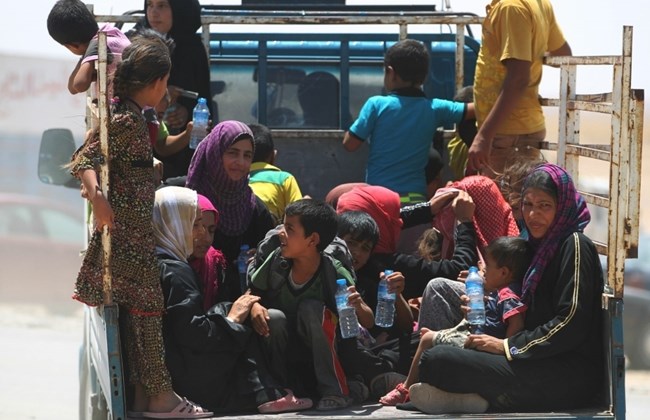
The International Committee of the Red Cross believes that up to a million more people could be forced to flee their homes in Iraq in the coming weeks and months, posing a massive humanitarian problem for the country. As fighting intensifies in different areas, including near Iraq’s second city of Mosul, the ICRC is calling for additional funds from donors to replenish aid supplies.

More than ten million people are already in need of assistance in the country. More than three million people are already internally displaced. If there is the predicted upsurge in violence, then the figure of internally displaced could dramatically increase.

The situation is unpredictable but we must prepare for the worst. There’s the likelihood that fighting will intensify, particularly in the Mosul area. Hundreds of thousands of people may very well be on the move in the coming weeks and months, seeking shelter and assistance. We need to be ready,” said the ICRC’s Regional Director for the Near and Middle East, Robert Mardini.

On Friday 29 July, the ICRC is asking for an additional 17 million Swiss francs ($17.1m, €15.6m) to its current budget for Iraq. The funds will be used to provide water, food, medical supplies and other assistance for those people caught up in the fighting. The ICRC will also focus efforts on promoting respect for international humanitarian law with parties involved in the conflict, and on visiting detainees. The money will allow the ICRC to step up its response throughout the country, reaching those most in need of help, as and when they need it.

Prudential RideLondon – cycling for charity

It’s called Prudential RideLondon and is the largest cycling charity event not only in the United Kingdom but in the world.

Three days of racing on two wheels starting from Friday 29 July with more than 100,000 cyclists expected to take part in the event.

Inspired by the famous London Marathon, here amateur cyclists take part in a challenge that winds over a distance of 100 or 46 miles, depending on your choice.

The event is of such resonance that will be broadcasted live both on BBC and on major international televisions.


The first edition was held in 2013 and it is organized by the London & Surrey Cycling Partnership (LSCP), with the support of Transport for London and London & Partners (non-profit partnership founded by the Mayor of London).

There will be a new entry on Friday for this 2016 edition.

Prudential RideLondon Grand Prix will feature this programme: two handycycle races for injured veteran servicemen and women and another one for top international handycyclists.

There will also be a special race for kids, exclusively reserved for under14 and Under16 riders.

Free cycle for anyone on Saturday: many streets of central London will be closed so riders can safely cycle passing some of the capital’s most iconic landmarks.

Everyone is welcome to take part, no matter of your age or personal skills.

On Sunday 31 July, more than 26,000 amateur cyclists will ride through London and Surrey:  start point will be Queen Elizabeth Olympic Park, through the beautiful Surrey countryside to finish on The Mall.

For newest or inexperienced cyclists there will be a shorter route of 46 miles that will rejoin the Prudential RideLondon-Surrey 100 in the last 17 miles of the race through London.

If you want to subscribe just visit www.prudentialridelondon.co.uk.

di Federica De Marco.

IT VER

“I’m not a pacifist, I’m simply against war” – Gino Strada at the Royal College of Surgeons

Royal College of Surgeons, 25th of July, London.

The Q&A at the “Why War” event, created by EmergencyUK, is started by the Londoner Giles Duley, a war-photographer who’d rather be classified as a anti-war photographer.

He shared with the audience the reasons why he happened to become a photographer and eventually a “anti-war photographer”; when he was a sportive young man he was victim of an accident that kept him in the hospital for a while, during which he received from his godfather two gifts: an Olympus camera and a book about the famous war-photographer Don McCullin. He then became passionate about photography and pursued a career as a music, fashion and tabloid photographer, traveling around the world, meeting cool and famous people. A life that all of his friends used to be jealous of, but he wasn’t very happy about that. At the end of the day he used to go back to his hotel room, feeling like he didn’t do anything special for himself of for the world. That’s when he re-opened that book that was given to him some years before about war-photography that he finally found out what he wanted to do though his art, storytelling the war.

So he starts co-operating with big associations and charities like Doctors without Borders, directly on the battle field. Unfortunately, in 2011, in Afghanistan, he stepped on an improvised explosive device (IED) and he was severely injured, losing both legs and an arm. This accident didn’t stop him from going back to work, once he recovered and so now he’s recently been back to refugee camps near Syria, where he documents the lives of these people that he’d rather not call “victims” of the war but normal people, with an incredible strength, to whom he wants to give back dignity through his photos and portraits; “When I speak to these people, I don’t see refugees, I see doctors, lawyers, builders, children, normal people who have been deprived of their normal lives”.

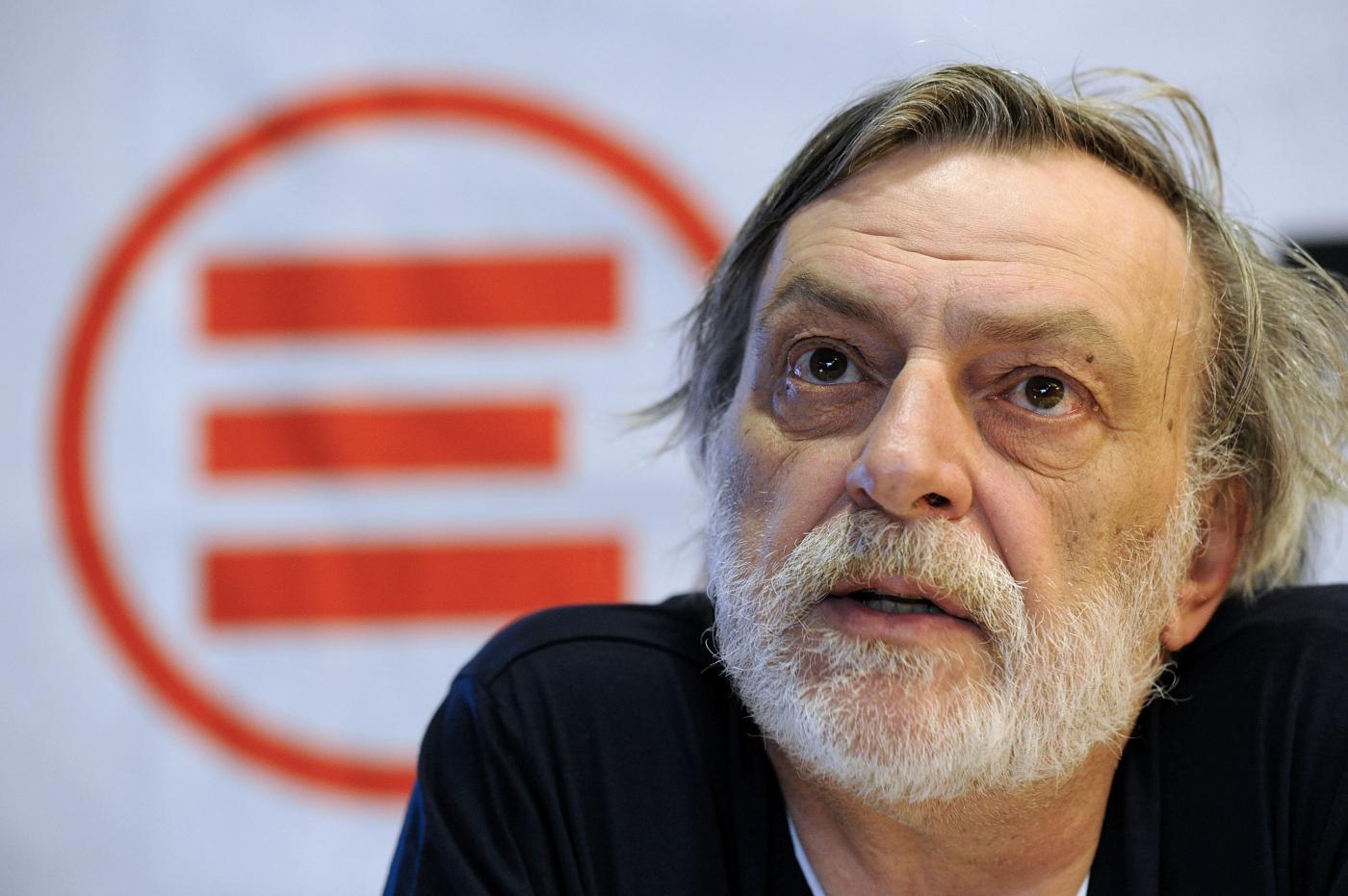
Then Giles is joined by Gino Strada on stage, surgeon and co-founder of Emergency, a charity organization that has been operating in conflict areas of Africa since 1994 to provide medical assistance to large part of the population who normally doesn’t have access to free and high quality medical care. More information can be found online on their official website, emergency.it, but today Gino’s purpose is to talk about the philosophy behind the mission of Emergency. He claims to be a cold person, even with the young patients who demand to see him before surgeries, because he’s afraid to become too emotional and attached, but also because he wouldn’t know what to say to these kids who need to be treated because of wars that could be avoided but are perpetrated by adults living in what we call a “civilized” world. The existing inequality between those who can have and those who cannot have, those who have rights and those who have not, generates discrimination and division among people, and nobody is taking care of eliminate this separation; talking about healthcare, specifically, there are so many people who cannot access quality and free treatments, even in Italy, although it covers one of the top positions in the ranking for best national health system. Then there is war; always there, ready to knock on our door, nowadays more than ever, although millions of people have already been experiencing that for decades now, with governments and media turning a blind eye on this matter. Strada said “I’m not a pacifist, I’m simply against war” and accused politicians of all parties and countries to not understand how nocive war is for everyone, and after all history showed us, is still an idea taken in examination by governments when actually it should just be abolished, because “war is not human”. Despite it, he doesn’t aim to be a politician, he only wants to keep doing his own job, the surgeon for people in need without asking to be paid by his patients. The last part of the event is the actual Q&A where various people, Italians but also other nationalities, in the audience, had the chance to ask their questions and they all seemed to lead to one main doubt: what can we do, as powerless and little human beings, to change things and stop war? The answer, unfortunately, is not easy, probably doesn’t exist, but the advice given from both Strada and Duley is to find in our own lives and routine something that can express our campaign against war. Duley found his own vocation in storytelling through photography, Strada through medicine. We can all do something starting from our ambitions, our skills and the people around us.

Google glass: making the ultimate cyborg

(Maurizio Porcu) Do you remember the Japanese anime series Dragon Ball? When I was six year-old, actually less than two decades ago, one of my dreams was wearing a “scouter”, namely a head-mounted display to measure individual power level.
“That will be the future,” I wondered in front of an old-fashioned television screen.
So you can guess my surprise and excitement when Google founder Sergey Brin presented last June at a conference in San Francisco their new project: Google glass.

[photo gadgets.ndtv.]

Continue reading Google glass: making the ultimate cyborg