Being a social follower today: do you know what and who influences you?

London (E. Flori, S.Orfei and E. Manicone)  – The Internet usage in Great Britain is still growing since its services have been sophisticated over the years. The last figures reported by the Office for National Statistics show that, in particular, London and South East of England “have the highest internet access”.

So, how do people spend time on the Internet? At this question, one of the common answers is social media. In fact, according to the latest data released, over 39 million social media’s users was dominating the UK population in 2017 and now is amounted to 44 million active users.

Social media, in fact, is becoming a major platform where pictures, videos but also news are shared. However, what it has been emerged is that a phenomenon, called ‘Influencer’, is becoming very popular on the online platforms, catching the attention of London’s population too.

So, what is an Influencer? Most of Londoners, according to our team survey, do not know it, even though they are affected – consciously or unconsciously by it. Therefore, from June 18th to June 27th London One academy’s inquiry, tried to discover what and who such phenomenon involves, how it operates and if it can be identified either in a special figure or via an abstract idea.

More than 4000 people aged between 8 and 70 were interviewed across several London’s areas, starting from the most famous landmarks, such as Trafalgar Square, Leicester Square, Covent Garden, Bond Street, to the the folkloristic East London, where also Spitalfields Market is located.

The survey’s results report that 24,79% of the interviewees either have never heard this term or are not sure about its meaning, while 75,21% were at least ready to provide a definition.

London One Academy team understands that young people
– who were the highest percentage amongst those who were aware of the term – recognise the Influencer’s notion easily, as it is a neologism specifically connected to social media.

The social platforms most used by Londoners are currently Instagram, Snapchat and Facebook, as showed by the graphics. As the interviewees explained, those social platforms are direct with an immediate impact and connection to their influencers with which they can have online conversations. The striking feature of the survey conducted is that even though 24,79% of respondents do not know the term Influencer, the majority of them appear to be influenced by famous people -celebrities, actors, singers, etc. – without calling them “influencers”.

So at the question: “who do most influence you on social media?”- 24,79% answered citing names of artists, musicians, athletes, writers or intellectuals, such as William Blake and Gandhi.

According to Federico Clapis, Italian artist, an Influencer ‘is just a more elegant term to identify someone who creates contents.” However, is the ‘influencer world’ just a matter of words and contents?

Marshall Mc Luhan would answer with his motto: “the medium is the message”. Such observation still applies today, also connected to the image of the Influencer that today, in particular,  plays the role of ‘the medium’ for many people in London.

So, “The medium is the message” turns out to be up-to-date in order to interpret not only the features of mass media communication, but also unexpected aspects of communication in the digital age.

Regarding the contents or topics followed by the users are are fashion, music and sport, but a notable number of people – almost 32%- don’t declare a specific sector of interest, as the histogram above depicts.

Also by connecting the topics shared and follow  to the variable of sex, it has been emerged that men are mainly involved in sports, while women follow influencers who are experts in fashion, music or also make up.

However, one of the common questions raised is  if such phenomenon has existed also in the past or it is a new trend recently came out.

According to the Influencer’s definition – mentioned by Mr Clapis too – it can be stated that, yes, there has always been an influencer in the human history. However, changes and developments are part of every societies and generations, and consequently a change is even visible in this case. The knowledge diffused, or commonly ‘shared’ by the influencers today, is defined as a  medium of ‘commerce and money’ rather than good information and communication. The results are, according to some respondents, a lack in identity and originality.

Studies by P. Lazarsfeld and E.Katz from the Columbia University, released in the 50s and 60s, demostrate the power of mass media shown over the years via opinion leaders, who used to control and affect society’s thoughts and behaviour. Nowadays this phenomenon is still alive, in particular on new media rather than traditional ones such as TV, press or radio, because of the social networks interactivity that attracts the young generation.

Consequently, the will of choosing specific brands and following the last trends is due to the need to confirm our identity into a community where we feel the necessity to be approved.

What is then the solution? Demonising or deleting apps could be the answer for someone but not for all. What it has been emerged from such survey is that the current century is deepening its roots into the digital era soil. What the future can offer us is a double edged weapon, it depends on the usage we do with it. Social media can be considered a drop in the ocean of the Industrial Revolution 4.0, but this does not mean we should underestimate their potential power.


The Italian cuisine is still at the top list of the Londoners’ diet

London (M. Sannino, E. Robustelli, A. Biccario) – It is widely claimed that Londoners are obsessed with the Italian food, or at least, the majority of them. Such popularity of the ‘Made in Italy’ is due to the quality of their products but also due to the intense promotion made over the last few years.

The remarkable results out of it has been an increase in Italian restaurants – more than 2000 in London – that the English press remark with the acronym “Yet Another F***ing Italian” (YAFI).

Such acronym does not surprise anybody, as the Italian community counts more than 600.000 Italians in the UK – according to the lasted data released by the Italian General Consulate in London –  whose 58,3% live in the English capital.

Yes, it is a consistent amount of people, but there are also other numerous communities that make London a colourful and multicultural city. Yet, what London One Academy understands, is that most of the food businesses in London offer Italian products to customers, by making the Italian cuisine at the top of their diet list.

The Italian cuisine has been always recognised for its ‘Mediterranean diet’ composed of low fat dishes known for their variety of fruit and vegetables, perfect for anyone want to follow a better lifestyle.

However, the same products started their trade in Great Britain long time ago, dating back to 43 AD. Indeed, when the emperor Claudius and his troops arrived in the southern regions of England, they imported wine, olive oil, fruits, vegetables and some food traditions that were very appreciated by the Celtic Britons until now.

During the Middle Ages, it was thanks to the trade in the Mediterranean that England became very wealthy and, as a consequence, Italian products started to be imported in the country.

Here an old advertisement of ‘spaghetti bolognese’ promoted with the sentence “Bring a little Rome home”.

In the last century the explosion of the Italian culture abroad happened after the release of the successful movie “La Dolce Vita” in 1960. According to the reports of that time “immoral” and rebel characters of the movie contributed to spread the Italian charm abroad, including the UK. In the same year the “spaghetti bolognese” became part of English dining tables acquiring its popularity.


A bit later, in the 80s, Italians started to open restaurants in the UK,  they brought their original ingredients and food traditions to English customers, who still appreciated them. But are they able to cook Italian food at home or do they prefer to eat it out?
According to London One Academy inquiry – lasted from 13th to 22nd June – 17.65% out of 2000 Londoners  avoid cooking Italian food, as they estimate it takes too much time and effort.

In fact, as many Italians learned from their grandmothers, cooking Italian plates requires patience, dedication and sometimes a lot of time, what most of English people do not have.

On the other hand, the 82.35% of them really appreciates cooking Italian dishes at home by claiming the enjoyable atmosphere that Italian cuisine brings when the food is cooked at home.

As Hannah stated: “I love cooking Italian food. My family and my friends love it!”. Others also recognise its genuine taste because it is “Healthy, delicious and simple” as Sarah from London states.

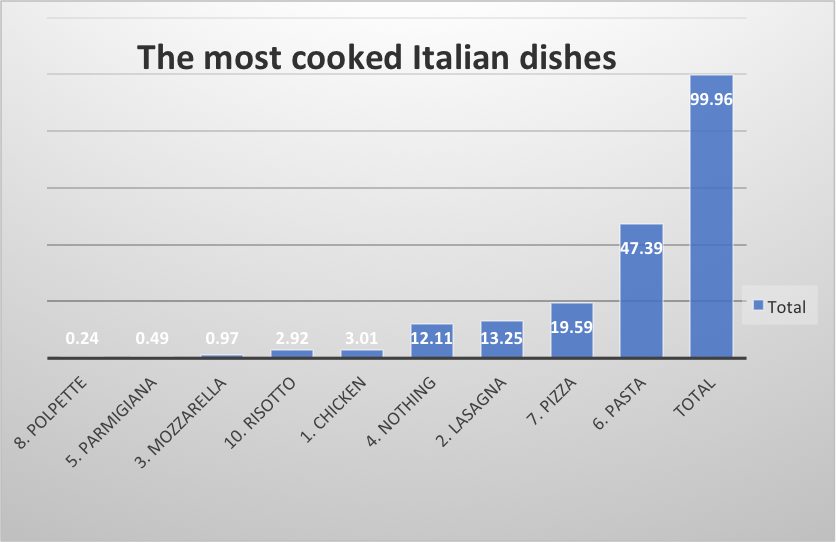
As the graphic below shows, the most popular Italian dish in the UK is pasta, such as bolognese and carbonara, mostly because it is easy to cook, or because of its amazing taste when combined with all kind of ingredients. Some people even said that they often try to make their own fresh pasta at home because the taste is “astounding”.

Regarding pizza, it can be considered as the second most cooked dish at home – 19.59% of Londoners cook it at home, or at least they try.

Paul, from Ireland, said “I usually love pizza, but since I can’t cook well, I prefer buying it”.

About Italian drinks, it has been shown that 16.27% out of 1800 Londoners interviewed do not know anything about it, but the statistics below also show that Italy is still famous for its viticulture and beverage. 23.14% of them know Chianti, Prosecco, Cherchi, Asti, Limoncello, Negroni, Grappa, Peroni or Moretti beer.
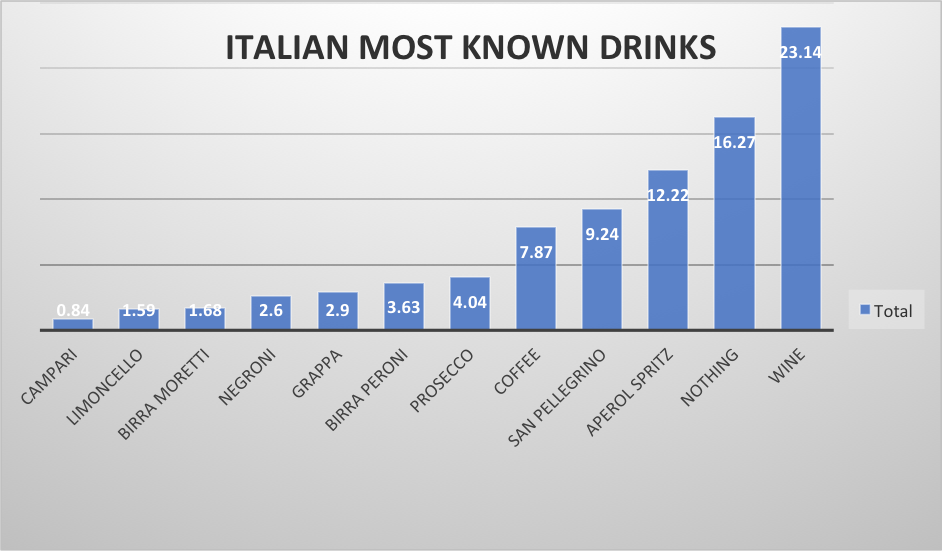
Amongst the Italian drinks, San Pellegrino, Aperol Spritz, Crodino, Campari are very well known by importing the habit of the popular Italian ‘Aperitivo’ composed of snacks and drinks.

But how is it going to happen to all these products under the Brexit deals? The opinions and answers about it are contrasting. As the chart shows, 53.13% think that Brexit will affect in different ways the imports, like prices and also quality. On the other hand, 31.81% claimed that Brexit will not affect negatively the Italian cuisine as its roots are well established all over the country.

In the meantime the Italian authorities are working together with the UK in order to help the Italian enterprises settled in Great Britain to overcome any challenges Brexit will showcase once the country will definitely leave the EU in 2019.

Raffaele Trombetta, the Italian Ambassador in London, has recently stated his will to ensure that Italy-UK relationships will be stronger than ever during and after Brexit. Italy represents an important mean of trade for the UK, that is why the Italian Chamber of Commerce in the UK and the British Chamber of Commerce in Italy are already finding solutions to avoid negative consequences.

https://www.youtube.com/watch?v=5fgE9Gscw5Y&feature=youtu.be

read more

The forecasts of the Italian food trading in the UK

46.7% out of 2000 Londoners believe that Brexit will undermine the UK-Italy trading relationship, rather than the 53.13% that think otherwise. The Italian quality is very appreciated, that is why people will not stop to buy Italian products after Brexit, according to 


The forecasts of the Italian food trading in the UK

London (M. Ragosta, M. De Rosa, Y. Zakomirnyy) – Over the years London has been hosting thousands of communities and the Italian families have been always hosted by the city, where the ‘Made in Italy’ also became part of the English daily routine. The Italian traditions, food and beverage are still considered the best in London where every year the Italian culture is celebrated by Bellavita Expo, the leading exhibition of Italian food and beverage.

Organised once a year, this time it took place at the Business Design Centre from June 17th to 19th, where the Italian gastronomic specialties have been promoted to thousands of English buyers and visitors.

The event, usually includes meetings with Michelin-starred chefs and masterclasses conducted by top chefs – such as Carlo Cracco, Francesco Mazzei and Theo Randall who attended this edition – mixologists, ‘pizzaioli’ and the best sommeliers.

However, the main idea of Bellavita is hosting  household names – coming from all the Italian regions – that usually showcase their products and traditions to all the attendees. In fact, the exhibitors’ stands offer authentic specialties you probably have never seen and tasted before as well as their stories that they shared also on London One Radio, which was the official radio of the exhibition.

At this edition, London One Radio and their team carried out their inquiry about what Londoners think about Italian food culture and Bellavita was an important chance to also understand what the exhibitors think about the UK-Italy trading relationship during and after Brexit.

https://www.youtube.com/watch?v=5fgE9Gscw5Y&feature=youtu.be

One of the  common thoughts showed since 2016 refers to the potential customs’ mutations that might affect the Italian exportations. According to the results of the inquiry – lasted from 13th to 22nd June – 46.7% out of 2000 people interviewed believe that that could happen, rather than the other 53.13% who think otherwise. These people, in fact, state that Brexit could actually benefit the commercial relations between the UK and Italy.

Such beliefs are also supported by the latest data released by the Assocamerestero that point out the commercial positive outcome that Italy performed in the last few years, by becoming the second country in the field of international trading. Italy, in fact,  is commercially dominating various areas such as design, fashion, food and pharmaceutical exports in particular.

That is why the Italian diaspora is more motivated to improve their trading performance so that Raffaele Trombetta, the Italian Ambassador in London, underlined the priority of making the bonds between the countries stronger than ever as well as avoiding negative impacts on the Italian enterprises in the UK, once the country will definitely leave the EU in 2019.

Bellavita Expo was able even this year to promote the ‘Made in Italy’ in the UK by making the British people interested in the Italian food culture, what is probably lacking in Great Britain as the Italian minister of agriculture Alfredo Pecoraro Scanio stated on London One Radio at the exhibition.

Bellavita Expo finished with their Awards given to the products with the higher score in Food and Beverage categories. The winners were Andre Cunha who won the Best UK Sommelier, while Alberto Triglia gained the prize for the best Italian product, which was ‘Prosciutto di Parma cappellettoni in green eggs sfoglia’.

The exhibition is recognised as a representative part of  “Food for Soul”, a non-profit organisation that is fighting against food waste. In fact, Bellavita inherited the principle of “nothing should ever be wasted”, so partecipants have to work with neglected edible ingredients, incredibly increasing the chefs’ creativity.